Tau mediates the impact of amyloid and vascular disease burden on the trajectory of clinical symptoms
Lianlian Du, Rebecca E. Langhough, Bruce P. Hermann, Erin M. Jonaitis, Tobey J. Betthauser, Leonardo A. Rivera‐Rivera, Karly A. Cody, Nathaniel A. Chin, Robert V. Cadman, Kevin M. Johnson, Aaron S. Field, Sanjay Asthana, Laura Eisenmenger, Bradley T. Christian

TL;DR
The study shows that both amyloid and vascular disease burdens contribute to faster cognitive decline, with tau pathology acting as a key mediator in Alzheimer's disease progression.
Contribution
The novel contribution is demonstrating that tau mediates the combined effect of amyloid and vascular disease on cognitive decline trajectories.
Findings
Longer amyloid and vascular disease chronicity are linked to faster cognitive decline.
Tau accumulation mediates the relationship between amyloid and vascular burden and cognitive decline.
White matter hyperintensity chronicity accelerates dementia progression even when amyloid duration is constant.
Abstract
Amyloid (A) and vascular (V) pathologies often co‐occur and progress over decades. We leveraged chronicity, defined as the years above a biomarker‐positivity threshold, to examine how the timing of A and V relates to cognitive decline. We modeled Clinical Dementia Rating–Sum of Boxes (CDR‐SB) trajectories in n = 558 participants with [C‐11] Pittsburgh compound B positron emission tomography (PET), magnetic resonance imaging–derived white matter hyperintensities (WMHs), and longitudinal CDR assessments. In n = 500 with MK6240 PET, we tested whether tau mediates A–V associations with CDR‐SB in a moderated mediation framework. Whether biomarker “burden” was modeled as chronicity (A+years, V+years), or estimated amyloid and WMH at CDR visits, significant interactions showed a synergistic effect of WMHs and amyloid on accelerated CDR‐SB trajectories. Tau significantly mediated these…
Genes, proteins, chemicals, diseases, species, mutations and cell lines named across the full text — each resolved to its canonical identifier and authoritative record.
Click any figure to enlarge with its caption.
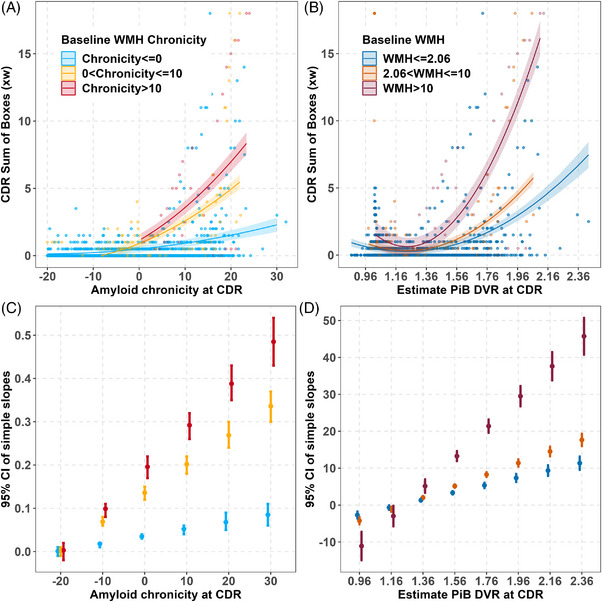 Figure 1
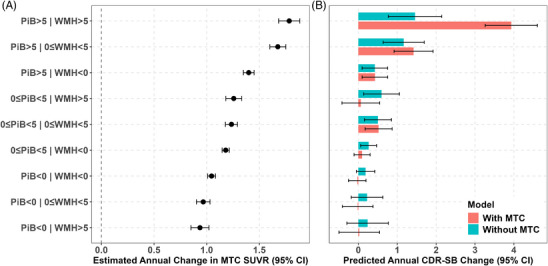 Figure 2
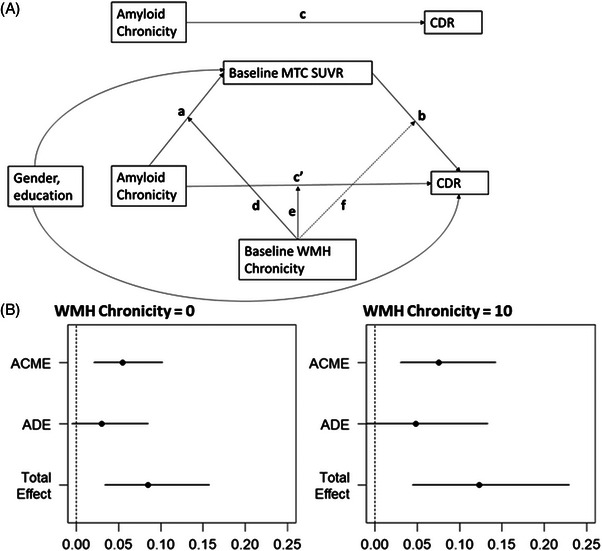 Figure 3
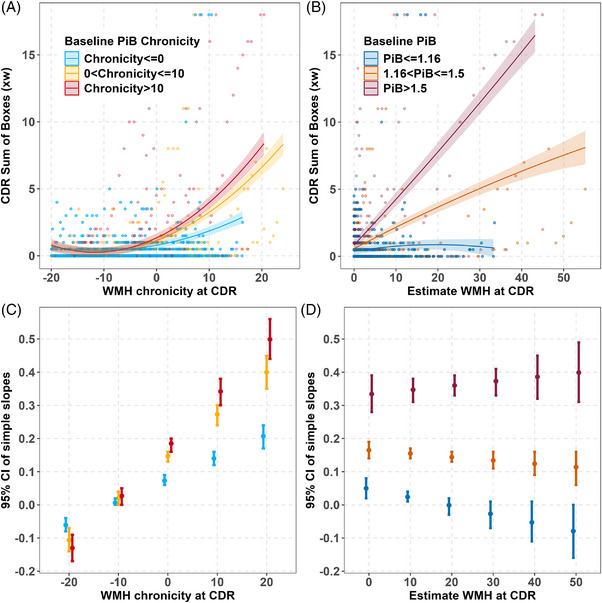 Figure 4
Peer Reviews
No public reviews on file for this paper yet. If you reviewed it on a platform where reviews are public (OpenReview, ICLR, NeurIPS, ICML), you can paste yours below so the community can read it here.
Videos
No videos yet. Explain this paper in a talk, walkthrough, or lecture? Add one.
Taxonomy
TopicsDementia and Cognitive Impairment Research · Alzheimer's disease research and treatments · Functional Brain Connectivity Studies