Automated Speech Markers of Alzheimer Dementia: Test of Cross-Linguistic Generalizability
Paula Andrea Pérez-Toro, Franco J Ferrante, Gonzalo Pérez, Boon Lead Tee, Jessica de Leon, Elmar Nöth, Maria Schuster, Andreas Maier, Andrea Slachevsky, Maria Luisa Gorno-Tempini, Agustín Ibáñez, Juan Rafael Orozco-Arroyave, Adolfo García

TL;DR
This study explores how speech patterns can help detect Alzheimer's disease, showing that timing features work across English and Spanish speakers.
Contribution
The study introduces interpretable speech features that generalize across languages for Alzheimer's detection.
Findings
Speech timing features generalized well across languages (AUC=0.75 for Spanish speakers).
Timing features predicted cognitive function (MMSE) better than semantic features.
Combined models did not improve performance in cross-language settings.
Abstract
Automated speech and language analysis (ASLA) is gaining momentum as a noninvasive, affordable, and scalable approach for the early detection of Alzheimer disease (AD). Nevertheless, the literature presents 2 notable limitations. First, many studies use computationally derived features that lack clinical interpretability. Second, a significant proportion of ASLA studies have been conducted exclusively in English speakers. These shortcomings reduce the utility and generalizability of existing findings. To address these gaps, we investigated whether interpretable linguistic features can reliably identify AD both within and across language boundaries, focusing on English- and Spanish-speaking patients and healthy controls (HCs). We analyzed speech recordings from 211 participants, encompassing 117 English speakers (58 patients with AD and 59 HCs) and 94 Spanish speakers (47 patients with…
Genes, proteins, chemicals, diseases, species, mutations and cell lines named across the full text — each resolved to its canonical identifier and authoritative record.
Click any figure to enlarge with its caption.
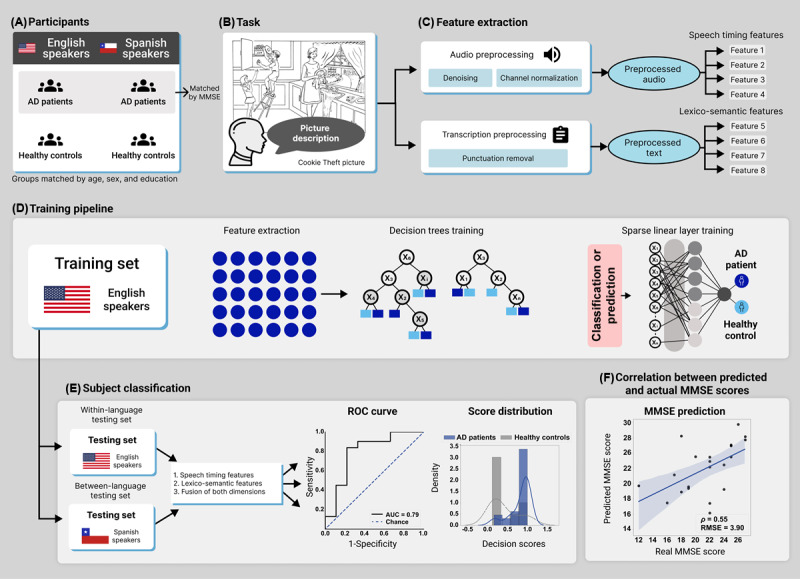 Figure 1
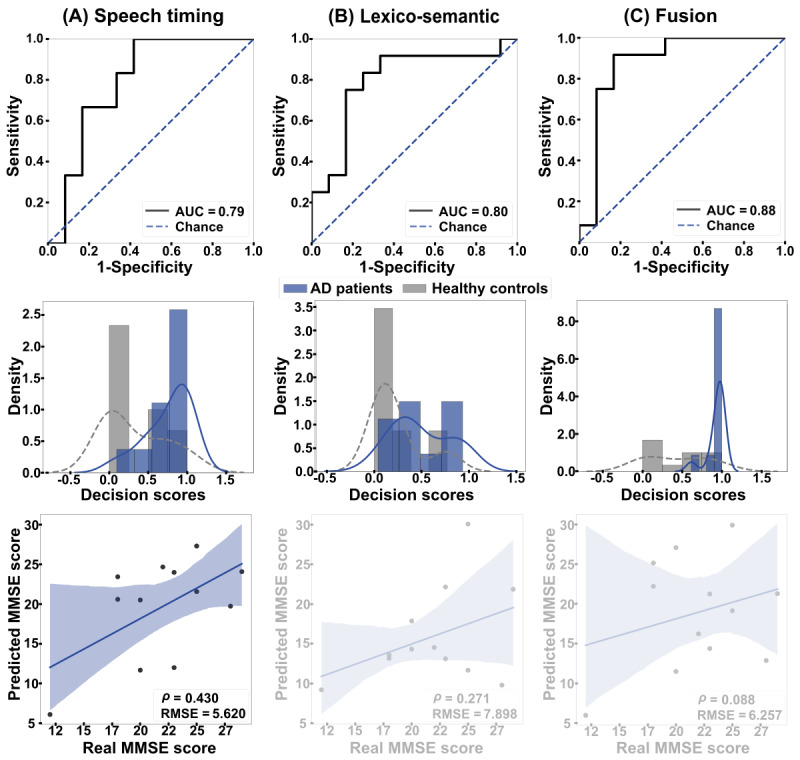 Figure 2
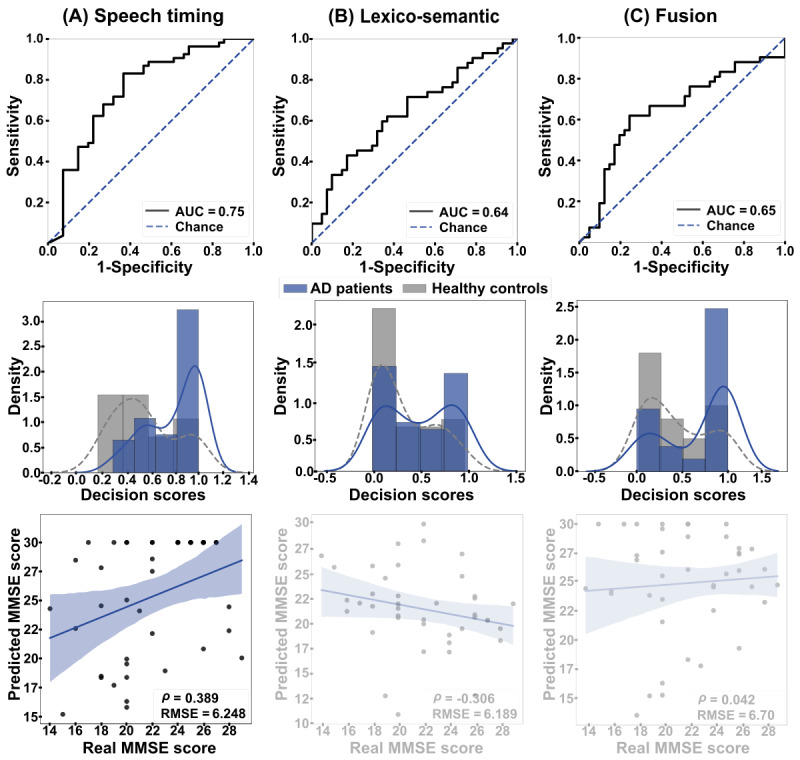 Figure 3
Peer Reviews
No public reviews on file for this paper yet. If you reviewed it on a platform where reviews are public (OpenReview, ICLR, NeurIPS, ICML), you can paste yours below so the community can read it here.
Videos
No videos yet. Explain this paper in a talk, walkthrough, or lecture? Add one.
Taxonomy
TopicsVoice and Speech Disorders · Neurobiology of Language and Bilingualism · Interpreting and Communication in Healthcare