Correction: Programmed cell death and redox metabolism protect Chlamydomonas reinhardtii populations from the galactic cosmic environment on the Artemis-1 mission
Timothy G. Hammond, Sajanlal R. Panikkanvalappil, Patricia L. Allen, Hamid Kian Gaikani, Corey Nislow, Guri Giaever, Ye Zhang, Howard G. Levine, Ramona Gaza, Dinah Dimapilis, Howard W. Wells, James M. Russick, Pierre M. Durand, Holly H. Birdsall

Abstract
Genes, proteins, chemicals, diseases, species, mutations and cell lines named across the full text — each resolved to its canonical identifier and authoritative record.
Click any figure to enlarge with its caption.
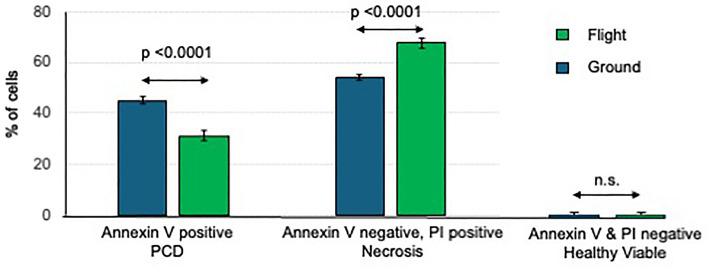 Figure 3
Peer Reviews
No public reviews on file for this paper yet. If you reviewed it on a platform where reviews are public (OpenReview, ICLR, NeurIPS, ICML), you can paste yours below so the community can read it here.
Videos
No videos yet. Explain this paper in a talk, walkthrough, or lecture? Add one.
Taxonomy
TopicsSpaceflight effects on biology · Microtubule and mitosis dynamics · Light effects on plants
Correction to: Scientific Reports 10.1038/s41598-025-05419-w, published online 02 July 2025
The original version of this Article contained errors in Figure 3, where the colors representing “Flight” and “Ground” were swapped. “Flight” was erroneously identified as the green columns, and “Ground” was erroneously identified as the blue columns. The original Fig. 3 appears below.Fig. 3. Viability and programmed cell death (PCD) of Chlamydomonas in flight vs. ground. Aliquots of flown and ground control Chlamydomonas were stained with Annexin V, to identify PCD, and propidium iodide, to identify dead cells, and analyzed by flow cytometry. Values shown are the % positively staining cells and are the mean ± SEM of six replicates. The p values for significance were evaluated by unpaired two-tailed t-test.
The original Article has been corrected.