Collection of entomological, demographic, water and sanitation, and climatic data of interest for arbovirus surveillance in Praia, Cabo Verde
Lara Ferrero Gómez, Keily Lucienne Fonseca Silva, Bruno dos Santos Pina, Patrick Silva, Ulisses António Lima da Cruz, José Moniz Lopes Fernandes, Hélio Daniel Ribeiro Rocha, Lara Ferrero Gomez, Lara Ferrero Gomez

TL;DR
This paper collects entomological, demographic, water, sanitation, and climate data in Praia, Cabo Verde, to support surveillance and prediction of mosquito-borne disease outbreaks.
Contribution
The study provides a comprehensive dataset from Praia for modeling arbovirus outbreak risks using spatial and non-spatial indicators.
Findings
Data were collected from 40 sentinel points in Praia from June to November 2022.
The dataset supports predictive modeling of arbovirus outbreak risks using statistical models.
The study highlights the utility of GBIF in transforming occurrence data into actionable surveillance information.
Abstract
Vector-borne diseases, primarily those transmitted by mosquitoes, are a serious public health problem. Some, such as dengue, put half of the world’s population at risk. Combating these diseases requires multifaceted strategies, with vector surveillance and control playing key roles. Robust and predictive surveillance systems for vector-borne diseases, based on risk stratification, enable the implementation of appropriate interventions across time and space. Here, we present a collection of entomological, demographic, water and sanitation, and climatic data from Praia (Cabo Verde), a hotspot for mosquito-borne diseases. These data were collected from June to November 2022, at 40 sentinel points scattered across the urban area of Praia. They constitute a valuable source of information for developing predictive scenarios of arbovirus outbreak risk using statistical models applied to…
Genes, proteins, chemicals, diseases, species, mutations and cell lines named across the full text — each resolved to its canonical identifier and authoritative record.
Click any figure to enlarge with its caption.
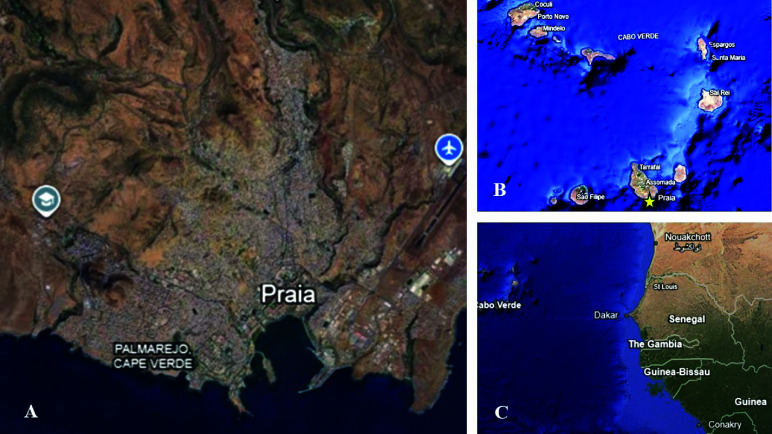 Figure 1
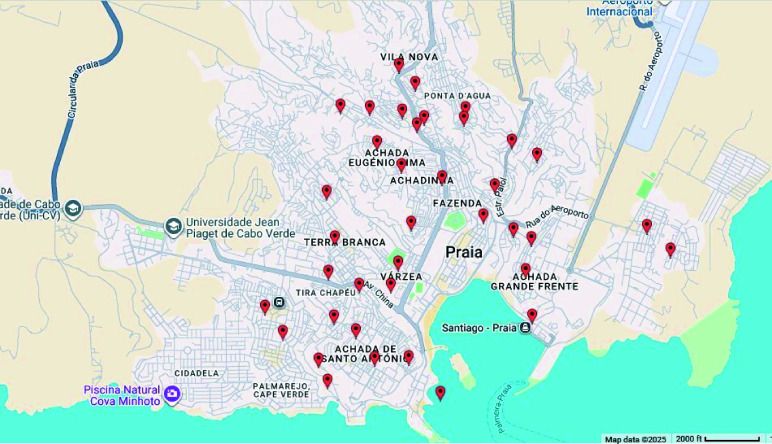 Figure 2
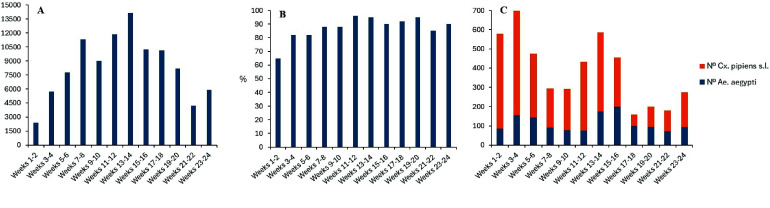 Figure 3
| Zone | Locality | Ref_OVT | Latitude | Longitude |
|---|---|---|---|---|
|
| Marrocos | OVT-1 | 14.91905 | −23.4856 |
|
| Ponta D’Agua Health Center | OVT-9 | 14.93255 | −23.5074 |
|
| Manoel Lopes Secondary School | OVT-17 | 14.93187 | −23.5124 |
|
| Amor de Deus School, Cabo Verde | OVT-25 | 14.91328 | −23.5284 |
|
| Atanasio’s Garden - Fonton | OVT-33 | 14.90788 | −23.5228 |
| Data categories | Group of indicators | Data record type | Frequency of data recording |
|---|---|---|---|
| Number of | Entomologic | Dynamic | Biweekly |
| Number of | Entomologic | Dynamic | Biweekly |
| Number of | Entomologic | Dynamic | Biweekly |
| Number of | Entomologic | Dynamic | Biweekly |
| Number of | Entomologic | Dynamic | Weekly |
| Average air temperature | Climatic | Dynamic | Weekly |
| Air temperature (°C) | Climatic | Dynamic | Weekly |
| Air humidity (%) | Climatic | Dynamic | Weekly |
| Wind speed (Km/h) | Climatic | Dynamic | Weekly |
| Precipitation (mm3) | Climatic | Dynamic | Weekly |
| Building number (100 m radio) | Demographic | Static | Once |
| Population density in Sentinel OVT | Demographic | Static | Once |
| Population density (100 m radio) | Demographic | Static | Once |
| Water storage type | Anthropogenic | Static | Once |
| Sanitation type | Anthropogenic | Static | Once |
| OVT | No. adult mosquitoes | No. | No. | No. Eggs | OI% | EDI |
|---|---|---|---|---|---|---|
|
| 143 | 31 | 112 | 999 | 86 | 49 |
|
| 111 | 13 | 98 | 144 | 25 | 24 |
|
| 79 | 41 | 38 | 1,772 | 91 | 84 |
|
| 158 | 26 | 132 | 1,376 | 79 | 72 |
|
| 71 | 36 | 35 | 2,641 | 95 | 125 |
|
| 946 | 95 | 851 | 2,035 | 79 | 107 |
|
| 148 | 29 | 119 | 790 | 54 | 60 |
|
| 280 | 83 | 197 | 2,436 | 87 | 116 |
|
| 8 | 3 | 5 | 3,958 | 83 | 198 |
|
| 62 | 37 | 25 | 1,791 | 87 | 85 |
|
| 7 | 3 | 4 | 796 | 70 | 46 |
|
| 21 | 16 | 5 | 1,800 | 91 | 81 |
|
| 56 | 22 | 34 | 2,697 | 83 | 134 |
|
| 47 | 21 | 26 | 1,798 | 90 | 89 |
|
| 63 | 38 | 25 | 3,299 | 91 | 149 |
|
| 15 | 9 | 6 | 2,531 | 91 | 115 |
|
| 27 | 16 | 11 | 1,801 | 87 | 85 |
|
| 134 | 43 | 91 | 4,097 | 100 | 170 |
|
| 148 | 36 | 112 | 2,106 | 87 | 100 |
|
| 109 | 58 | 51 | 6,384 | 100 | 266 |
|
| 223 | 33 | 190 | 2,243 | 100 | 93 |
|
| 62 | 52 | 10 | 1,661 | 86 | 83 |
|
| 25 | 15 | 10 | 993 | 65 | 66 |
|
| 112 | 77 | 35 | 3,058 | 95 | 132 |
|
| 25 | 11 | 14 | 2,656 | 91 | 120 |
|
| 99 | 63 | 36 | 2,205 | 100 | 95 |
|
| 73 | 44 | 29 | 3,327 | 100 | 138 |
|
| 56 | 12 | 44 | 1,691 | 91 | 80 |
|
| 168 | 70 | 98 | 4,278 | 100 | 178 |
|
| 41 | 29 | 12 | 4,183 | 100 | 190 |
|
| 221 | 52 | 169 | 1,716 | 100 | 71 |
|
| 76 | 30 | 46 | 5,978 | 95 | 271 |
|
| 144 | 41 | 103 | 3,367 | 100 | 140 |
|
| 336 | 33 | 303 | 3,050 | 100 | 127 |
|
| 46 | 2 | 44 | 1,005 | 95 | 43 |
|
| 12 | 4 | 8 | 934 | 72 | 58 |
|
| 59 | 38 | 21 | 540 | 66 | 33 |
|
| 17 | 12 | 5 | 6,329 | 100 | 263 |
|
| 94 | 65 | 29 | 4,588 | 91 | 208 |
|
| 106 | 18 | 88 | 1,864 | 91 | 85 |
|
|
|
|
|
|
|
|
- —Ministry of Education of Cab Verde
Peer Reviews
No public reviews on file for this paper yet. If you reviewed it on a platform where reviews are public (OpenReview, ICLR, NeurIPS, ICML), you can paste yours below so the community can read it here.
Videos
No videos yet. Explain this paper in a talk, walkthrough, or lecture? Add one.
Taxonomy
TopicsMosquito-borne diseases and control · Viral Infections and Vectors · Viral Infections and Outbreaks Research
Data description
Background and context
Vector-borne diseases pose a health risk to more than 80% of the world’s population and represent 17% of the global burden of communicable diseases [1].
For sub-Saharan Africa, diseases transmitted by mosquito vectors, such as yellow fever, dengue, chikungunya, Zika, Rift Valley fever, West Nile virus fever, and malaria, are a challenge, especially the latter, which is responsible for a disproportionate number of cases and deaths (94% of the 600,000 deaths in 2023) [2]. At the same time, arbovirus epidemics have also grown in the African region. Increased urbanization and climate change favor the proliferation of mosquito vectors, increasing the risk of outbreaks and the need for improved vector surveillance and control [3]. Major epidemics of dengue, Zika, and chikungunya have recently occurred in countries across the region, with more than 27,000 cases of Aedes-borne diseases documented since 2007 [4]. The World Health Organization launched the Global Arbovirus Initiative in 2022, a six-pillar international program to combat arbovirus infections. This initiative aims to reduce local risks, stimulate innovation, and strengthen collaborations [5].
Effective vector management requires multidisciplinary data that integrates entomological information with epidemiological, environmental, climatic, and social information to design and implement integrated vector management strategies, such as vector and disease surveillance. An ideal integrated arbovirus surveillance system includes both vector and disease monitoring systems, while also connecting environmental, climatic, and social change monitoring [6]. For surveillance to be effective, it is important to contextualize the physical space and time in which it will be conducted, as well as to define appropriate, measurable indicators to provide evidence that allows predicting the risk of outbreaks of arboviruses, such as dengue and Zika.
Cabo Verde, an archipelagic country in West Africa, lies at the crossroads of three continents (the Americas, Africa, and Europe). Due to its geographic location, climate change, and the effects of intense human and commercial trafficking, Cabo Verde is extremely vulnerable to the emergence and resurgence of vector-borne diseases [7]. Mosquito-borne diseases have been part of its history, with epidemics of malaria and yellow fever since the 16th century and, more recently, dengue fever and Zika [8–12]. The main vectors of arboviruses and malaria are the Aedes aegypti and Anopheles arabiensis mosquito species, respectively [13–16]. Furthermore, populations of mosquitoes from the Culex pipiens s.l, a potential vector for other arboviruses such as West Nile fever and Rift Valley fever, are found on all the islands [17]. Meanwhile, the country’s capital, Praia, with a quarter of the total population, has the most significant social inequalities and has also been the most affected by vector-borne diseases [18].
In this pilot study, entomological, climatic, environmental, demographic, and anthropic indicators were collected weekly for six months (from June 7 to November 15, 2022) at forty sentinel points in the capital of the country, to obtain reliable data that can be used to predict spatiotemporally the risk of dengue, Zika, or other emerging arboviruses.
Methods
Data collection
Data were collected in Praia, the capital of Cabo Verde, located on the island of Santiago, which has more than a quarter of the country’s population (151,155 inhabitants), according to [19] (2022) (Figure 1). The geolocation of the ovitraps (OVT) was used as a reference point for the collection of all indicators at each sentinel point.
(A) Praia, (B) Cape Verde, (C) West Africa region in front of Cabo Verde.
To ensure the representativeness of the entire city in the collected data series, 40 sentinel points were defined, organized into five zones (A, B, C, D, and E) that comprise the five health districts connecting the five health centers with different neighborhoods in the city (Table 1). Sentinel sites were selected considering several factors: locations with a high density of vulnerable population, a known history of locations with abundant Ae. aegypti, locations with the presence of vegetation, animals, water reservoirs, and protection from the wind.
The forty sentinel points were georeferenced, based on the location of the forty OVTs used in this study as an entomological tool for Ae. aegypti egg collection (Figure 2).
Geolocation of the forty Sentinel OVTs in the city of Praia. https://es.batchgeo.com/map/81ae794a29d303f63f107096c289646a
Data were collected using the application “ODK Collect” for Android (RRID:SCR_027538) [20] for field data collection and direct transfer to the automatically generated matrix on a computer (Kobo Toolbox) [21]. Data were then transferred directly to the matrix automatically generated on the computer using the Kobo Toolbox.
Fifteen data categories were collected, positionally linked to each georeferenced OVT, and classified into four groups of indicators: entomological, demographic, climatic, and anthropogenic. Some data categories correspond to fixed or static information, while others correspond to dynamic or variable information throughout the study period. Within the dynamic data categories, the data were recorded weekly, except for entomological data from the collection of adult specimens, which were biweekly (Table 2).
Mosquito collection and identification
For the collection of adult mosquitoes, BG-Sentinel traps were used [22], with BG-Lure scent baits. These traps were kept in the field for 24 h, providing datasets from the 40 sentinel sites for biweekly periods, covering 20 sites per week.
For the collection of Ae. aegypti eggs, OVTs adapted from [23] (1965 model) were used, using polyethylene terephthalate bottles as containers and wooden pallets as oviposition substrates. Forty OVTs filled with tap water were placed weekly outdoors in the 40 sentinel sites, and the pallets were collected after five days. In this study, the OVTs were exclusively placed outdoors, considering the history (from other previous works made by the Tropical Diseases Research Group – GIDTPiaget [24]) of areas and local hotspots of Ae. aegypti. Hence, we prioritized high-density localities, including twenty-one educational centers, four health centers, and a nursing home.
Once the field material was collected, it was packaged in thermal bags and taken to the entomology laboratory of the GIDTPiaget for conditioning and identification.
Adult mosquito samples were placed at −20 °C for 20 min to ensure their killing. The specimens were then manually counted, females were separated from males, and morphological differentiation was performed down to the species (Ae. aegypti) and species complex (Cx. pipiens s.l. and Anopheles gambiae s.l.) level using a Motic (SMZ-168) stereoscope and the taxonomic key for Cabo Verde mosquitoes by [8] (1980).
In the laboratory, the pallets collected in the field were dried in a vertical position, without touching each other and uncovered, for 24 h. Next, egg counting was conducted by transects of pallet areas under the stereoscope mentioned above.
Statistical analysis
A descriptive analysis was performed using Excel 2021 and XLSTAT 2025, a statistical software for Excel, to present the quantitative results of the entomological data series collected in the field. This data included the distribution and abundance of adult mosquito species and eggs of Ae. Aegypti (NCBI:txid7159). The presentation of the measure was done through tables. Two different indices were used to estimate the vector population density and its distribution: the positive OVT index (OI), which is the proportion of OVTs positive for the presence of Aedes eggs, and the density eggs index (EDI), which is the average number of eggs per positive OVT used to estimate the vector population infestation [25]. A Pearson correlation coefficient was applied, with statistical significance set at p ≤ 0.05, to analyze the relationship between the observed profiles, throughout the study period, for the data series and entomological indices.
Data validation and quality control
Initially, all data collected in the field were reviewed and validated in real-time with the open-source platform Kobo Toolbox, which was used to migrate the data collected with the ODK Collect application, also open-source. The resulting mosquito dataset was published as a Darwin Core Archive, a standardized format for sharing biodiversity data [26]. The core data table contains 3,840 records and includes an extension data table that provides additional information about the core records [27]. The dataset was submitted and validated using the Integrated Publishing Toolkit (IPT) validator tool available from the Global Biodiversity Information Facility (GBIF) [28]. Metadata fields are also available from the GBIF website [29].
Results
During the study period, 3,840 entomological occurrences (available in GBIF) were obtained from 960 records over 24 weeks at the 40 sentinel sites established in Praia, Cabo Verde. These occurrences included adult male and female mosquitoes of the species Ae. aegypti and Cx. pipiens s.l. collected with BG Sentinel traps, as well as Ae. aegypti eggs collected with OVTs.
The BG Sentinel adult trap collected 4,628 mosquitoes during the 24-week study period. Cx. pipiens s.l. was the most abundant species. Ae. aegypti, the vector of the Zika and dengue epidemics in Cabo Verde, accounted for 29.32% of the mosquitoes collected (Table 3). During the sampling, only seven BG Sentinel traps out of the 480 placed during the entire study period were lost due to blackout or disconnection of the power supply by the residents.
The OVTs collected a total of 100,967 Ae. aegypti eggs during the 24-week study period. This result shows the importance of this tool, not only for monitoring Ae. aegypti, but also as a physical measure by eliminating a considerable number of eggs from the environment, even in situations of low Ae. aegypti circulation [30, 31] (Ae. aegypti columns in Table 3). The average OI value obtained for all OVTs (n = 40) during the study period was 87.35%. All OVTs recorded values above the threshold considered a risk for vector control strategies (>10%) [32]. Specifically, 25% and 100% were the lowest and highest OI values found, respectively; only two OVTs had average OI values lower than 60%, indicating a very high infestation of Ae. aegypti in Praia, Cabo Verde (Table 3). Finally, during sampling, 15 of the 960 OVTs placed throughout the study period were lost because they were lying around, drying out, or missing.
We analyzed the sampling data to identify temporal relationships in the abundance of mosquitoes captured during the study period and in the values of the entomological indices. Varied temporal profiles of the collections and OI and EDI indices were obtained (Figure 3). The Pearson analysis showed a moderate positive correlation between OI and egg number (r = 0.68 and p-value = 0.0004). An increase in the values recorded for the number of eggs and OI was observed over time, with a more pronounced decrease for the former. The abundance of adult mosquitoes followed a cyclical profile, with two pronounced peaks in weeks 3–4 and 13–14. There was no relationship between the abundance of Ae. aegypti adults and eggs.
(A) Average number of eggs over time, (B) Average OI over time, (C) Average number of Ae. aegypti and Cx. pipiens s.l. mosquitoes over time.
The abundance of mosquito vectors plays a key role in determining the timing and magnitude of arbovirus epidemics. Understanding the temporal relationship of mosquito abundance allows for the prediction of disease outbreaks, facilitating the implementation of vector control strategies [33].
However, using OVT data has limitations. The number of eggs deposited in an OVT does not necessarily represent the abundance of biting female mosquitoes [34]. The Egg density EDI (Table 3) in this study is not linked to adult mosquito density; other factors like climate drivers (temperature, rainfall, and humidity) can affect the mosquito’s life cycle and breeding site productivity [35–37].
Re-use potential
The records and results presented in this study provide important information for future field surveillance studies, integrating indicators beyond entomological ones and providing a large and diverse number of records that can be analyzed, linked to this study, or compared with other areas in Cabo Verde or abroad.
Hence, collecting climatic, environmental, and sociodemographic datasets, as well as entomological data, with the potential to be analyzed in future studies, provides evidence for the creation of robust predictive surveillance systems that facilitate public health decision-making.
The reference list from the paper itself. Each links out to its DOI / PubMed record.
- 1WHO. Global Vector Control Response 2017–2030. Geneva: World Health Organization, 2017; ISBN: 978 92 4 151297 8.
- 2WHO. World Malaria Report 2023. Geneva: World Health Organization, 2023; ISBN: 978-92-4-008617-3.
- 3Bangoura ST, Keita AK, Diaby M Arbovirus epidemics as global health imperative, Africa, 2023. Emerg. Infect. Dis., 2025; 31(2): 1–8. doi:10.3201/eid 3102.240754.PMC 1184513339983695 · doi ↗ · pubmed ↗
- 4Buchwald AG, Hayden MH, Dadzie SK Aedes-borne disease outbreaks in West Africa: a call for enhanced surveillance. Acta Trop., 2020; 209: 105468. doi:10.1016/j.actatropica.2020.105468.32416077 · doi ↗ · pubmed ↗
- 5WHO. Launch-Global Integrated Arboviruses Initiative. Geneva, Switzerland: World Health Organization, 2022; Virtual meeting. https://www.who.int/initiatives/global-arbovirus-initiative. Accessed on 10 September 2025.
- 6Fite J, Baldet T, Ludwig A A one health approach for integrated vector management monitoring and evaluation. One Health, 2024; 20: 100954. doi:10.1016/j.onehlt.2024.100954.39811079 PMC 11732561 · doi ↗ · pubmed ↗
- 7WHO. Country Cooperation Strategy. World Health Organization, 2018; Available at: https://www.who.int/publications/i/item/WHO-CCU-18.02-Cabo Verde. Accessed on 10 September 2025.
- 8Ribeiro H, Ramos H, Capela RA Os Mosquitos de Cabo Verde (Diptera, Culicidae): sistemática, distribuição, bioecologia e importância médica. Lisboa: Ultramar J IC do, 1980; 2021: 141p. OCLC:8207203.