Gel immersion transpapillary stone removal for recurrent choledocholithiasis
Yota Hirayama, Tesshin Ban, Kei Ando, Naoto Imura, Yoshimasa Kubota, Shun Sasoh, Takashi Joh

Abstract
Genes, proteins, chemicals, diseases, species, mutations and cell lines named across the full text — each resolved to its canonical identifier and authoritative record.
Click any figure to enlarge with its caption.
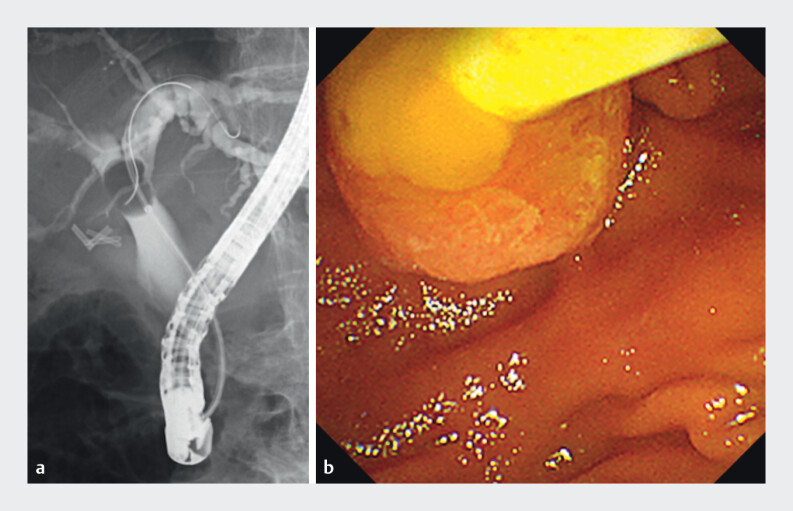 Fig. 1
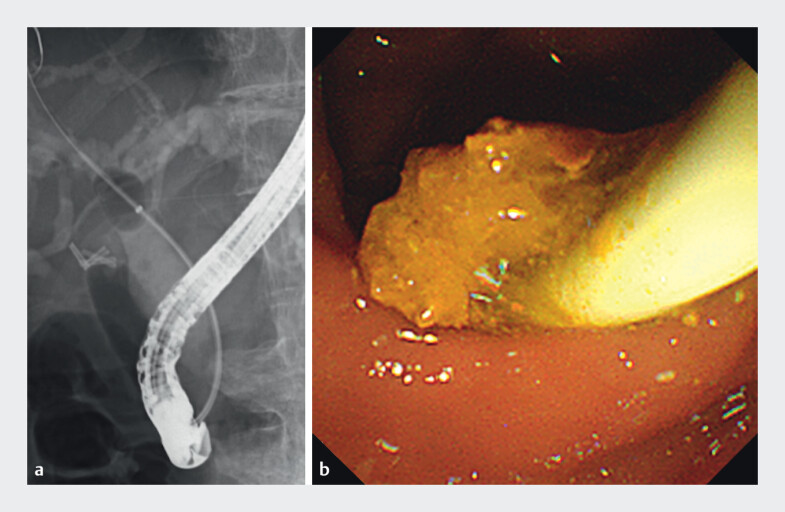 Fig. 2
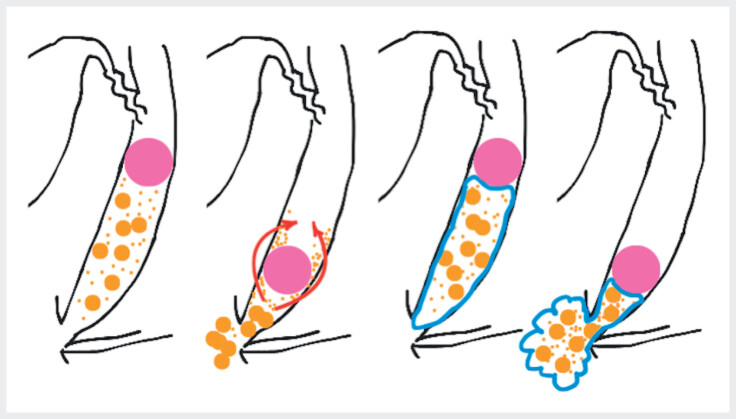 Fig. 3
Peer Reviews
No public reviews on file for this paper yet. If you reviewed it on a platform where reviews are public (OpenReview, ICLR, NeurIPS, ICML), you can paste yours below so the community can read it here.
Videos
No videos yet. Explain this paper in a talk, walkthrough, or lecture? Add one.
Taxonomy
TopicsGallbladder and Bile Duct Disorders · Kidney Stones and Urolithiasis Treatments · Biliary and Gastrointestinal Fistulas
Endoscopic retrograde cholangiopancreatography (ERCP)-guided stone removal using a balloon catheter is a promising approach for patients with small choledocholithiasis (diameter: ≤10 mm 1 2 ). The recurrence of choledocholithiasis significantly increases in patients with certain characteristics, such as dilated common bile duct (CBD), advanced age, history of cholecystectomy, and multiple stones 3 . However, data on endoscopic strategies for the frequent recurrence of choledocholithiasis, debris, or sludge formation are scarce. Gel immersion endoscopy has emerged as a novel technique and has also been reported in ERCP-related procedures 4 5 . Here, we report the potential of gel immersion ERCP-guided clearance for recurrent choledocholithiasis.
A 94-year-old woman with a history of ERCP-guided stone removals presented with acute cholangitis due to a suspected third recurrence of choledocholithiasis. ERCP-guided stone removal was attempted using a balloon catheter (Extractor Pro; Boston Scientific, Marlborough, USA); however, only the mucous content was removed ( Fig. 1 a, b , Video 1 ). Next, we inserted an endoscopic introducer (EndoSheather; Piolax Medical Device, Yokohama, Japan) into the CBD, followed by bile aspiration and injection of the 10 mL gel (Viscoclear; Otsuka Pharmaceutical Factory, Naruto, Japan) with contrast medium. This maneuver facilitated the removal of small residual stones and debris without adverse events ( Fig. 2 a, b , Video 1 ).
Conventional endoscopic retrograde cholangiopancreatography (ERCP)-guided stone removal using a balloon catheter. a Cholangiography is performed during biliary sweep using an inflated balloon. b In an endoscopic view, the sweep with a balloon catheter following the injection of a contrast medium results in the extraction of only mucinous contents.
Gel immersion endoscopic retrograde cholangiopancreatography (ERCP)-guided stone removal using a balloon catheter. a Cholangiography using a gel with contrast medium. b In an endoscopic view, a significant amount of the gel–stone/debris complex is removed.
Gel immersion transpapillary stone removal for recurrent choledocholithiasis.Video 1
The small choledocholithiasis and debris likely escaped through the gap beside the inflated balloon or adhered to the CBD wall during clearance using the balloon catheter ( Fig. 3 , Video 1 ). This indicates the incomplete removal of small stones and debris during conventional ERCP-guided stone extraction. In gel immersion ERCP-guided clearance, small residuals are encased in a highly viscous gel, which may facilitate the extraction of the gel–stone/debris complex while preventing its escape alongside retrieval balloon.
Schema of gel immersion endoscopic retrograde cholangiopancreatography (ERCP)-guided stone removal using a balloon catheter versus a conventional method. In the conventional method, the debris escapes around the balloon (red arrows). In contrast, the debris is removed and enclosed in a highly viscous gel. Left, conventional; right, gel immersion; pink circles, balloons; brown circles, small stones; brown dots, debris; blue areas, gels.
However, further investigation is necessary to address the outcomes, including pancreatitis and recurrence.
Endoscopy_UCTN_Code_TTT_1AR_2AH
The reference list from the paper itself. Each links out to its DOI / PubMed record.
- 1Sharma R Sharma V Singhal U Outcomes of balloon vs basket catheter for clearance of choledocholithiasis: a systematic review and meta-analysis Endosc Int Open 202210 E 1447 E 145310.1055/a-1905-025136397864 PMC 9666065 · doi ↗ · pubmed ↗
- 2Manes G Paspatis G Aabakken L Endoscopic management of common bile duct stones: European Society of Gastrointestinal Endoscopy (ESGE) guideline Endoscopy 20195147249110.1055/a-0862-034630943551 · doi ↗ · pubmed ↗
- 3Kozyk M Giri S Harindranath S Recurrence of common bile duct stones after endoscopic clearance and its predictors: A systematic review DEN Open 20244 e 29410.1002/deo 2.29437818098 PMC 10560705 · doi ↗ · pubmed ↗
- 4Miyano A Ogura T Okuda A Gel-immersion electrohydraulic lithotripsy during digital single-operator cholangioscopy is helpful when bleeding occurs Endoscopy 202355 E 98E 9936216256 10.1055/a-1941-8488 PMC 9829775 · doi ↗ · pubmed ↗
- 5Ban T Kubota Y Sasoh S Gel-immersion biliary cannulation during a balloon-assisted endoscope-guided endoscopic retrograde cholangiopancreatography Endoscopy 202557 E 329E 33040294626 10.1055/a-2575-3533 PMC 12037225 · doi ↗ · pubmed ↗