The complete mitochondrial genome of the silver-backed chevrotain (Tragulus versicolor) from Vietnam and its phylogenetic position within Tragulidae
Huy Hoang Quoc, Long Ha Thang, Mau Trinh Dang, Son Nguyen Truong, Dac Chung Ngo

TL;DR
This paper presents the complete mitochondrial genome of the silver-backed chevrotain, a rare and endangered species in Vietnam, and clarifies its evolutionary position within the Tragulidae family.
Contribution
The study provides the first complete mitochondrial genome of the silver-backed chevrotain and confirms its distinct phylogenetic position within the Tragulus genus.
Findings
The mitochondrial genome of T. versicolor is 16,317 bp long and includes typical mitochondrial genes.
Phylogenetic analysis confirms the monophyly of Tragulidae and the distinct placement of T. versicolor within the genus Tragulus.
The mitogenome is publicly available (GenBank accession PV872897) and serves as a resource for future conservation and evolutionary studies.
Abstract
The silver-backed chevrotain (Tragulus versicolor Thomas, 1910) is the only endemic ungulate species in Vietnam and among the most little-known ungulates in the world. The species currently has a very narrow distribution area and is facing many threats of extinction due to habitat loss and illegal hunting. In this study, we describe complete mitochondrial genome of T. versicolor and its taxonomic position within Tragulidae. The circular genome is 16,317 bp in length, comprising 13 protein-coding genes, 22 tRNA genes, two rRNA genes, and one control region, with a GC content of 40.3%. Phylogenetic analysis based on complete mitochondrial genomes using the maximum-likelihood method confirms the monophyly of Tragulidae and the distinct position of T. versicolor within Tragulus. This is the first publicly available mitogenome of T. versicolor (GenBank accession no. PV872897), which provides…
Genes, proteins, chemicals, diseases, species, mutations and cell lines named across the full text — each resolved to its canonical identifier and authoritative record.
Click any figure to enlarge with its caption.
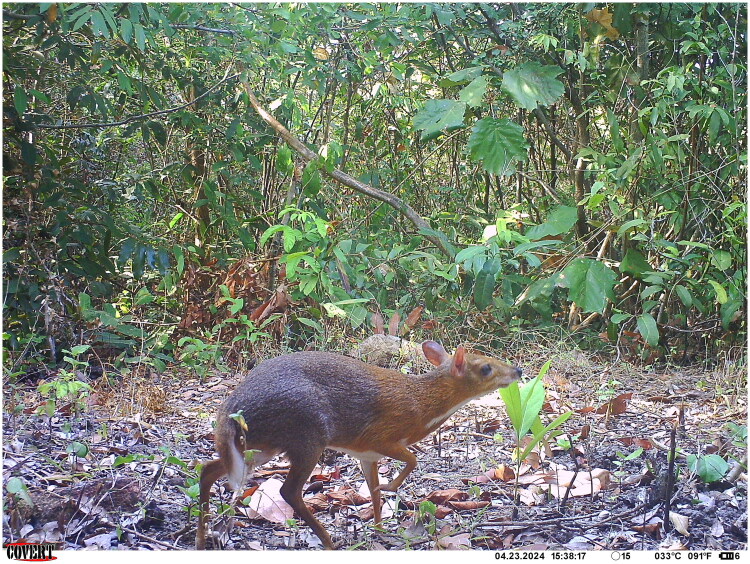 Figure 1
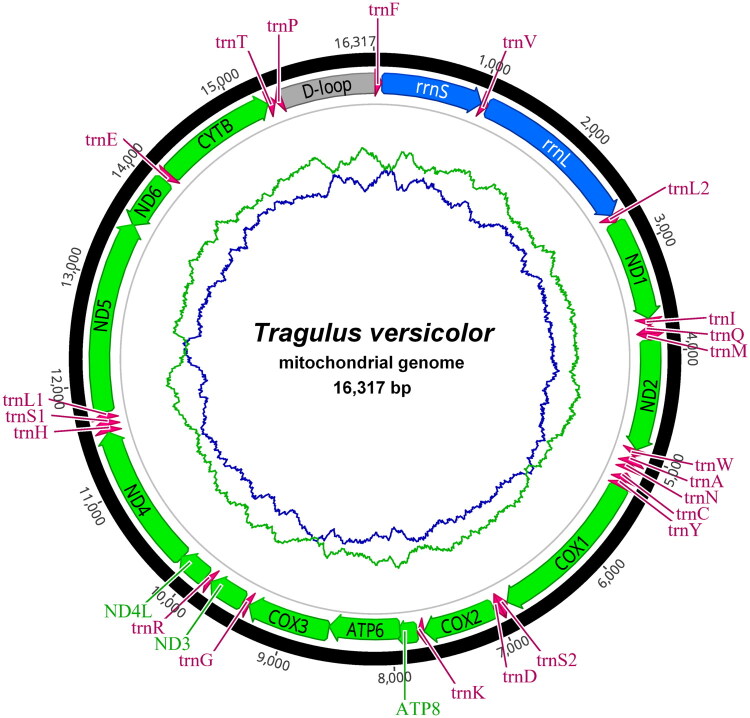 Figure 2
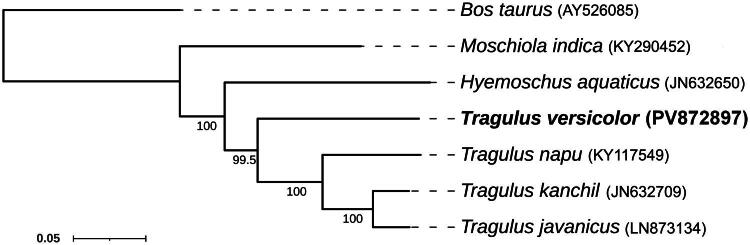 Figure 3
Peer Reviews
No public reviews on file for this paper yet. If you reviewed it on a platform where reviews are public (OpenReview, ICLR, NeurIPS, ICML), you can paste yours below so the community can read it here.
Videos
No videos yet. Explain this paper in a talk, walkthrough, or lecture? Add one.
Taxonomy
TopicsGenomics and Phylogenetic Studies · Identification and Quantification in Food · Genetic diversity and population structure
Introduction
The silver-backed chevrotain (Tragulus versicolor Thomas, 1910) (Figure 1), also known as the Vietnam chevrotain, is a critically endangered species according to the Vietnam Red Book (Dang et al. 2023). The species was first described by Thomas in 1910 based on specimens collected near Nha Trang City, southern Vietnam (Thomas 1910). After a long period with no confirmed records, a single confirmed specimen of T. versicolor was recorded in Gia Lai Province in 1990, in sympatry with T. kanchil (Kuznetsov and Borissenko 2004). T. versicolor then remained undetected until 2017, when the first photographs of a wild population were obtained using camera traps in Nui Chua National Park (Nguyen et al. 2019). T. versicolor is characterized by a distinctive two-tone pelage – rufous anterior and silvery posterior – that distinguishes it from other members of the genus Tragulus (Thomas 1910).
Camera trap photo of Tragulus versicolor taken in Khanh Hoa Province, Vietnam (2024). Photo credit: Leibniz-IZW/SIE/GreenViet.
The silver-backed chevrotain has a highly restricted distribution in dry and semi-dry forests of south-central Vietnam, where recent field surveys confirmed five populations across a narrow coastal range (Dang et al. 2023). Here, we present the first complete mitochondrial genome of T. versicolor, providing a valuable reference for phylogenetic analysis and a baseline resource for conservation genetics of this evolutionarily distinct and threatened species.
Materials and methods
Sample collection
A tissue sample of T. versicolor was collected on 24 October 2022 from Ninh Hoa District, Khanh Hoa Province, Vietnam (12.4911°N, 109.1906°E). The specimen was obtained from a local hunter under the permission and supervision of local rangers. The species was identified based on external morphology, including the two-tone pelage pattern – rufous anterior and silvery posterior – and the size consistent with a mature individual (Thomas 1910). A muscle tissue sample was preserved in 95% ethanol and stored at −20 °C until DNA extraction. The specimen was deposited at the Department of Zoology, University of Science, Vietnam National University, Hanoi (https://en.vnu.edu.vn/university-of-science-vnuhus-post12712.html; contact: Dr. Nguyen Thi Tham, [email protected]) under the voucher number KH01.
DNA extraction and sequencing
Genomic DNA was extracted using the QIAamp DNA Mini Kit (Qiagen, Hilden, Germany). A paired-end library (PE150) was constructed following the DNBSEQ™ protocol and sequenced on the DNBSEQ platform at BGI Genomics (Shenzhen, China), yielding 4,042,092 clean reads (∼1.21 Gb). The clean reads exhibited high quality, with 98.77% of bases having a Phred score ≥ Q20, and 95.73% ≥ Q30. Adapters and low-quality reads were removed using SOAPnuke v1.5.6 with the following parameters: -n 0.01 -l 20 -q 0.5 -adaMR 0.25 --polyX 50 --minReadLen 150 (Chen et al. 2018). Clean data were used for subsequent mitochondrial genome assembly. Clean data were checked with FastQC v0.11.9 to review base composition and score profiles.
To verify congruence between reads and the circular assembly, the clean reads were remapped to a circularized reference with the origin placed within the control region using BWA-MEM v0.7.17 (Li 2013); alignments were processed with samtools v1.19 (Danecek et al. 2021). Per-base depth was computed with samtools depth -a -J and used to generate the coverage profile and histogram (Supplementary Figure S1). This analysis indicated a mean coverage ∼254× across the mitogenome and a breadth (≥1×) of 99.8%.
Genome assembly and annotation
The mitochondrial genome was assembled de novo using GetOrganelle v1.7.7 (Jin et al. 2020) with the animal_mt setting and T. kanchil as a reference. Assembly quality was verified by checking for internal stop codons, and gene positions. Annotation was performed using the MITOS2 web server (Donath et al. 2019) with the vertebrate mitochondrial code (transl_table = 2). In total, 37 genes were identified, including 13 protein-coding genes (PCGs), 22 tRNAs, and two rRNAs. Gene boundaries, orientations, and codons were manually curated in Geneious Prime v2025.1.3 (Biomatters Ltd., Auckland, New Zealand), and the final circular mitogenome map was generated in Geneious.
Phylogenetic analysis
Complete mitochondrial genomes of five other Tragulidae were retrieved from GenBank: Tragulus kanchil (JN632709), T. napu (KY117549), T. javanicus (LN873134), Hyemoschus aquaticus (JN632650), Moschiola indica (KY290452), and Bos taurus (AY526085) as the outgroup. Complete mitochondrial genomes, including all 37 genes (13 PCGs, 22 tRNAs, and two rRNAs) and the control region (D-loop), were aligned as a whole using MAFFT v7.490 (Katoh and Standley 2013) with the L-INS-i algorithm. A maximum-likelihood tree was reconstructed in IQ-TREE v2.2.2.6 (Minh et al. 2020) under the GTR + F + I + G4 model with 1000 ultrafast bootstrap replicates. The tree was rooted with Bos taurus and visualized in iTOL v7.2.1 (Letunic and Bork 2021).
Results
The complete mitochondrial genome of T. versicolor comprises 37 genes, including 13 PCGs, 22 tRNA genes, and two rRNA genes (Figure 2). Among these, the majority are encoded on the heavy (H) strand, while eight tRNA genes and nad6 are located on the light (L) strand. Detailed gene coordinates (start–end), strand orientation, and tRNA anticodons are available in the GenBank record for this mitogenome (accession PV872897). The overall base composition is 32.7% A, 26.9% T, 26.8% C, and 13.6% G. The GC content is 40.3%.
Circular mitochondrial genome map of Tragulus versicolor. Protein-coding genes in green, tRNAs in pink, rRNAs in blue, and the control region (D-loop) in gray. The GC-skew in green and AT-skew in blue curves.
The phylogenetic analysis of complete mitochondrial genomes by maximum-likelihood produced a well-resolved topology with strong bootstrap support (Figure 3). Tragulus versicolor formed a distinct lineage, sister to the clade comprising T. napu, T. kanchil, and T. javanicus, with a bootstrap value of 100%. This indicates an early divergence of T. versicolor from the remaining Southeast Asian tragulids.
Phylogram based on the maximum-likelihood analysis of complete mitochondrial genomes. Numbers at nodes represent bootstrap values (>50%). the following sequences were used: AY526085 (Chung and Ha 2004), KY290452 (Sarvani et al. 2018), JN632650 (Hassanin et al. 2012), KY117549 (Mohd Salleh et al. 2017), JN632709 (Hassanin et al. 2012), and LN873134 (Gallus et al. 2015).
Discussion and conclusions
Gene sizes in T. versicolor are consistent with other tragulid mitogenomes, with cox1 being the longest PCG (1545 bp) and atp8 the shortest (207 bp), a pattern also observed in T. kanchil (Abu-Bakar et al. 2024). The rRNA genes (rrnS and rrnL) lie between trnF and trnL2, and the control region (D-loop) between trnP and trnF, conforming to the canonical vertebrate order (Hassanin et al. 2012; Sarvani et al. 2018). This arrangement matches those of T. kanchil, T. napu, and T. javanicus (Endo et al. 2004; Mohd Salleh et al. 2017; Abu-Bakar et al. 2024), indicating a conserved mitochondrial genome structure across Tragulus.
Phylogenetic analysis confirmed the basal position of Moschiola indica, in line with earlier cytb and mitogenome studies (Hassanin et al. 2012; Sarvani et al. 2018; Abu-Bakar et al. 2024). The outgroup Bos taurus was clearly separated, supporting the monophyly of Tragulidae and the placement of T. versicolor within it. Compared to Bayesian inference using cytb (Nguyen et al. 2024), our ML mitogenome analysis provided stronger support, showing T. versicolor as a distinct lineage with an intermediate branch length.
The complete mitogenome of the silver-backed chevrotain provides an essential genetic resource for species identification, forensic analysis, and conservation planning. As an evolutionarily distinct lineage needing urgent protection, these data will aid law enforcement against illegal trade and guide future assessments of population structure and genetic diversity for conservation management.
Supplementary Material
Supplementary Figure S1.pdf
The reference list from the paper itself. Each links out to its DOI / PubMed record.
- 1Abu-Bakar MAA, Aifat NR, Rovie-Ryan JJ, Abdul-Latiff MAB, Ampeng A, Md-Nor S, Md-Zain BM. 2024. Molecular phylogenetics and phylogeography of Malaysian mousedeer (Tragulus kanchil) based on mitochondrial DNA sequences of the D-loop region. Sains Malays. 53(7):1509–1523. 10.17576/jsm-2024-5307-03 · doi ↗
- 2Chen Y, Chen Y, Shi C, Huang Z, Zhang Y, Li S, Li Y, Ye J, Yu C, Li Z, et al. 2018. SOA Pnuke: a Map Reduce acceleration-supported software for integrated quality control and preprocessing of high-throughput sequencing data. Gigascience. 7(1):1–6. 10.1093/gigascience/gix 120PMC 578806829220494 · doi ↗ · pubmed ↗
- 3Chung HY, Ha JM. 2004. Bos taurus mitochondrion, complete genome. Gen Bank accession AY 526085.1 (NCBI Nucleotide database). Available at: https://www.ncbi.nlm.nih.gov/nuccore/AY 526085.1/
- 4Danecek P, Bonfield JK, Liddle J, Marshall J, Ohan V, Pollard MO, Whitwham A, Keane T, Mc Carthy SA, Davies RM, et al. 2021. Twelve years of SA Mtools and BC Ftools. Gigascience. 10(2):giab 008. 10.1093/gigascience/giab 00833590861 PMC 7931819 · doi ↗ · pubmed ↗
- 5Dang Huy Phuong, Hoang Quoc Huy, Nguyen The Truong An, Le Tan Quy. 2023. Tragulus versicolor. Vietnam Red List of Threatened Species Available at: http://vnredlist.vast.vn/tragulus-versicolor/
- 6Donath A, Jühling F, Al-Arab M, Bernhart SH, Reinhardt F, Stadler PF, Middendorf M, Bernt M. 2019. Improved annotation of protein-coding genes boundaries in metazoan mitochondrial genomes. Nucleic Acids Res. 47(20):10543–10552. 10.1093/nar/gkz 83331584075 PMC 6847864 · doi ↗ · pubmed ↗
- 7Endo H, Fukuta K, Kimura J, Sasaki M, Hayashi Y, Oshida T. 2004. Phylogenetic relationships among populations of the mouse deer in the Southeast Asian Region from the nucleotide sequence of cytochrome b gene. Mamm Study. 29(2):119–123. 10.3106/mammalstudy.29.119 · doi ↗
- 8Gallus S, Kumar V, Bertelsen MF, Janke A, Nilsson MA. 2015. Tragulus javanicus mitochondrial complete genome (Version LN 873134) [Dataset]. https://www.ncbi.nlm.nih.gov/nuccore/LN 873134