Fight smarter, not harder: NPR1-mediated immune balance in citrus greening disease
Ritu Singh, Marcella Teixeira

Abstract
Genes, proteins, chemicals, diseases, species, mutations and cell lines named across the full text — each resolved to its canonical identifier and authoritative record.
Click any figure to enlarge with its caption.
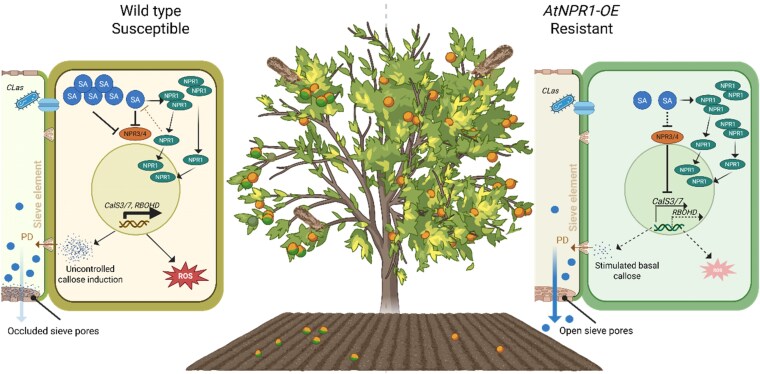 Figure 1
Peer Reviews
No public reviews on file for this paper yet. If you reviewed it on a platform where reviews are public (OpenReview, ICLR, NeurIPS, ICML), you can paste yours below so the community can read it here.
Videos
No videos yet. Explain this paper in a talk, walkthrough, or lecture? Add one.
Taxonomy
TopicsPhytoplasmas and Hemiptera pathogens · Plant Pathogenic Bacteria Studies · Plant Pathogens and Fungal Diseases
Huanglongbing (HLB), or citrus greening, is a devastating disease caused by the bacterium Candidatus Liberibacter asiaticus (CLas). The pathogen is spread by psyllids, sap-sucking insects that feed from citrus plants. A major challenge in combating HLB is that the citrus plant's own immune system contributes to the disease's severity. Infected plants overreact to the pathogen, triggering reactive oxygen species (ROS) outburst and excessive callose deposition, a carbohydrate that plugs phloem pores. This uncontrolled defense response, rather than stopping the pathogen, leads to collapse of the phloem, obstructing the transport of photoassimilates (Ma et al. 2022; Welker and Levy 2022), resulting in stunted growth and yellowing leaves (Schneider 1968; da Graça et al. 2016).
Recent studies suggest that the key to fighting HLB lies, not in a stronger immune response, but in a smarter one. Comparisons between susceptible and tolerant citrus varieties suggest that systemic acquired resistance, a salicylic acid (SA)–dependent systemic immune response, is key to HLB tolerance (Wang et al. 2016; Welker and Levy 2022). SA is central to systemic acquired resistance signaling and is perceived by NONEXPRESSOR OF PATHOGENESIS-RELATED GENES 1, 3, and 4 (NPR1, NPR3, and NPR4). While NPR1 activates the defense-related genes, NPR3 and 4 play opposite roles to modulate this activity, highlighting the importance of a finely tuned balanced immune response (Ding et al. 2018; Kumar et al. 2022). Furthermore, NPR1-like genes are induced in the tolerant variety but not the susceptible (Martinelli et al. 2012). Interestingly, genetically engineering susceptible citrus with the NPR1 gene from the model plant Arabidopsis (AtNPR1) successfully confers tolerance to the disease (Dutt et al. 2015). This leads to a central paradox: how can boosting a master immune activator (NPR1) fix a disease caused by an overactive immune system? Understanding this mechanism is key to developing a sustainable defense against citrus greening.
In this issue of Plant Physiology, Sarkar and colleagues (2025) uncovered the mechanism behind this paradox. They first pinpointed the timing of immune activation in citrus plants during CLas infection. By infecting sweet orange (Hamlin) and grapefruit (Duncan) using psyllids, they observed callose deposition within just 1 d of infection, while ROS accumulation was observed at 14 d postinoculation. This established 14 d postinoculation as a critical window to study citrus immune responses.
The authors then investigated how the immune regulator AtNPR1 mediates tolerance to HLB. To address this question, the authors evaluated callose and ROS accumulation after inoculating wild type Hamlin and Duncan trees, as well as trees engineered to overexpress Arabidopsis NPR1 (AtNPR1-OE), with either CLas-free or CLas-infected psyllids. In wild type citrus, CLas infection triggered massive callose and ROS accumulation, which ultimately clogged phloem and exacerbated disease. In contrast, AtNPR1-OE plants behaved differently: without infection, these plants maintained slightly elevated basal callose levels, but infection no longer triggered uncontrolled callose or ROS accumulation. As a result, after infection, ROS and callose levels remained far lower in the engineered trees than in wild type, preserving phloem function.
Microscopic examination of vascular anatomy confirmed these differences. Infected wild type plants showed substantial expansion of phloem and xylem tissues and extensive callose deposition that sealed sieve pores, whereas AtNPR1-OE plants exhibited only moderate vascular changes and retained visible pore openings. Furthermore, biochemical analysis revealed that wild type plants accumulated high levels of SA upon infection, while AtNPR1-OE plants showed only a mild increase.
To confirm this AtNPR1-mediated immune regulation, the team pursued a second strategy. They silenced CsNPR3, a citrus gene that represses SA signaling. Silencing CsNPR3 phenocopied AtNPR1 overexpression: higher basal callose deposition suppressed infection-triggered callose and ROS accumulation and reduced HLB symptom development. This suggests that CsNPR3 plays a positive role in HLB disease development.
Finally, to determine whether this NPR1-mediated immune balance is conserved in other pathosystems, the group extended its investigation to Arabidopsis thaliana challenged with Pseudomonas syringae (Psm). They compared how wild type plants, AtNPR1-OE, and npr1–3 mutants responded to *Psm-*induced callose and ROS accumulation. As in citrus, AtNPR1 overexpression increased basal callose levels but suppressed pathogen-triggered callose and ROS, while npr1 mutants showed uncontrolled ROS accumulation. Moreover, infection of the double mutant npr3/npr4 with Psm resulted in similar outcomes, demonstrating that NPR proteins fine-tune the balance between basal and induced defenses.
Together, these findings identify NPR1 as a central brake that prevents citrus immunity from spiraling out of control (Figure). By maintaining steady basal callose levels while curbing excessive ROS and SA accumulation, NPR1 enables plants to tolerate CLas infection without self-destruction. This dual role, activating and restraining, underscores the importance of immune homeostasis in long-term survival. The authors propose that HLB susceptibility arises from immune imbalance in vulnerable citrus varieties, which could be corrected by NPR1 overexpression or NPR3 repression. Mechanistically, NPR1 likely maintains immune homeostasis through feedback inhibition of SA biosynthesis, thereby preventing excessive induction of callose and ROS biosynthesis-related genes (Lee et al. 2020).
The reference list from the paper itself. Each links out to its DOI / PubMed record.
- 1da Graça JV, Douhan GW, Halbert SE, Keremane ML, Lee RF, Vidalakis G, Zhao H. Huanglongbing: an overview of a complex pathosystem ravaging the world's citrus. J Integr Plant Biol. 2016:58(4):373–387. 10.1111/jipb.1243726466921 · doi ↗ · pubmed ↗
- 2Ding Y, Sun T, Ao K, Peng Y, Zhang Y, Li X, Zhang Y. Opposite roles of salicylic acid receptors NPR 1 and NPR 3/NPR 4 in transcriptional regulation of plant immunity. Cell. 2018:173(6):1454–1467. 10.1016/j.cell.2018.03.04429656896 · doi ↗ · pubmed ↗
- 3Dutt M, Barthe G, Irey M, Grosser J. Transgenic citrus expressing an Arabidopsis NPR 1 gene exhibit enhanced resistance against huanglongbing (HLB; citrus greening). P Lo S One. 2015:10(9):e 0137134. 10.1371/journal.pone.013713426398891 PMC 4580634 · doi ↗ · pubmed ↗
- 4Kumar S, Zavaliev R, Wu Q, Zhou Y, Cheng J, Dillard L, Powers J, Withers J, Zhao J, Guan Z, et al Structural basis of NPR 1 in activating plant immunity. Nature. 2022:605(7910):561–566. 10.1038/s 41586-022-04699-w 35545668 PMC 9346951 · doi ↗ · pubmed ↗
- 5Lee D, Lal NK, Lin Z-JD, Ma S, Liu J, Castro B, Toruño T, Dinesh-Kumar SP, Coaker G. Regulation of reactive oxygen species during plant immunity through phosphorylation and ubiquitination of RBOHD. Nat Commun. 2020:11(1):1838. 10.1038/s 41467-020-15601-532296066 PMC 7160206 · doi ↗ · pubmed ↗
- 6Ma W, Pang Z, Huang X, Xu J, Pandey SS, Li J, Achor DS, Vasconcelos FNC, Hendrich C, Huang Y, et al Citrus Huanglongbing is a pathogen-triggered immune disease that can be mitigated with antioxidants and gibberellin. Nat Commun. 2022:13(1):1–13. 10.1038/s 41467-021-27699-235082290 PMC 8791970 · doi ↗ · pubmed ↗
- 7Martinelli F, Uratsu SL, Albrecht U, Reagan RL, Phu ML, Britton M, Buffalo V, Fass J, Leicht E, Zhao W. Transcriptome profiling of citrus fruit response to huanglongbing disease. P Lo S One. 2012:7(5):e 38039. 10.1371/journal.pone.003803922675433 PMC 3364978 · doi ↗ · pubmed ↗
- 8Sarkar P, El-Mohtar C, Wang C, Turner D, Welker S, Robertson CJ, Orbovic V, Mou Z, Levy A. NPR 1 suppresses Candidatus Liberibacter asiaticus–induced callose and ROS accumulation. Plant Physiol. 2025.10.1093/plphys/kiaf 532PMC 1263178941118530 · doi ↗ · pubmed ↗