Photoswitchable Active Esters for the Control of Amide Bond Formation with Light
Marc Villabona, Arnau Marco, Rosa María Sebastián, Christopher Barner-Kowollik, Gonzalo Guirado, Jordi Hernando

TL;DR
This paper introduces light-sensitive chemical reagents that allow precise control over amide bond formation using light.
Contribution
The development of photoswitchable active esters that enable light-controlled amide bond formation.
Findings
Photoswitchable active esters show up to 24-fold enhancement in aminolysis rate in their closed isomer state.
Light-induced modulation was applied to dye labeling, polymer gelation, and thin film patterning.
Reversible control was achieved using 365 nm light for activation and 625 nm for inhibition.
Abstract
Active esters are among the most utilized reagents for (bio)materials functionalization via amide bond formation. To endow this type of ligation processes with spatiotemporal precision, we herein report the development of photoswitchable active esters, which toggle between poorly and highly reactive states upon irradiation with UV and visible light. Specifically, a dithienylethene photoswitch was introduced within the structure of common p-nitrophenyl active esters, whose electronic changes upon reversible open-closed photoisomerization turn on and off the activating effect of the p-nitro substituent on amidation reactivity. As a result, efficient light-induced modulation of amide bond formation kinetics was accomplished with these compounds, with their closed isomer exhibiting up to 24-fold enhancement of aminolysis rate with amines relative to the open state. This behavior was…
Genes, proteins, chemicals, diseases, species, mutations and cell lines named across the full text — each resolved to its canonical identifier and authoritative record.
Click any figure to enlarge with its caption.
 1
1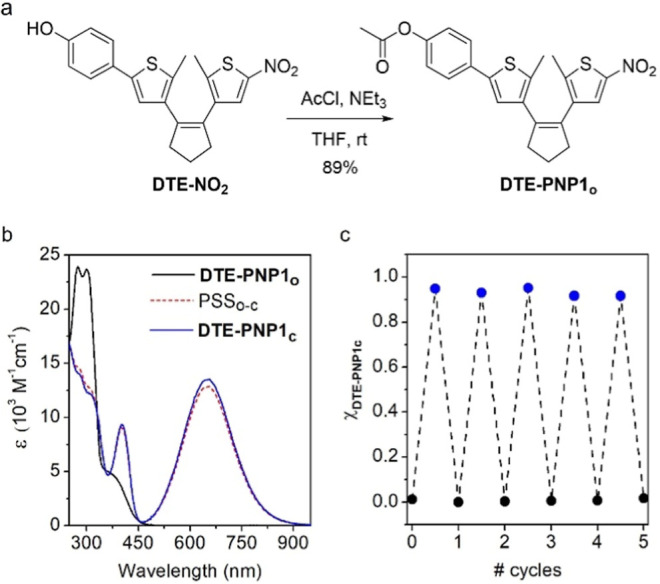 2
2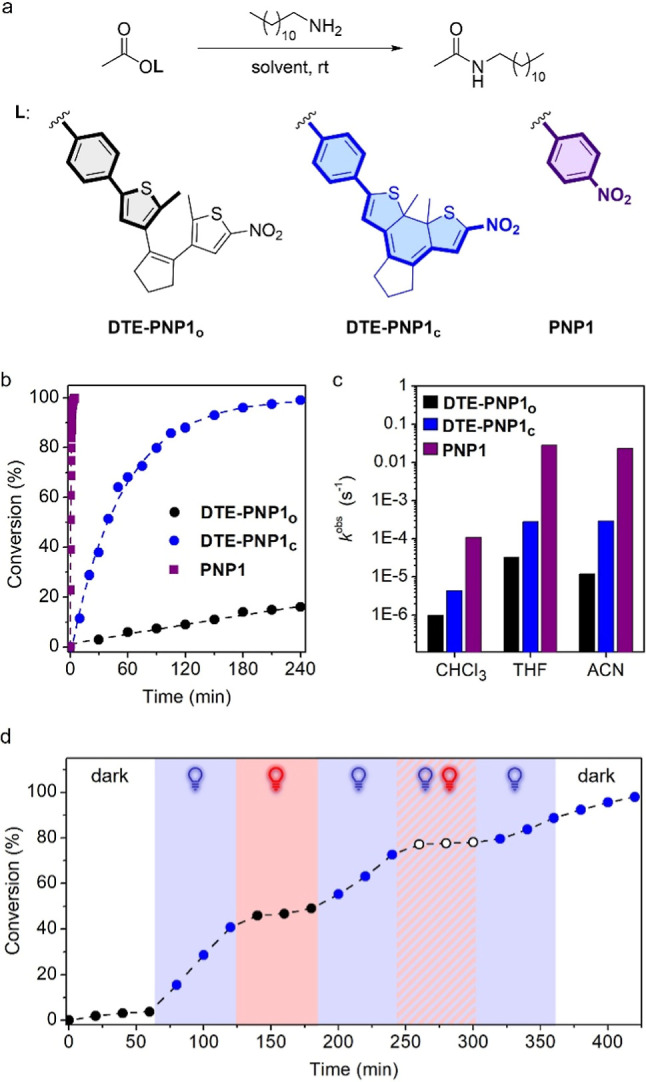 3
3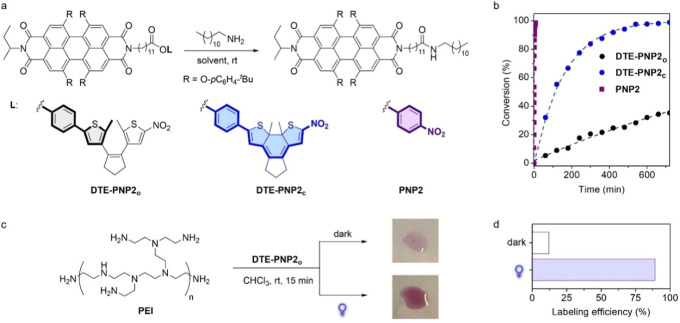 4
4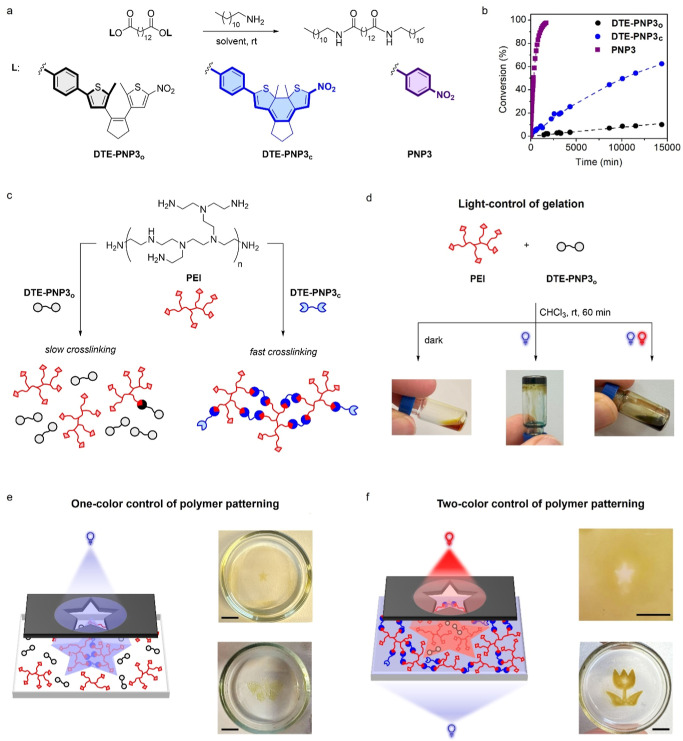 5
5| compounds | solvent |
|
|
|
|
|
|---|---|---|---|---|---|---|
| DTE-PNP1 and PNP1 | CHCl3 | 1.0 × 10⁻⁶ | 4.4 × 10⁻⁶ | 1.1 × 10⁻⁴ | 4.4 | 25 |
| THF | 3.3 × 10⁻⁵ | 2.8 × 10⁻⁴ | 2.8 × 10⁻² | 8.4 | 100 | |
| acetonitrile | 1.2 × 10⁻⁵ | 2.9 × 10⁻⁴ | 2.3 × 10⁻² | 24 | 79 | |
| DTE-PNP2 and PNP2 | CHCl3 | 8.0 × 10⁻⁷ | 6.0 × 10⁻⁶ | 2.8 × 10⁻⁵ | 7.5 | 4.7 |
| THF | 7.4 × 10⁻⁶ | 1.0 × 10⁻⁴ | 1.1 × 10⁻² | 14 | 110 | |
| DTE-PNP3 and PNP3 | CHCl3 | 1.3 × 10⁻⁷ | 1.1 × 10⁻⁶ | 3.6 × 10⁻⁵ | 8.5 | 33 |
- —Carl-Zeiss-Stiftung10.13039/100007569
- —Karlsruhe Institute of Technology10.13039/100009133
- —Ministerio de Ciencia, Innovaci?n y Universidades10.13039/100014440
- —Deutsche Forschungsgemeinschaft10.13039/501100001659
- —Ag?ncia de Gesti? d'Ajuts Universitaris i de Recerca10.13039/501100003030
- —Ag?ncia de Gesti? d'Ajuts Universitaris i de Recerca10.13039/501100003030
- —European Regional Development Fund10.13039/501100008530
- —Ministry of Education, Culture and Sports of SpainNA
Peer Reviews
No public reviews on file for this paper yet. If you reviewed it on a platform where reviews are public (OpenReview, ICLR, NeurIPS, ICML), you can paste yours below so the community can read it here.
Videos
No videos yet. Explain this paper in a talk, walkthrough, or lecture? Add one.
Taxonomy
TopicsPhotochromic and Fluorescence Chemistry · Chemical Synthesis and Analysis · Click Chemistry and Applications
Introduction
1
Amide bond formation, a pivotal transformation in organic synthetic chemistry,? is one of the primary strategies used for the functionalization of biomolecules,? polymer networks,? nanostructures,? and surfaces and thin films.? For many of these applications, on-demand control of amide coupling with light would be highly desirable, as photoinduced reactions allow chemical ligation with spatiotemporal resolution,? and therefore have become powerful tools for bioconjugation,? surface patterning? advanced printing,? and the postsynthetic modification of materials.? However, although the development of light-mediated amidation reactions has rapidly evolved in the last ten years with the emergence of photoredox catalysis, attention has so far been focused on establishing synthetic procedures that enable amide bond formation at milder conditions than classical methods,? while their use for photoligation in materials science or biological substrates has been scarcely considered.? In addition, all these precedents share a common feature that compromises the spatiotemporal precision with which photoinduced amidation can be accomplished: reactivity is triggered by irradiation with a single source of light, which (1) cannot preclude photoactivated reagents to diffuse and react outside of the irradiated region, and (2) does not enable reaction confinement on the nanoscale due to the diffraction limit imposed by photoexcitation with far-field optics.?
One of the methodologies proposed to surpass these limitations is the antagonistic control of photoligation processes with two orthogonal wavelengths, where one color of light is used to trigger a covalent reaction and another to suppress it. ?,?,? By developing photoswitchable reagents that reversibly toggle between reactive and nonreactive states upon photoisomerization, this strategy has been successfully applied to lithography and nanofabrication,? polymer manipulation,? and bioconjugation.? In most of these cases, photoswitching is utilized to regulate cycloaddition reactions with two colors of light, ?,?,?,?,? though its use to reversibly modulate nucleophile addition to aldehydes and ketones, ?,?,?,? Michael acceptors, ?,? and boronic esters? has also been reported. In contrast, its application to light-control amide bond formation has not been considered yet, except for a photoswitchable supramolecular receptor particularly designed to accelerate the amidation reaction between two specific adenosine-containing substrates.? Therefore, herein we aim to expand the toolbox of dual-wavelength controlled photoligation processes to amidation processes, thereby granting enhanced spatiotemporal precision to one of the most popular approaches used for chemical functionalization and manipulation.
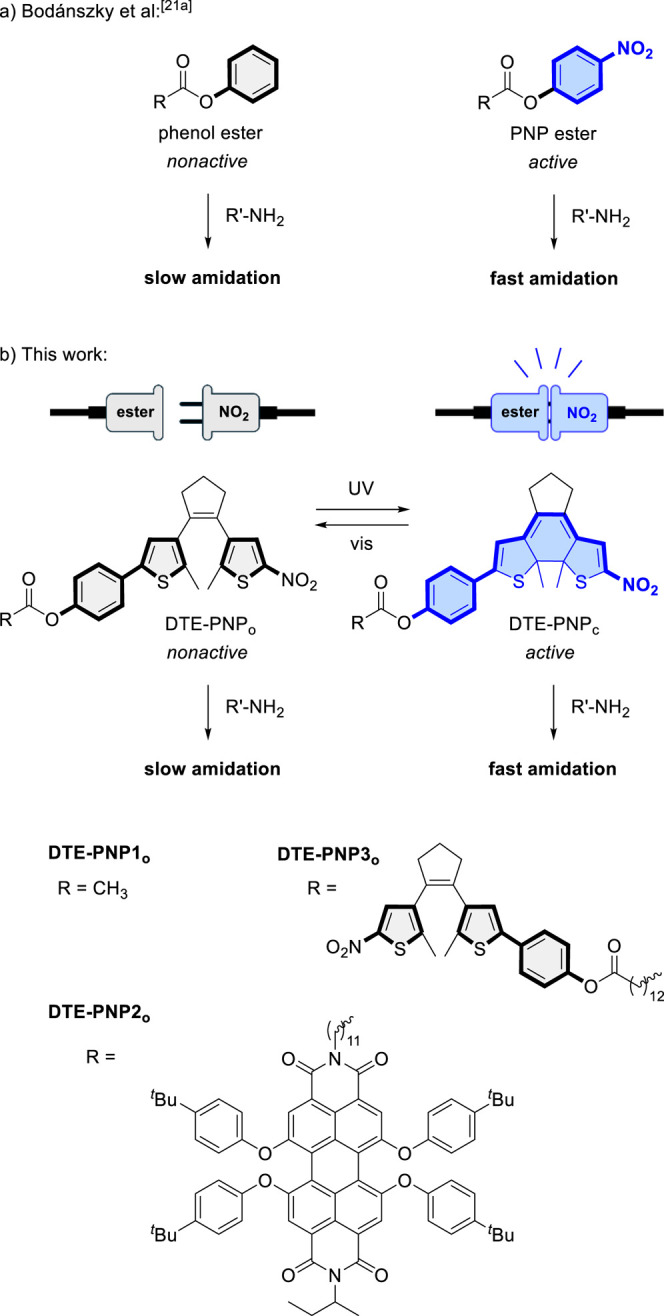
Our strategy for photoswitchable amidation is based on the well-known chemistry of active esters, which are among the most widely used substrates for amide preparation. ?−? ?,? This is the case for p-nitrophenyl (PNP) esters, which constitute one of the first examples of active esters described.? As their electron-withdrawing p-nitro substituent enhances the electrophilicity of the carbonyl moiety and lowers the basicity of the p-nitrophenolate leaving group, PNP esters undergo fast aminolysis, in contrast to the esters of electron-richer phenols and common alkyl esters (Figurea).? Herein, we reversibly control amide bond formation with light by introducing photoswitchable motifs into PNP esters, whose photoisomerization could turn on and off the electronic effect of the p-nitro group on reactivity. Specifically, we selected dithienylethenes (DTE) as photoswitching units, because their photoconversion between ring-open (o) and ring-closed (c) states modulates the electronic communication between the external substituents of their thiophene rings.? This feature has already been exploited to optically control the reactivity of several DTE-appended groups ?,? and, very recently, we have demonstrated that it allows photomodulating the acidity of phenols.? Thus, by tethering phenol and nitro groups through a DTE photoswitch, the phenol acidity was modified ca. 5 pK a units as a result of the change in electronic conjugation that occurs upon photoisomerization. Herein, we hypothesize that the acylation of such nitro-DTE-phenol conjugates could afford photoswitchable phenyl esters (DTE-PNP) with light-regulated amidation reactivity, which may then be applied to conduct two-color controlled photoligation processes. As shown in Figureb, these compounds should exhibit slow aminolysis rates in the open state where the phenoxy moiety is not conjugated to the nitro group but to a thiophene ring, which should impart negligible electronic effects according to its Hammett σ-para substituent constant (σ_p_ = 0.05?). In contrast, amidation reactivity should be activated upon photocyclization by enabling electronic communication between the phenoxy group and the electron-withdrawing nitro substituent (σ_p_ = 0.78?) through the planar conjugated backbone of the closed DTE isomer, thereby mimicking the structure of active PNP esters.
(a) Difference in aminolysis reactivity described for esters of electron-deficient and electron-richer phenols (e.g., p-nitrophenyl and phenyl esters). (b) Strategy devised in this work for light-controlling amidation reactions using photoswitchable active esters (DTE-PNP), where a photoisomerizable dithienylethene unit is used to switch on and off the electronic communication between phenyl esters and an activating nitro group. This strategy has been applied to model (DTE-PNP1) and functional (DTE-PNP2, DTE-PNP3) photoswitchable active esters.
Results and Discussion
2
Light-Control of Amidation with Photoswitchable
Active Esters
2.1
To validate our approach for the light-control of amidation, we initially investigated the reactivity of a model DTE-PNP compound in solution. For simplicity, we selected the acetate ester DTE-PNP1 as a benchmark system, which was prepared by direct acylation with acetyl chloride of the photoswitchable phenol DTE-NO _ 2 _ previously synthesized by us? (Figurea). Notably, the resulting ester preserved the photoswitching properties of DTE-NO _ 2 . In solvents of low and intermediate polarity (e.g., toluene, CHCl_3 and THF), the open isomer DTE-PNP1 _ o _ efficiently photoisomerized to the closed state DTE-PNP1 _ c _ upon irradiation at 365 nm, with photocyclization quantum yields (Φ_o‑c_) exceeding 0.15 and conversions around 95%, which may be further optimized by a detailed analysis via a photochemical action plot to map wavelength dependent quantum yields that typically do not align with molar absorptivity.? Subsequent illumination at 625 nm promoted quantitative back-photoisomerization to the initial open isomer with lower quantum yields (Φ_c‑o_ ∼ 0.007–0.009), which enabled repetitive photoswitching of DTE-PNP1 with minor photodegradation under sequential UV- and red-light irradiation (Figureb–c, Table S1 and Figures S1–S3). In contrast, thermal back-isomerization was not observed for DTE-PNP1 _ c _ at room temperature, which remained stable in the dark for at least 48 h (Figure S4). As already reported for push–pull substituted DTE compounds, ?,? the photochemical performance of DTE-PNP1 slightly declined in solvents of higher polarity such as acetonitrile and DMSO (Φ_o‑c_ < 0.06), although good ring-closing photoconversions could still be achieved under UV irradiation (>70%), while the red-light induced photocycloreversion reaction remained quantitative in these media (Table S1, Figures S2 and S3).
*(a) Synthesis of photoswitchable active ester DTE-PNP1. (b) UV–vis absorption spectra of the open and closed isomers of DTE-PNP1 in CHCl3, as well as of the photostationary state mixture obtained upon irradiation of DTE-PNP1
o at 365 nm (PSSo‑c). (c) Variation of the molar fraction of the closed isomer DTE-PNP1
c upon consecutive cycles of irradiation of a CHCl3 solution of DTE-PNP1 at 365 nm (for photocyclization) and 625 nm (for photocycloreversion).*
To investigate the modulation of amidation reactivity for the two isomers of DTE-PNP1, we monitored their reaction with a model primary alkylamine (1-dodecylamine) in aprotic solvents of varying polarity (CHCl_3_, THF and acetonitrile) at room temperature by ^1^H NMR spectroscopy (Figuresa and S5). Specifically, separate aminolysis reactions were conducted for pure DTE-PNP1 _ o _ and UV-induced photostationary mixtures enriched with DTE-PNP1 _ c _ (>80%), using a 20-fold excess of amine to make amide bond formation follow pseudo-first order kinetics (c DTE‑PNP1 = 5.0 mM, c amine = 100 mM). However, only the apparent pseudo-first order rate coefficients are reported herein (k ^obs^), as their dependence on amine concentration is often not linear due to self-catalytic effects and may vary with the nature of the solvent and substrate.? For comparison purposes, similar measurements were performed for the acetate of p-nitrophenol (PNP1) as a reference active ester, using UV–vis absorption spectroscopy to monitor reaction kinetics in those solvents where amidation took place very fast (<20 min) (Figuresa and S6). Attempts to expand these experiments to aqueous media (such as acetonitrile/water mixtures) were unsuccessful due to poor DTE-PNP1 and PNP1 solubility.
*(a) Aminolysis reaction between DTE-PNP1 (c = 5.0 × 10⁻³ M) or PNP1 (c = 5.0 × 10⁻³ M) with 1-docecylamine (c = 0.10 M) at room temperature. (b) Evolution of aminolysis conversion with reaction time for DTE-PNP1
o , DTE-PNP1
c and PNP1 in acetonitrile at room temperature. Data points are experimental data obtained from 1H NMR or UV–vis absorption spectra (see the Supporting Information for further details), while lines are fits to a pseudo-first order kinetic model (fit error <5%). Full conversion for DTE-PNP1
o was only observed after 6 days. (c) Pseudo-first order rate constants for the aminolysis reaction of DTE-PNP1
o , DTE-PNP1
c and PNP1 in chloroform, THF and acetonitrile at room temperature. (d) Evolution of aminolysis conversion with reaction time for DTE-PNP1
o in acetonitrile at room temperature when subjected to different sequential illumination conditions: (i) in the dark (0–60 min); (ii) irradiation at λmax = 365 nm and 0.017 mW cm–2 (60–120 min); (iii) irradiation at λmax = 625 nm and 400 mW cm–2 (120–180 min); (iv) irradiation at λmax = 365 nm and 0.017 mW cm–2 (180–240 min); (v) combined irradiation at λmax = 365 nm (0.017 mW cm–2) and λmax = 625 nm (400 mW cm–2) (240–300 min); (vi) irradiation at λmax = 365 nm and 0.017 mW cm–2 (300–360 min); and (vii) in the dark (360–420 min). Data obtained from 1H NMR spectra (see the Supporting Information for further details).*
When analyzing the amidation rate coefficients determined for DTE-PNP1 and PNP1 in different solvents, several conclusions can be drawn (Figureb,c, Table and Figure S7). For these compounds, higher reactivity was observed in THF and acetonitrile relative to the less polar solvent CHCl_3_, probably due to the enhanced stabilization of the polar tetrahedral intermediate generated in the first step of the amidation process by amine addition to the carbonyl group.? In addition, larger rate coefficients were measured for PNP1 than for the two states of DTE-PNP1 in all solvents. We ascribe this result to the larger distance between the carbonyl and nitro groups in DTE-PNP1 _ c _ relative to PNP1, as rotation of the bond that links the phenyl ester and DTE_c_ fragments may attenuate the activating effect on amidation reactivity due to decreased conjugation efficiency. More importantly, we registered a clear variation in amide bond formation kinetics for the two states of DTE-PNP1, with the closed isomer DTE-PNP1 _ c _ exhibiting larger aminolysis coefficients in all analyzed solvents (k DTE‑PNP1c ^obs^/k DTE‑PNP1o ^obs^ > 4). This effect was found to develop with increasing solvent polarity, leading to a high reactivity amplification factor between the closed and open isomers of DTE-PNP1 in acetonitrile: k DTE‑PNP1c ^obs^/k DTE‑PNP1o ^obs^ = 24, which is of the same order as previously reported for photoswitchable imine formation using a related DTE-based strategy.? As a result, the aminolysis reaction of DTE-PNP1 _ c _ was completed in only 4 h at room temperature, while only ca. 15% of DTE-PNP1 _ o _ was consumed after this reaction time. Interestingly, similar effects on reactivity modulation were observed when 1-dodecylamine was replaced by a secondary amine such as dihexylamine (k DTE‑PNP1c ^obs^/k DTE‑PNP1o ^obs^ = 39 in acetonitrile, Figure S8). Overall, these results validate our molecular design and demonstrate that switching on and off the electronic communication between phenol esters and nitro groups through a photoisomerizable DTE spacer allows modulation of amidation reactivity.
1: Kinetics of the Aminolysis Reaction of the Esters Prepared with 1-Dodecylamine at Room Temperature ,
In light of the large variation of aminolysis rates found for the two states of DTE-PNP1 in acetonitrile, we explored the two-color control of amide bond formation in situ using this compound as a photoswitchable active ester; i.e., whether amidation could be triggered by UV-induced photocyclization to the more reactive DTE-PNP1 _ c _ isomer and inhibited by irradiation with red light to recover the less active DTE-PNP1 _ o _ state through back-photoisomerization. To do so, the aminolysis of DTE-PNP1 _ o _ with 1-dodecylamine in acetonitrile and at room temperature was monitored by ^1^H NMR spectroscopy while applying a sequence of different illumination conditions (Figured): (1) no irradiation, where very low reactivity was observed for the initial nonactive ester DTE-PNP1 _ o _ (t irr = 0–60 min); (2) UV illumination at λ_max_ = 365 nm and 0.017 mW cm^–2^, which led to photoconversion to active DTE-PNP1 _ c _ and, consequently, fast aminolysis reaction (t irr = 60–120 min and t irr = 180–240 min); (3) red-light irradiation at λ_max_ = 625 nm and 400 mW cm^–2^, which photoisomerized DTE-PNP1 back to the less reactive open isomer (t irr = 120–180 min); and (4) combined UV (λ_max_ = 365 nm, 0.017 mW cm^–2^) and red irradiation (λ_max_ = 625 nm, 400 mW cm^–2^), where the use of high visible-to-UV light intensity ratio allowed displacing the photostationary equilibrium toward DTE-PNP1 _ o _ and, therefore, dramatically slowing amide bond formation (t irr = 240–300 min). When the red illumination source was switched off while preserving UV irradiation, DTE-PNP1 _ c _ was reformed and the amidation reaction was reactivated (t irr = 300–360 min) and subsequently preserved in the dark (t irr = 360–420 min), thereby demonstrating that the changes in reactivity observed were not influenced by additional heating effects that could be caused by irradiation. More importantly, the antagonistic response on amidation rate that was achieved under concomitant UV and red light photoexcitation could be exploited to confine the aminolysis process spatially, which we investigated by analyzing the spatial profile of the more reactive DTE-PNP1 _ c _ species upon patterned illumination in liquid solution (Figure S9). Thus, while local, single irradiation at λ_max_ = 365 nm resulted in widespread distribution of DTE-PNP1c molecules throughout the sample due to diffusion, complementary photoexcitation at λ_max_ = 625 nm with high power allowed their selective localization within the volume element illuminated with UV light. Hence, all these results demonstrate that our model DTE-based photoswitchable active ester enables two-color control of amidation.
Light-Modulation of Amidation with Functional
Photoswitchable Active Esters
2.2
To explore the potential of our methodology to photomodulate amide bond formation, we prepared a DTE-based photoswitchable active ester bearing a fluorescent moiety that could be transferred to amino-terminated molecular platforms under dual-wavelength control; i.e., an illustrative example of functional DTE-PNP compounds (DTE-PNP2) (Figurea). For this purpose, a perylene diimide (PDI) fluorophore was selected because of its excellent photophysical properties and facile chemical derivatization.? In addition, the PDI emitter chosen shows low or no absorption at the 365 nm (ε_PDI_ ∼ 0.5 ε_DTEo_) and 625 nm (ε_PDI_ ∼ 0) wavelengths required for DTE photoisomerization and, therefore, it should not significantly interfere with the photocyclization and photocycloreversion reactions of DTE-PNP2 (Figure S10a). It must be noted that the synthesis of DTE-PNP2and of any other analogous photoswitchable active esteris straightforward, as it just requires coupling phenol DTE-NO _ 2 _ to a carboxylated derivative of the functional unit of interest (Scheme S1).
*(a) Aminolysis reaction between DTE-PNP2 (c = 5.0 × 10⁻³ M) or PNP2 (c = 5.0 × 10⁻³ M) with 1-docecylamine (c = 0.10 M) at room temperature. (b) Evolution of aminolysis conversion with reaction time for DTE-PNP2
o , DTE-PNP2
c and PNP2 in THF at room temperature. Data points are experimental data obtained from 1H NMR or UV–vis absorption spectra (see the Supporting Information for further details), while lines are fits to a pseudo-first order kinetic model (fit error <5%). Full conversion was observed for DTE-PNP2
o after 10 days. (c) Photomodulation of PEI functionalization with PDI fluorophores using DTE-PNP2. Images show the color of the resulting polymer solutions after reaction with DTE-PNP2
o at two different illumination conditions (top) in the dark; and (bottom) after UV irradiation (λmax = 365 nm and 10 mW cm–2). (d) PDI labeling efficiency achieved for PEI at these two different irradiation conditions according to 1H NMR measurements.*
Because of its poor solubility in polar organic solvents, the photoswitching behavior of DTE-PNP2 was only investigated in CHCl_3_ and THF. In a similar fashion to DTE-PNP1, irradiation of the open isomer DTE-PNP2 _ o _ at 365 nm in these solvents efficiently photoproduced the closed state DTE-PNP2 _ c _ (>78% conversion, Φ_o‑c_ = 0.04–0.07), a process that could be quantitatively reverted upon red-light illumination (Φ_c‑o_ ∼ 0.01) and repeated for several photoswitching cycles with good fatigue resistance (Table S2 and Figure S10). In addition, the introduction of a PDI unit in DTE-PNP2 led to emission detection for both its open and closed states, though with different fluorescence quantum yields (Φ_f,DTE‑PNP2o _ = 0.80 and Φ_f,DTE‑PNP2c _ = 0.19 in THF) (Table S2 and Figure S11). As the PDI emission spectrum overlaps with the absorbance of the DTE closed isomer, emission quenching in DTE-PNP2 _ c _ could be ascribed to resonance energy transfer between these moieties, as previously measured for another PDI-DTE dyad developed by us.? Importantly, such a quenching effect must be inhibited upon DTE-PNP2 _ c _ aminolysis and removal of the DTE-NO _ 2c _ byproduct, thus allowing the transfer of a DTE-free, bright PDI emitter to the desired amino substrate; for instance, the amide coupling product formed by reaction between DTE-PNP2 _ c _ and 12-dodecylamine exhibited intense fluorescence in solution (Φ_f_ = 0.95 in THF).
Aminolysis with 12-dodecylamine was also employed as the benchmark system to assess the modulation of amidation reactivity between the two isomers of DTE-PNP2 at room temperature, utilizing equivalent conditions to those used with DTE-PNP1 (Figurea). Similar experiments were conducted for the model PDI-containing p-nitrophenyl ester PNP2 (Scheme S1). As shown in Table, replacing the acetate group of DTE-PNP1 and PNP1 by the carboxylated PDI unit in DTE-PNP2 and PNP2 slowed down the amidation process in most cases (CHCl_3_ and THF), in agreement with the well-known dependence of reaction rates with the steric hindrance around the acyl group.? In spite of this, a clear positive effect derived from the introduction of the bulkier PDI group in DTE-PNP2 and PNP2: the difference in reactivity between the open and closed isomers of DTE-PNP2 was not only preserved, but it slightly increased relative to DTE-PNP1: k DTE‑PNP2c ^obs^/k DTE‑PNP2o ^obs^ = 7.5 and 14 in CHCl_3_ and THF, respectively, which further validates our strategy toward light-controlled amidation (Table, Figuresb and S12). Consequently, these results denote that photoswitchable DTE-PNP active esters could be used to optically control chemical functionalization by light-modulated amide bond formation.
To illustrate this concept, we utilized DTE-PNP2 to photoregulate the functionalization of an amino-containing polymer with PDI chromophores through amidation. High-molecular weight poly(ethylenimine) (PEI, M n ∼ 250,000 g mol^–1^) containing both reactive primary and secondary amines was chosen as a substrate in these experiments, which had to be dissolved in CHCl_3_ (c = 0.15 mM) because of its low solubility in THF. The resulting solution was then incubated with DTE-PNP2 _ o _ (c = 1.9 mM; 13 PDI units per polymer chain) for 15 min at two different illumination conditions: (1) in the dark, and (2) under UV irradiation (λ_exc_ = 365 nm, 10 mW cm^–2^). Subsequent treatment allowed us to isolate the reacted polymer, whose PDI content was determined by ^1^H NMR in each case (Figurec,d). It must be noted that only PDI and PEI resonances were observed in the ^1^H NMR spectra measured for the treated polymer samples, while no DTE signals were detected (Figure S13). Consequently, the PDI content determined by ^1^H NMR analysis should not come from DTE-PNP2 molecules unspecifically physisorbed to the polymer, but to DTE-free PDI units covalently attached to PEI via amide bond formation. Clearly, minor covalent PDI labeling occurred in the dark due to the low aminolysis rate constant of the initial open state of DTE-PNP2, which therefore marginally reacted with PEI (1.6 PDI units attached per polymer chain, 12% labeling efficiency). In contrast, efficient PDI functionalization was accomplished upon UV irradiation by generating the more reactive closed isomer of DTE-PNP2 in situ, which largely underwent aminolysis with PEI and yielded a strongly red-colored polymer sample (11.2 PDI units anchored per polymer chain, 89% labeling efficiency).
Light-Control of Polymer Network Formation
via Photoswitchable Amidation
2.3
One of the major applications of dual-wavelength gated photoligation reactions is the light-induced control of polymer network formation, eventually aiming to develop advanced processes for polymer printing and manipulation. ?−? ? ? Thus, herein we investigated the use of our photoswitchable active esters to photoregulate the curing of amino-functionalized polymers by cross-linking with two colors of light. Thus, dimer DTE-PNP3 was devised as a cross-linker agent, synthesized by simply tethering two units of phenol DTE-NO _ 2 _ to tetradecandioyl chloride (see Supporting Information). A long alkyl chain was chosen as a spacer between the terminal DTE-PNP units of the dimer because of two principal motives: (1) to provide sufficient flexibility as to minimize steric and conformational constraints that could disfavor amidation reactivity for the two separate DTE-PNP moieties; and (2) to prevent detrimental effects on the photocyclization efficiency of the appended DTE groups. The latter has been reported for DTE aggregates linked through short tethers, where intramolecular energy transfer processes between nearby closed and open units lead to incomplete photoconversion.? Thanks to the long C12 spacer introduced, this issue was not observed for DTE-PNP3 in CHCl_3_, which preserved the high ring-closing conversion of monomer DTE-PNP1, producing 90% of closed DTE units under irradiation at 365 nm (Scheme S2, Table S3 and Figure S14). As a result, UV illumination of the initial open isomer DTE-PNP3 _ o _ efficiently led to the sequential photocyclization of its two DTE units to predominantly produce the fully closed form DTE-PNP3 _ c _ in the photostationary state. This behavior, in combination with the quantitative ring-opening efficacy measured for DTE-PNP3 _ c _ under red-light illumination, allowed repetitive photoswitching of DTE-PNP3 in CHCl_3_ between its fully open and closed states with low degradation effects (Figure S14).
When subjected to aminolysis with model 1-dodecylamine at room temperature, DTE-PNP3 also reproduced the reactivity behavior previously determined for monomer DTE-PNP1 (Figurea). In this case, kinetic studies were conducted in CHCl_3_, as it was the solvent of choice for the subsequent polymer cross-linking experiments (see below). As shown in Table and Figureb, clear modulation of amidation reactivity was observed between the open and closed isomers of DTE-PNP3, reaching a value of k DTE‑PNP3c ^obs^/k DTE‑PNP3o ^obs^ = 8.5. As already noted for PDI-containing DTE-PNP2, replacing the acetate moiety of DTE-PNP1 by a bulkier acyl group in DTE-PNP3 amplified the rate constant difference between the two states of the photoswitchable active ester, though at the expense of slowing down amide bond formation. A similar steric hindrance effect was found for the reactivity of reference active ester dimer PNP3, which was prepared by coupling of tetradecandioyl chloride with two equivalents of p-nitrophenol (see Supporting Information).
*(a) Aminolysis reaction between DTE-PNP3 (c = 2.5 × 10⁻³ M) or PNP3 (c = 2.5 × 10⁻³ M) with 1-docecylamine (c = 0.10 M) at room temperature. (b) Evolution of aminolysis conversion with reaction time for DTE-PNP3
o , DTE-PNP3
c and PNP3 in CHCl3 at room temperature. Data points are experimental data obtained from 1H NMR measurements (see the Supporting Information for further details), and lines are fits to a pseudo-first order kinetic model (fit error <5%). Full reaction conversion for DTE-PNP3
o was not even observed after 30 days. (c) Modulation of PEI cross-linking by amidation reaction with the open and closed states of DTE-PNP3. (d) Light-color control of PEI gelation in CHCl3 at room temperature by reaction with DTE-PNP3
o under different illumination conditions: (left) in the dark; (middle) after UV irradiation (λmax = 365 nm and 30 mW cm–2); and (right) after simultaneous UV (λmax = 365 nm and 30 mW cm–2) and red-light irradiation (λmax = 625 nm and 800 mW cm–2). (e) One-color control of solid polymer pattern formation by reaction of PEI with DTE-PNP3
o under UV illumination (λmax = 365 nm and 3.8 mW cm–2) through a mask for 22 min (scale bar: 4.0 mm). (f) Two-color control of solid polymer pattern formation by reaction of PEI with DTE-PNP3
o under combined UV (λmax = 365 nm and 3.8 mW cm–2) and red-light (λmax = 650 nm and 500 mW cm–2) irradiation with differently shaped beams for 22 min (top) UV illumination of the whole field of view and red illumination through a star-shaped mask; and (bottom) UV and red illumination through flower- and star-shaped masks, respectively (scale bar: 4.0 mm). In (e,f) images of the polymer patterns created are shown after rinsing with CHCl3 to remove all unreacted species.*
To exploit the difference in amidation reactivity exhibited by the two isomers of DTE-PNP3 for the light-color control of polymer network formation, we investigated the cross-linking process of PEI as an amino-containing polymer (Figurec). In the first step, the photomodulation of PEI gelation in CHCl_3_ upon DTE-PNP3-induced covalent cross-linking was explored at room temperature. For this, gelation conditions were first optimized by amidation reaction with the reference cross-linker PNP3. In this way, we determined that chemical organogels could be rapidly produced in CHCl_3_ (ca. 5 min) by mixing appropriate amounts of PEI (c = 0.3 mM) and PNP3 (c = 35 mM) (Figure S15). Then, analogous gelation experiments were conducted by replacing PNP3 with DTE-PNP3 _ o _ under three different illumination conditions: (1) in the dark; (2) under UV irradiation (λ_exc_ = 365 nm, 30 mW cm^–2^); and (3) under combined UV (λ_exc_ = 365 nm, 30 mW cm^–2^) and red-light irradiation (λ_exc_ = 625 nm, 800 mW cm^–2^). As shown in Figured, PEI gelation was selectively promoted under sole UV irradiation in ca. 60 min; i.e., by photoconverting DTE-PNP3 _ o _ to the more reactive isomer DTE-PNP3 _ c _. The time required for cross-linker photocyclization (ca. 30 min at the experimental conditions used) should largely account for the longer gelation time measured in this case relative to the PNP3-induced process, together with the slower amidation kinetics of DTE-PNP3 _ c _. On the other hand, no gelation was observed in the dark when starting from the less reactive isomer DTE-PNP3 _ o _ (even after 72 h), or under simultaneous UV and red-light illumination with high visible-to-UV intensity ratio to warrant predominant formation of DTE-PNP3 _ o _ in the photostationary state (at least for 6 h). These results were corroborated by monitoring the gelation kinetics of separate PEI:DTE-PNP3 _ o _ and PEI:DTE-PNP3 _ c _ mixtures with rheometric measurements, where an estimate of the gel time can be obtained from the crossover of the storage (G′) and loss (G″) moduli (Figure S16). Whereas no gel point was determined for the PEI:DTE-PNP3 _ o _ sample after 50 min, G′/G″ crossover was observed for the PEI:DTE-PNP3 _ c _ mixture just after 8 min, thereby indicating the fast gelation capacity of the closed state of the cross-linker. Overall, our gelation experiments demonstrate that toggling between the two different states of photoswitchable DTE-PNP esters allows the two-color control of solid polymer network formation, which is triggered with UV irradiation and inhibited by illumination with red light.
In the next stage, we applied the light-color controlled cross-linking reaction between PEI and DTE-PNP3 to fabricate polymer patterns. After preliminary optimization of the experimental conditions, we established that, when depositing a liquid layer (ca. 1 mm in height) of a CHCl_3_ solution of PEI (c = 0.75 mM) and DTE-PNP3 _ o _ (c = 10 mM) onto glass, irradiation with UV light (λ_exc_ = 365 nm, 3.8 mW cm^–2^) at room temperature for ca. 20 min promoted the formation of an insoluble, yellow-colored thin polymer layer by DTE-PNP3 _ c _ photogeneration and subsequent cross-linking (ca. 5 μm thick according to scanning electron microscopy). In contrast, no solid polymer network formation was observed in the dark even at longer incubation times (at least for 30 min) or when applying simultaneous two-color irradiation with UV (λ_exc_ = 365 nm, 3.8 mW cm^–2^) and red light (λ_exc_ = 625 nm and 500 mW cm^–2^) (Figures S17 and S18). Due to the high polymer content and, therefore, viscosity of the liquid formulations used, molecular diffusion was largely prevented during these experiments, which we exploited to create defined polymer patterns by conducting UV illumination through differently shaped masks; i.e., under one-color activation of PEI curing, which yielded spatially patterned polymer films exhibiting a characteristic yellow color (Figurese and S19). More interestingly, we also attempted polymer photopatterning under two-color irradiation (Figure S19). For this, we first conducted experiments where we induced generalized solid polymer film formation by irradiating the entire liquid formulation with UV light (λ_exc_ = 365 nm, 3.8 mW cm^–2^), while locally stopping amidation-promoted cross-linking by confined red illumination through a mask (λ_exc_ = 650 nm, 500 mW cm^–2^). As shown in Figuref, spatially patterned polymer layers were obtained in this way where the lack of yellow-colored polymer material was observed in the areas irradiated with red light, thus demonstrating the two-color antagonistic control of PEI cross-linking. In a further step, we took advantage of this behavior to produce other polymer patterns where both the UV and red illumination beams were patterned through masks, which illustrate the potential of the photoswitchable active esters developed in this work to modulate amidation reactions with high spatial precision (Figuref).
Conclusion
3
We introduce photoswitchable active esters for the light-color control of amide bond formation reactions with amines. Our approach relies on introducing a dithienylethene photoswitch within the structure of p-nitrophenyl active esters, whose open-closed photoisomerization allows reversibly turning on and off the activating effect of the p-nitro substituent on amidation reactivity. After reaction, the photoswitchable fragment of our active esters is released as a leaving group, while its acyl moiety remains attached to the reactive amine yielding a stable amide with no light-sensitivity. This behavior was successfully validated for three different types of photoswitchable phenyl esters: a model acetate ester, a functional ester bearing a transferable perylene diimide chromophore, and an ester dimer that was used as a cross-linker for amino-containing polymers. By enabling electronic communication between the phenyl ester and the p-nitro group through the conjugated backbone of the photocyclized dithienylethene unit, the closed isomer of these compounds showed 4- to 24-fold larger aminolysis rates than their open state when reacted with a model primary amine at room temperature. Taking advantage of this feature, two-color control of amide bond formation was demonstrated, as it could be promoted upon UV-induced photocyclization of the photoswitchable esters and dramatically slowed by back-photoisomerization to their initial open isomer with red light. In addition, although their amidation reactivity decreases relative to common active phenyl esters due to steric and electronic effects, our photoswitchable esters in their activated closed state undergo amide bond formation on the time scale of minutes to hours at ambient conditions. As a result, these compounds can be exploited to photocontrol relevant examples of amidation-based ligation processes, such as dye labeling, polymer gelation and polymer thin film patterning. Overall, these results illustrate the potential of photoswitchable active esters to accomplish the functionalization and manipulation of materials with enhanced spatiotemporal precision.
Supplementary Material
The reference list from the paper itself. Each links out to its DOI / PubMed record.
- 1a Arthur, G. The Amide Linkage: Selected Structural Aspects in Chemistry, Biochemistry, and Materials Science; Wiley-Interscience: New York, 2000.
- 2a Brinkley M. A.Brief Survey of Methods for Preparing Protein Conjugates with Dyes, Haptens, and Cross-Linking Reagents Bioconjugate Chem.19923121310.1021/bc 00013 a 0011616945 · doi ↗ · pubmed ↗
- 3a Das A.Theato P.Activated Ester Containing Polymers: Opportunities and Challenges for the Design of Functional Macromolecules Chem. Rev.201611631434149510.1021/acs.chemrev.5b 0029126305991 · doi ↗ · pubmed ↗
- 4a Thanh N. T. K.Green L. A. W.Functionalisation of Nanoparticles for Biomedical Applications Nano Today 20105321323010.1016/j.nantod.2010.05.003 · doi ↗
- 5a Gooding J. J.Ciampi S.The Molecular Level Modification of Surfaces: From Self-Assembled Monolayers to Complex Molecular Assemblies Chem. Soc. Rev.20114052704271810.1039/c 0cs 00139 b 21290036 · doi ↗ · pubmed ↗
- 6a Tasdelen M. A.Yagci Y.Light-Induced Click Reactions Angew. Chem., Int. Ed.201352235930593810.1002/anie.20120874123653429 · doi ↗ · pubmed ↗
- 7a Lim R. K. V.Lin Q.Photoinducible Bioorthogonal Chemistry: A Spatiotemporally Controllable Tool to Visualize and Perturb Proteins in Live Cells Acc. Chem. Res.201144982883910.1021/ar 200021 p 21609129 PMC 3175026 · doi ↗ · pubmed ↗
- 8a Delaittre G.Goldmann A. S.Mueller J. O.Barner-Kowollik C.Efficient Photochemical Approaches for Spatially Resolved Surface Functionalization Angew. Chem., Int. Ed.20155439113881140310.1002/anie.20150492026331726 · doi ↗ · pubmed ↗