Deciphering Microscopic Agglutination Test (MAT) Serogroup Cross-Reactivity in Leptospirosis: The Influence of Age and Antibody Titers
Eric J. Nilles, Cecilia Then Paulino, William Duke, Ronald Skewes-Ramm, Adam Kucharski, Colleen L. Lau

TL;DR
This study explores how age and antibody levels affect cross-reactivity in a common leptospirosis test, showing older people react to more serogroups despite lower antibody levels.
Contribution
The study identifies age and antibody titer as key factors influencing serogroup cross-reactivity in the microscopic agglutination test for leptospirosis.
Findings
Older individuals and those with higher antibody titers showed reactivity to more serogroups.
Maximum antibody titer was the strongest predictor of serogroup breadth.
Mean titer decreased with age, suggesting broader reactivity in older individuals reflects cumulative exposure.
Abstract
Leptospirosis is a zoonotic disease caused by Leptospira spp., with over 250 serovars classified into 24 serogroups. Control measures depend on understanding serovar-specific epidemiology, yet the microscopic agglutination test (MAT) is only serogroup specific, and classification is complicated by cross-reactivity. While MAT is the reference standard for leptospirosis serodiagnosis and seroepidemiological studies, factors influencing serogroup cross-reactivity remain poorly characterized. We investigated the relationship between age, antibody titer, and serogroup diversity among seropositive individuals in a population-based serosurvey in the Dominican Republic. Between June and October 2021, we conducted a multistage national serosurvey, enrolling 6683 participants across 134 clusters. MAT was performed on sera from 2091 participants in two provinces using a 20-serovar panel. MAT…
Genes, proteins, chemicals, diseases, species, mutations and cell lines named across the full text — each resolved to its canonical identifier and authoritative record.
Click any figure to enlarge with its caption.
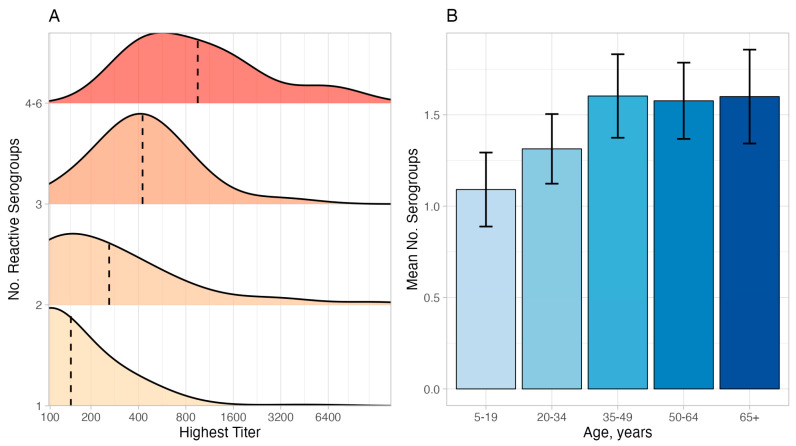 Figure 1
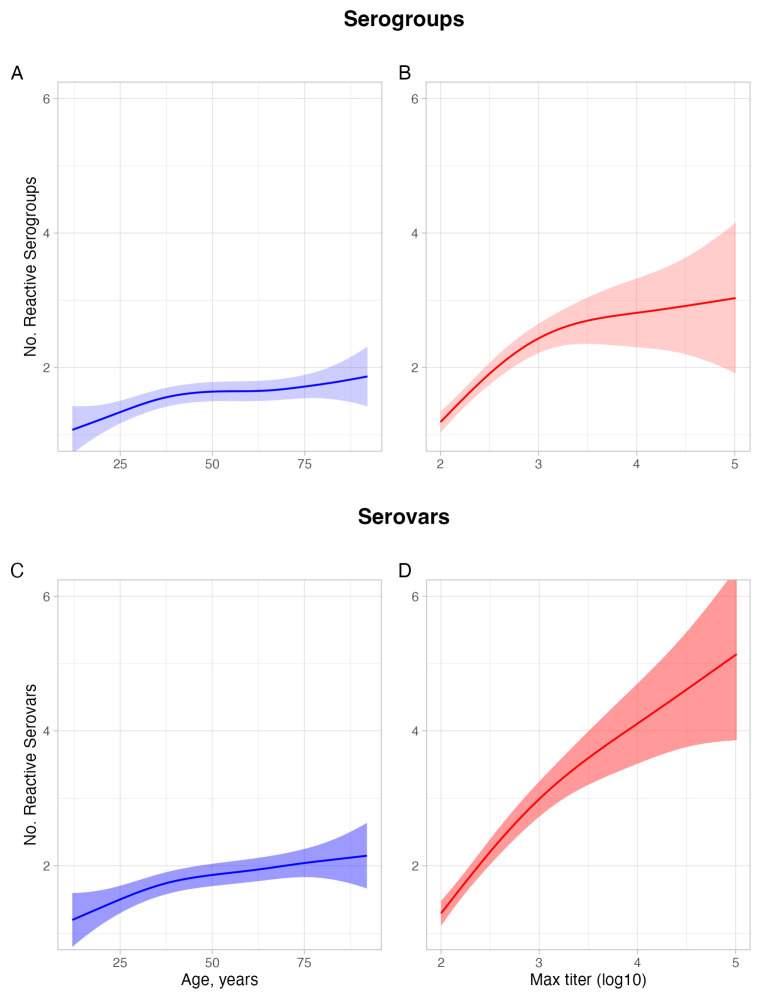 Figure 2
- —US Centers for Disease Control and Prevention
- —Australian National Health and Medical Research Council (NHMRC) Fellowship
Peer Reviews
No public reviews on file for this paper yet. If you reviewed it on a platform where reviews are public (OpenReview, ICLR, NeurIPS, ICML), you can paste yours below so the community can read it here.
Videos
No videos yet. Explain this paper in a talk, walkthrough, or lecture? Add one.
Taxonomy
TopicsLeptospirosis research and findings · Viral Infections and Vectors · Zoonotic diseases and public health
1. Introduction
Leptospirosis is caused by pathogenic spirochete bacteria of the genus Leptospira, classified into over 250 serovars and 24 serogroups based on their antigenic properties [1]. Different serovars are associated with varying clinical features and disease severities, and are linked to different mammalian reservoirs, including various wild, domestic, and farm animals [2]. Consequently, while leptospirosis is considered a single disease, its clinical manifestations, epidemiology, and transmission pathways are highly variable depending on the infecting serovar. For public health control, this variability has key implications. For example, control measures for Leptospira interrogans serovar Icterohaemorrhagiae, primarily transmitted by rats, focus on rodent control. In contrast, for Leptospira interrogans serovar Canicola, for which dogs are the primary reservoir, dog vaccination may be the most effective intervention. Therefore, understanding the serovar or serogroup-specific epidemiology in a particular setting is key to inform targeted public health interventions.
The microscopic agglutination test (MAT) is widely used for diagnosing acute leptospirosis infection and conducting population-based seroepidemiological studies. Although MAT has served as the reference standard leptospirosis immunoassay for nearly a century, interpreting results can be challenging. MAT typically uses a panel of around 20 serovars, with reactivity assessed through a dilutional approach to measure serovar-specific titers. Due to frequent cross-reactivity among serovars, results are generally reported at the serogroup level, although serogroup cross-reactivity also remains a challenge. While the factors driving cross-reactivity are not well characterized, they may hold significant implications for result interpretation. In this study, we conduct a secondary analysis of data from a multistage household serological survey in the Dominican Republic [3,4] to examine factors influencing the breadth of MAT-measured serovar and serogroup reactivity.
2. Materials and Methods
2.1. Study Design, Participant Selection, and Ethical Approvals
As previously described [3,4], between 30 June and 10 October 2021, we conducted a three-stage cross-sectional national household serological survey and enrolled 6683 participants from 3832 households in 134 clusters across all 32 provinces in the Dominican Republic. Of these, sera from clusters in Espaillat province (northwest, n = 10) and San Pedro de Macoris province (southeast, n = 13) were tested using MAT to detect Leptospira antibodies [5,6]. These provinces were intentionally oversampled during the national survey to allow for more granular provincial analyses, given they were the sites of ongoing enhanced prospective acute febrile infection surveillance [7]. Written consent was obtained for all participants. For children < 18 years old, except emancipated minors, consent was obtained from the legal guardian. Written assent was provided by adolescents 14–17 years old, and verbal assent by children 7–13 years old. The study protocol was approved by the National Council of Bioethics in Health, Santo Domingo (013-2019), the Institutional Review Board of Pedro Henríquez Ureña National University, Santo Domingo, and the Mass General Brigham Human Research Committee, Boston, USA (2019P000094).
2.2. Immunoassay Characteristics
MATs were used to detect anti-Leptospira antibodies and determine the putative serogroups associated with infections. Serological analyses were performed at the US CDC’s Zoonoses and Select Agent Laboratory, Bacterial Special Pathogens Branch, Atlanta, USA. A panel of 20 pathogenic serovars comprising 17 serogroups were selected for the MAT panel (Supplementary Table S1), and samples were tested at dilutions from 1:100 to endpoint. MAT titers ≥ 1:100 were considered seropositive and indicative of prior infection.
2.3. Statistical Analyses
We first assessed the association between maximum MAT titers and the number of reactive serogroups. Maximum titer was defined as the highest titer recorded, irrespective of the associated serogroup. To examine the factors affecting the diversity of serogroups and serovars among seropositive cases, we performed partial effects analyses. We applied a Generalized Additive Model (GAM) to titers log10-transformed for normalization. Analysis included smoothed terms for age and maximum titer to understand non-linear associations with serogroup diversity. Covariates considered in the initial model included occupation, study region (northwest vs. southeast), urban vs. rural setting, residence in an informal settlement, education, and reported rat exposure. Variables that did not improve model fit were excluded from the final model. To understand if our findings were consistent across spatially discrete regions, we repeated the analyses after stratifying by study region (NW vs. SE). Analyses and data visualization were performed using the R statistical programming language (R version 4.2.3, 1 March 2023) [8], the mgcv package (version 1.9.1) for partial effect analysis and ggplot2 (version 3.5.2) for data visualization [9].
3. Results
Of 2124 participants enrolled in the two study provinces during the national serosurvey, 2091 samples (98.4%) were tested for antibodies to Leptospira using MAT. Of these, 237 individuals (11.3%) registered agglutinating antibodies and comprise the current study population. Characteristics of the study population are provided in Table S2. The distribution of reactive serogroups, serovars, and MAT strain are detailed in Table S1.
Sera from older participants and those with higher titers reacted against more serogroups (Figure 1, Table S3). Mean maximum titers, however, trended down among older individuals in both unadjusted and adjusted analyses (Figure S1). Partial effect analyses demonstrated that both age and titer track with the number of reactive serogroups, with independent associations between age and number of reactive serogroups (p = 0.005) and maximum titer and number of reactive serogroups (p < 0.0001) (Figure 2A,B). Given that we used smoothed predictors in the model, we could not directly compare the relative effect of age versus titer, but given the F-value for maximum titer was ten-fold higher than age (42 vs. 4), we can infer that maximum titer was the most important predictor. Additional variables such as gender, study region, and urban vs. rural settings were not associated with the number of reactive serogroups and reduced model fit when included, so were dropped from the final model. Analysis of serovar rather than serogroup data demonstrated similar trends but, overall, a stronger association between number of reactive serovars and age and titer (Figure 2C,D).
4. Discussion
Our findings provide insights into the interpretation of MAT results for leptospirosis, particularly in population-based surveys. We show that higher MAT titers are independently associated with reactivity to a greater number of serogroups, indicating that cross-reactivity increases at high titers but is less pronounced at lower levels. Additionally, while older individuals tend to react to more serogroups, this finding is not driven by higher titers—in fact, titers tend to decline with age. Rather, broader serogroup reactivity in older individuals likely reflects cumulative exposure over time or may involve immunological mechanisms such as memory B cell persistence, affinity maturation, or the accumulation of broadly reactive antibody repertoires [10].
While the challenge of MAT cross-reactivity is well known [11,12], limited investigation has been performed to characterize factors that drive cross-reactivity. Our contribution lies in applying quantitative modeling to a large, population-based serosurvey, enabling us to disentangle the independent and non-linear effects of host age and antibody titer on serogroup breadth. A range of other demographic variables were examined but were not retained in the final models as they did not improve explanatory power or model fit. By using generalized additive models, we were able to move beyond basic correlations and characterize more nuanced associations, including the finding that cross-reactivity increases markedly at high titers but appears to be also influenced by cumulative exposure or potentially immune maturation in older age groups. Our methodological approach provides insights that strengthen the utility of MAT for surveillance and outbreak response, moving beyond the incremental recognition of MAT limitations toward a more robust interpretation of the assay in public health practice. Animal studies have suggested that both the magnitude and breadth of the immune response vary by host species [12], although the role of titer, age, and prior antigen exposure (i.e., immune imprinting) remains unclear. We also found that associations between age or titer and antibody breadth were more pronounced at the serovar level than at the serogroup level. This is not unexpected given serogroups aggregate multiple serovars that—by definition—generate broadly similar immune responses. As such, serovar-level cross-reactivity is more sensitive to differences in age and titer levels, at least in endemic settings.
From a public health perspective, our findings have several implications. First, when designing seroepidemiological surveys, investigators should consider age structure and antibody titers, as cross-reactivity is more likely among these subgroups. Second, in outbreak investigations, the presence of broad serogroup reactivity at high titers should be interpreted cautiously to avoid misattribution of the infecting serogroup. Third, in endemic settings, surveillance programs may benefit from stratifying analyses by age to differentiate recent from cumulative exposures. Lastly, although no widely available human vaccine exists, ongoing efforts to develop region-specific formulations warrant further consideration. Notably, age- and titer-associated patterns of serogroup reactivity may have implications for vaccine development and evaluation. For example, age-specific immune imprinting could influence vaccine responsiveness, underscoring the importance of stratifying future vaccine trials by age to account for age-associated differences in antigenic responses. Taken together, these insights help maximize the utility of MAT data for guiding targeted interventions despite its limitations at the serogroup level.
Beyond human epidemiology, these findings also have One Health implications. MAT is widely used in veterinary and wildlife studies to identify potential reservoirs, yet age- and titer-associated cross-reactivity may equally complicate interpretation in non-human hosts. By clarifying these dynamics in humans, our study underscores the need for integrated approaches that combine human, animal, and environmental data to improve attribution of infection sources. For example, aligning seroepidemiological surveys across species with molecular and ecological investigations could provide more reliable insights into transmission pathways and reservoir contributions.
Our study is limited by the absence of clinical and molecular data, which would have allowed us to directly link serogroup reactivity with infecting strains and disease outcomes—and allow us to assess if increased serogroup reactivity among high titer individuals is primarily driven by recent infection. Future studies would benefit from integrating MAT with molecular methods such as quantitative PCR, multilocus sequence typing (MLST), or whole-genome sequencing (WGS). Such approaches provide higher resolution for distinguishing infecting serovars and linking serological profiles with transmission pathways. Importantly, incorporating intermediate Leptospira species into diagnostic panels may provide additional insights, as these are increasingly recognized as causes of human disease and may contribute to antibody cross-reactivity in MAT assays. Together, these approaches will complement and extend our findings, ensuring that serological insights are more effectively translated into actionable epidemiological and public health knowledge. By using maximum titer as a putative measure of infecting serogroup, this study does not account for serogroup-specific differences in reactivity or differences in host immune imprinting and response. However, although we do report putative infecting serogroup, for additional contextual information (Supplemental Materials), the serogroup specific data does not impact our findings which aimed to assess factors driving cross-reactivity.
5. Conclusions
While there are well-recognized limitations to using MAT for serogroup-specific diagnosis, the assay is generally more affordable and sensitive than molecular or culture-based methods and is widely used in both endemic and outbreak settings. As such, studies like ours which help clarify how host factors such as age and antibody titer influence MAT reactivity improve the interpretation of MAT results and maximize its epidemiological utility for public health surveillance and control efforts. By delineating how host age and antibody titers shape MAT cross-reactivity, our study provides practical guidance for improving the design and interpretation of serosurveys, outbreak responses, and surveillance strategies in leptospirosis-endemic regions.
The reference list from the paper itself. Each links out to its DOI / PubMed record.
- 1Palaniappan R.U. Ramanujam S. Chang Y.-F. Leptospirosis: Pathogenesis, immunity, and diagnosis Curr. Opin. Infect. Dis.20072028429210.1097/QCO.0b 013e 32814 a 572917471039 · doi ↗ · pubmed ↗
- 2Pedersen K. Anderson T.D. Maison R.M. Wiscomb G.W. Pipas M.J. Sinnett D.R. Baroch J.A. Gidlewski T. Leptospira antibodies detected in wildlife in the USA and the US Virgin Islands J. Wildl. Dis.20185445045910.7589/2017-10-26929715063 · doi ↗ · pubmed ↗
- 3Nilles E.J. Paulino C.T. de St Aubin M. Restrepo A.C. Mayfield H. Dumas D. Finch E. Garnier S. Etienne M.C. Iselin L. SARS-Co V-2 seroprevalence, cumulative infections, and immunity to symptomatic infection—A multistage national household survey and modelling study, Dominican Republic, June–October 2021 Lancet Reg. Health—Am.20221610039010.1016/j.lana.2022.10039036408529 PMC 9642112 · doi ↗ · pubmed ↗
- 4Nilles E.J. Paulino C.T. Galloway R. Aubin M.d.S. Mayfield H.J. Restrepo A.C. Dumas D. Garnier S. Etienne M.C. Duke W. Seroepidemiology of human leptospirosis in the Dominican Republic: A multistage cluster survey, 2021 P Lo S Negl. Trop. Dis.202418 e 001246310.1371/journal.pntd.001246339715275 PMC 11735007 · doi ↗ · pubmed ↗
- 5Martin B.M. Sartorius B. Mayfield H.J. Restrepo A.M.C. Kiani B. Paulino C.J.T. Etienne M.C. Skewes-Ramm R. Aubin M.d.S. Dumas D. Quantifying spatial variation in environmental and sociodemographic drivers of leptospirosis in the Dominican Republic using a geographically weighted regression model Sci. Rep.202552707310.1038/s 41598-025-13413-540715704 PMC 12297537 · doi ↗ · pubmed ↗
- 6Martin B.M. Sartorius B. Mayfield H.J. Restrepo A.M.C. Kiani B. Paulino C.J.T. Etienne M.C. Skewes-Ramm R. Aubin M.d.S. Dumas D. Geospatial analysis of leptospirosis clusters and risk factors in two provinces of the Dominican Republic P Lo S Negl. Trop. Dis.202519 e 001310310.1371/journal.pntd.001310340498763 PMC 12157080 · doi ↗ · pubmed ↗
- 7Nilles E.J. Aubin M.d.S. Dumas D. Duke W. Etienne M.C. Abdalla G. Jarolim P. Oasan T. Garnier S. Iihoshi N. Monitoring Temporal Changes in SARS-Co V-2 Spike Antibody Levels and Variant-Specific Risk for Infection, Dominican Republic, March 2021–August 2022 Emerg. Infect. Dis. J.20232972373310.3201/eid 2904.22162836848869 PMC 10045678 · doi ↗ · pubmed ↗
- 8R Core Team R: A language and environment for statistical computing R Foundation for Statistical Computing R Core Team Vienna, Austria 2021