Correction: Poštuvan et al. A Lonelier World after COVID-19: Longitudinal Population-Based Study of Well-Being, Emotional and Social Loneliness, and Suicidal Behaviour in Slovenia. Medicina 2024, 60, 312
Vita Poštuvan, Nina Krohne, Meta Lavrič, Vanja Gomboc, Diego De Leo, Lucia Rojs

Abstract
Genes, proteins, chemicals, diseases, species, mutations and cell lines named across the full text — each resolved to its canonical identifier and authoritative record.
Click any figure to enlarge with its caption.
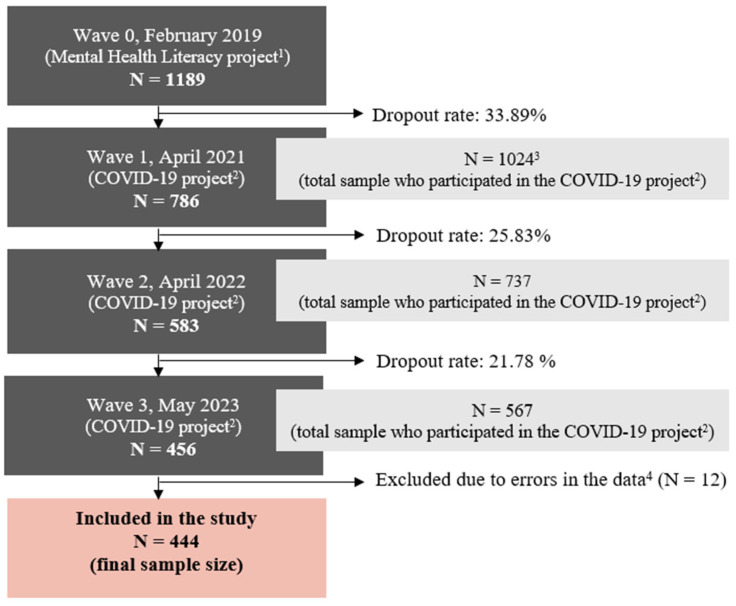 Figure 1
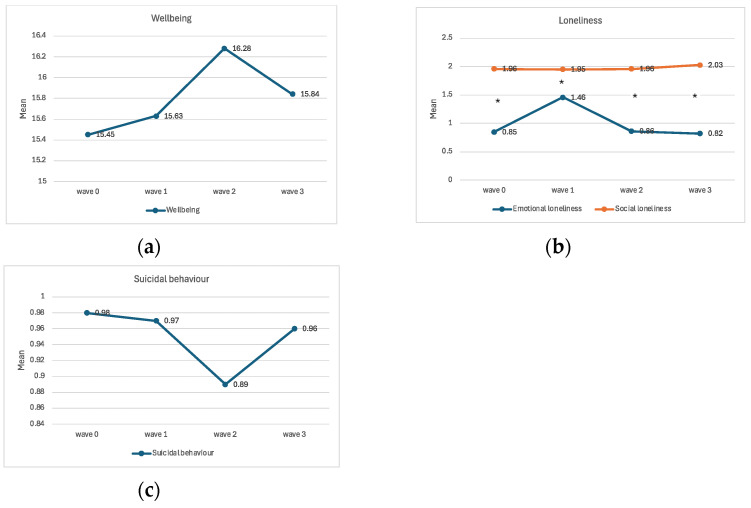 Figure 2
Peer Reviews
No public reviews on file for this paper yet. If you reviewed it on a platform where reviews are public (OpenReview, ICLR, NeurIPS, ICML), you can paste yours below so the community can read it here.
Videos
No videos yet. Explain this paper in a talk, walkthrough, or lecture? Add one.
Taxonomy
TopicsCOVID-19 and Mental Health · Health disparities and outcomes
Error in Figures
In the original publication [1], there were some mistakes in Figures 1 and 2 as published. In Figure 1, final sample size and number of excluded participants were corrected. The correct Figure 1 appears below.
In Figure 2, there was statistical mistake published. The corrected Figure 2 appears below.
Error in Tables
There was an error in the original publication due to the mistake in the number of participants included and excluded from the study, which caused statistical mistakes, so changes were made in Tables 1–5. The corrected tables are presented below.
Text Correction
There was an error in the original publication due to the mistake in the number of participants. A correction has been made to an Abstract, Section 2.2. Participants, as well as Section 2.4. Statistical Analysis. Changes in the tables resulted in changes in the text after Figure 5 in Section 3. Results, 4. Discussion and Section 5. Conclusions. The corrected paragraphs appear below.
- Abstract:
Materials and Methods: A representative sample of 444 participants completed online questionnaires at four time points: 2019 (wave 0), 2021 (wave 1), 2022 (wave 2), and 2023 (wave 3). Results: The results show significant changes in the levels of well-being and emotional loneliness over these periods. In particular, emotional loneliness increased during the pandemic, followed by a later decrease. Well-being appeared to increase after pandemic-related restrictions diminished but decreased again one year later. No significant changes concerning social loneliness and suicidal ideation were observed.
- 2.2. Participants
A stratified sample of the general population of Slovenia was included in this study (see Section 2.1).
A total of 1189 participants took part in the study at the baseline (wave 0). Subsequent waves (1–3) were marked by a level of dropout (see Figure 1), leading to the final number of 444 participants. The flowchart of the sample procedure is illustrated in Figure 1. The total dropout rate from wave 0 to wave 3 was 62.66%.
Considering the whole sample, gender distribution did not change during this study. There were 211 (47.52%) female and 233 (52.48%) male participants. The age characteristics changed during the years, as the sample aged. These data are presented in Table 1.
- 2.4. Statistical Analysis
Additionally, pairwise comparisons between social and emotional loneliness within each wave were performed using Bonferroni-adjusted post hoc tests. Multivariate tests were used to evaluate effect sizes (partial η^2^) for these comparisons.
3. Results
The changes in well-being and emotional loneliness were statistically significantly different in the four waves, while social loneliness and suicidal behaviour showed no statistical differences. In the detailed results, we can see that well-being increased from wave 1 to 2 and decreased from wave 2 to 3, but the effect size is small. Emotional loneliness, however, increased significantly from wave 0 to 1 and decreased from wave 1 to 2, with a large effect size for both changes. Later, from wave 2 to 3, no changes in loneliness were observed.
Across all measurement points from 2019 to 2023, participants consistently reported significantly higher social loneliness than emotional loneliness, with all pairwise comparisons yielding p < 0.001. Multivariate analyses indicated strong effect sizes (partial η^2^ ranging from 0.397 to 0.422) for 2019, 2022, and 2023, and a moderate effect size (partial η^2^ = 0.111) for 2021.
4. Discussion
Our results show that people reported higher levels of social loneliness than emotional loneliness before, during and after the pandemic. Insufficient or unsatisfying social networks appeared to be more common than a perceived lack of intimate connection with other people, which is consistent with previous research [5].
Moreover, our results show a significant increase in emotional loneliness from the period when the COVID-19 pandemic began until 2021.
When observing the difference between the two components of loneliness, our results show a larger instability in emotional loneliness compared to social loneliness. The results are surprising—an increase in social loneliness, which refers to a perceived lack of social interactions, would be generally expected as a consequence of the COVID-19-related measures of social isolation, while the sharp increase in emotional loneliness was not expected. Emotional loneliness is associated with the feeling of lacking an intimate connection in one’s closest relationships, which should not be severely impacted by preventive measures.
Furthermore, the data on the well-being scale do not show any direct changes during the pandemic period, but indicate a mild increase after the end of the pandemic. It seems that overcoming the pandemic may have inspired some optimism, but the decline in the last wave (year 2023) brought the average scores back, closer to the pre-pandemic period.
The observed increase in emotional loneliness in 2022 and the decline in well-being in 2023 could also be understood as part of the general decline in mental health documented in several studies focusing on the pandemic period [32], which was exacerbated by the recent crises in Slovenia and Europe.
Our findings, demonstrating continually high levels of social loneliness and dependence of emotional loneliness on external factors (lockdown), recognise loneliness as a key mental health challenge in the post-pandemic era. Considering the well-researched adverse implications of loneliness on mental and physical health [35], we emphasise the need to increase loneliness-related literacy in healthcare providers to recognise and promote social interaction as one of the key pillars of a healthy lifestyle.
The following sentence was removed from the original manuscript.
“Considering that the levels of social and emotional loneliness remained elevated, we hypothesize that the COVID-19-related measures might have had a longer-lasting effect on how people perceive social interactions or how satisfying intimate relationships are.”
5. Conclusions
Our study highlights the lasting impact of the COVID-19 pandemic on social and emotional loneliness. While social loneliness remained persistently high before, during, and after the pandemic, emotional loneliness proved to be far more reactive to external disturbances. This volatility suggests that emotional loneliness is not just an individual experience but a broader societal issue, vulnerable to crises and policy decisions. Addressing long-term social loneliness while mitigating the impact of future disruptions on emotional loneliness should be a key priority for prevention and intervention strategies.
The authors state that the scientific conclusions are unaffected. This correction was approved by the Academic Editor. The original publication has also been updated.
The reference list from the paper itself. Each links out to its DOI / PubMed record.