Correction: Liem et al. High Ocular Disease Burden and Increased Referral Needs in Patients with Chronic Kidney Disease: A Step Toward Personalized Care. J. Pers. Med. 2025, 15, 204
Yulia Liem, Pavitra Thyagarajan, Miao Li Chee, Cynthia Ciwei Lim, Boon Wee Teo, Charumathi Sabanayagam

Abstract
Genes, proteins, chemicals, diseases, species, mutations and cell lines named across the full text — each resolved to its canonical identifier and authoritative record.
Click any figure to enlarge with its caption.
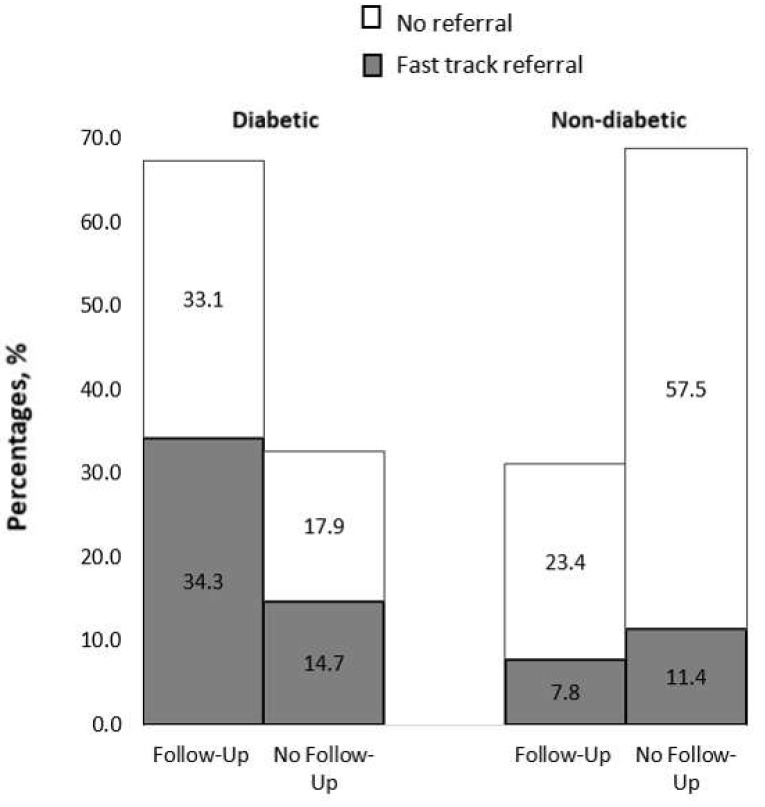 Figure 1
Peer Reviews
No public reviews on file for this paper yet. If you reviewed it on a platform where reviews are public (OpenReview, ICLR, NeurIPS, ICML), you can paste yours below so the community can read it here.
Videos
No videos yet. Explain this paper in a talk, walkthrough, or lecture? Add one.
Taxonomy
TopicsRetinal and Optic Conditions
Error in Figure and Table
In the original publication [1], there was a mistake in Table 1 and Figure 1 as published. The correction pertains to the clarification of data reported in the section regarding annual referrals (Table 1). In Figure 1, there was a mislabeling in the graph legend. The label “Follow-up without referral” should be corrected to “No referral”, as the original label inaccurately represented the data. The corrected Table 1 and Figure 1 appears below.
Text Correction
A correction has been made to Section 3, Results, paragraphs number 2 and number 3. In Table 1, the original total of 341 includes those who were recommended annual rescreening as well those with no mention of annual rescreening. We did not differentiate these two groups in our accepted version. We have now clarified and revised the numbers to 154 (Routine annual) in Table 1. We also have revised the affected sentences pertaining to the changes as follows:
Of the 528 participants, 187 (35%) required referral for ocular conditions and 154 (29%) were recommended for annual rescreening for conditions such as mild NPDR or early AMD, as shown in Table 1. The remaining 187 (35%) participants did not require any referral. Among those referred, six received urgent referrals for conditions such as CRAO, macular hole, PDR, retinal detachment, and retinal emboli. An additional 30 participants were referred within 1–2 weeks (semi-urgent), the majority of which were for PDR at 63% (n = 19), followed by late AMD at 20% (n = 6). Within the three-month referral group, 29% (n = 151) had fast-track referral. Among these, two cases had ungradable images, while 17 cases were referred for monitoring due to “treated stable DR”. When stratified into CKD stages, referral rates for <3 months (n = 161), referral rates increased with CKD progression from, 43% in Stage G3, to 58% in G4, and 72% in G5.
When stratified by diabetes status and follow-up status when available (n = 418) (Figure 1), 67.4% of the 251 participants with diabetes were on annual follow-up. However, 51% of those referred to annual follow-up had to be fast-track referred for conditions like referable DR, glaucoma/glaucoma suspect, ERM, AMD, etc. Of the 167 non-diabetic participants, 31.1% were on follow-up, among whom 7.8% required fast-track referral. Of the non-diabetic participants not on eye follow-up (69% in total), 11% required fast-track referral. Six of the non-diabetic and 12 of the diabetic patients required urgent referral within one week for conditions such as pseudo-holes, impending occlusions, disc swelling, etc.
The authors state that the scientific conclusions are unaffected. This correction was approved by the Academic Editor. The original publication has also been updated.
The reference list from the paper itself. Each links out to its DOI / PubMed record.