Boosting Caloric Performances of Ni-Co-Mn-Ti Shape Memory Alloy for Multi-Scenario Refrigeration by Spark Plasma Sintering
Hongyuan Tang, Ziqi Guan, Yanze Wu, Zhenzhuang Li, Jiaqi Liu, Xing Lu

TL;DR
This paper shows how a specific shape memory alloy can be optimized for refrigeration using spark plasma sintering.
Contribution
The study introduces a new Ni-Co-Mn-Ti alloy processed via spark plasma sintering with enhanced caloric performance for refrigeration.
Findings
The alloy achieved a compressive strength of 2005 MPa and a fracture strain of 27%.
It demonstrated an adiabatic temperature change of up to 34.2 K under specific loading conditions.
A barocaloric effect with an entropy change of 16.1 J·kg−1·K−1 was observed under 100 MPa pressure.
Abstract
In this study, Ni37Co13Mn33.5+xTi16.5–x alloys with different particle sizes (75–150 μm, 50–75 μm, 0–50 μm) were successfully fabricated using spark plasma sintering under different processing conditions. By adjusting the composition of alloy and particle size, a significant transformation entropy change and the generation of a suitable amount of second phases along the grain boundaries were achieved in the SPS Ni37Co13Mn34.5Ti15.5 alloy with a particle size range of 0–50 μm. The mechanical properties of this optimized alloy were excellent, exhibiting a compressive strength of 2005 MPa and a fracture strain of 27%. Furthermore, under a loading rate of 0.28 s−1, the alloy demonstrated an adiabatic temperature change of up to 34.2 K. In addition, the alloy also exhibited a barocaloric effect under low-pressure conditions, achieving a substantial entropy change of 16.1 J·kg−1·K−1 and an…
Genes, proteins, chemicals, diseases, species, mutations and cell lines named across the full text — each resolved to its canonical identifier and authoritative record.
Click any figure to enlarge with its caption.
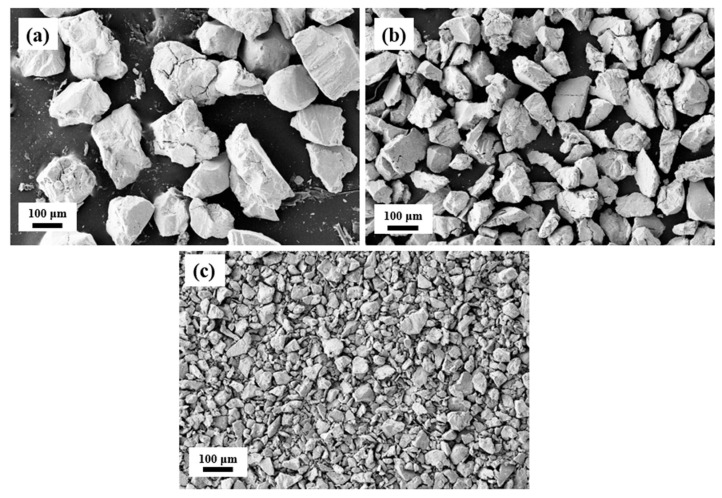 Figure 1
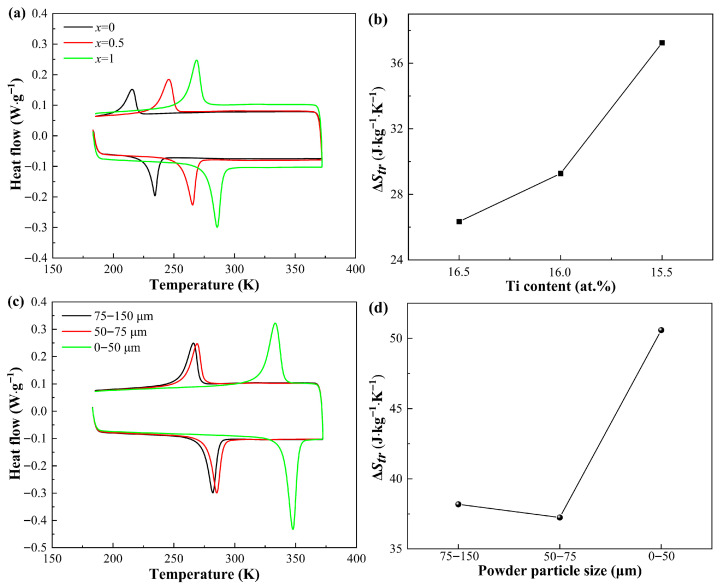 Figure 2
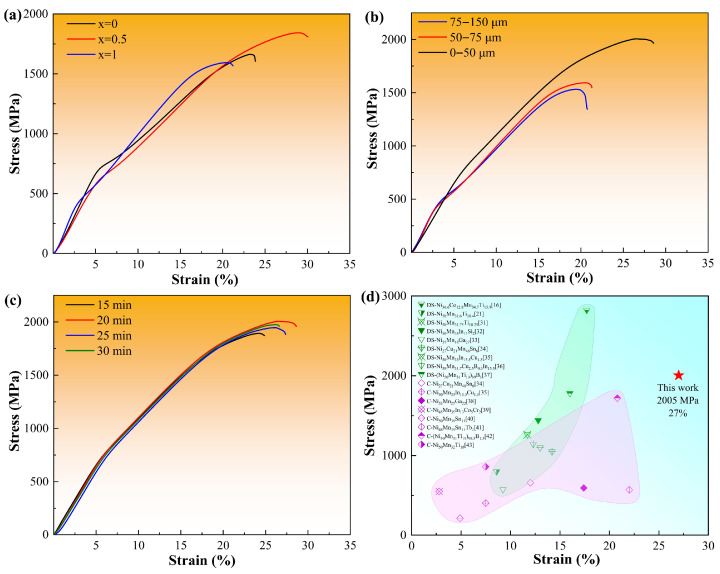 Figure 3
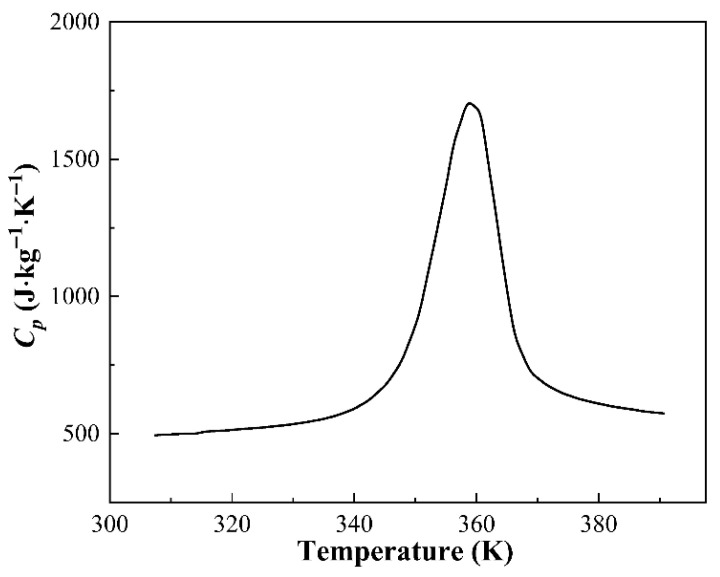 Figure 4
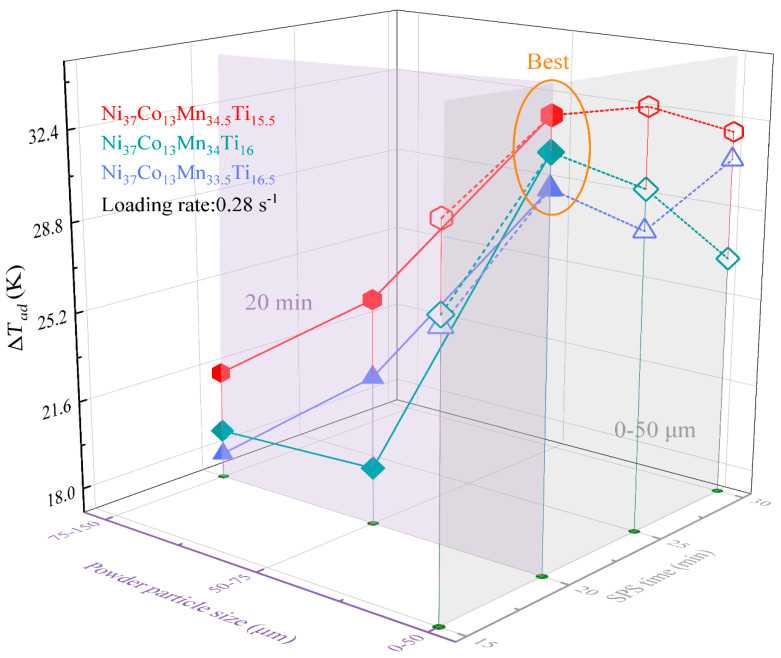 Figure 5
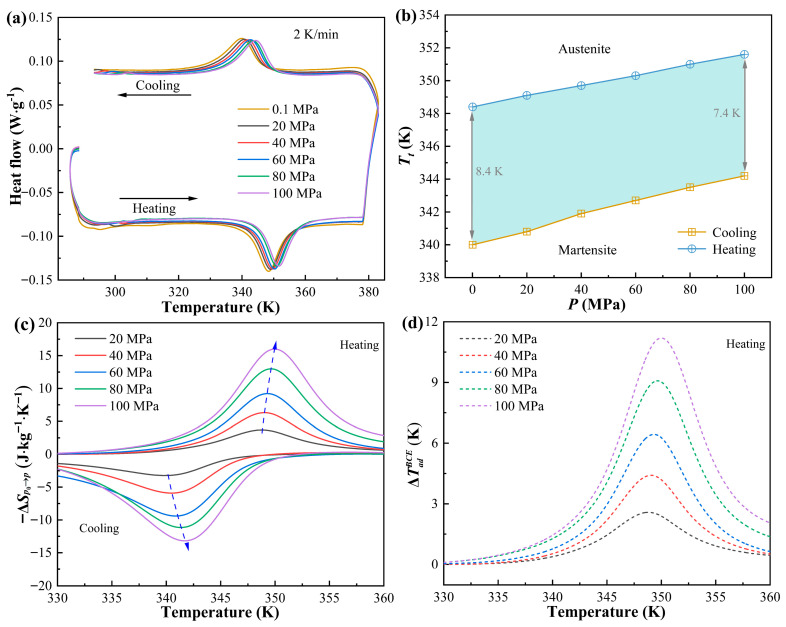 Figure 6
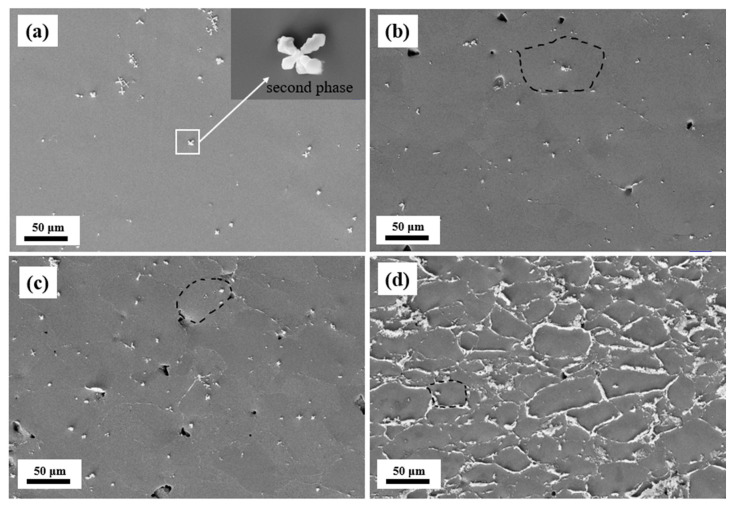 Figure 7
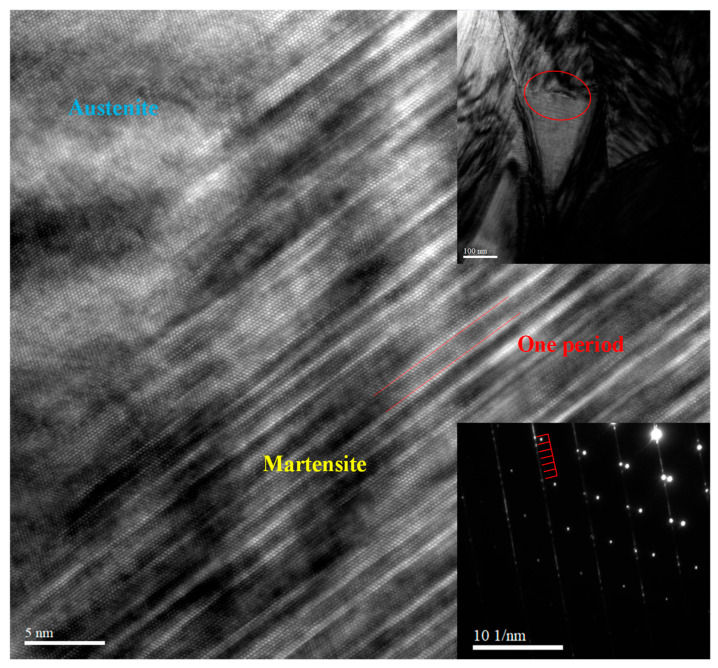 Figure 8
- —National Natural Science Foundation of China
- —Fundamental Research Funds for the Provincial Universities of Liaoning
- —Natural Science Foundation of Liaoning Province
- —Postdoctoral Fellowship Program of China Postdoctoral Science Foundation
- —Innovation Fund of Institute of Metal Research, CAS
Peer Reviews
No public reviews on file for this paper yet. If you reviewed it on a platform where reviews are public (OpenReview, ICLR, NeurIPS, ICML), you can paste yours below so the community can read it here.
Videos
No videos yet. Explain this paper in a talk, walkthrough, or lecture? Add one.
Taxonomy
TopicsShape Memory Alloy Transformations · Magnetic and transport properties of perovskites and related materials · Advanced Thermoelectric Materials and Devices
1. Introduction
Refrigeration has become an increasingly essential aspect of modern life [1]. However, conventional refrigeration technologies, such as vapor compression systems, have been identified as significant contributors to global warming. This environmental impact underscores the urgent need for the development of novel, eco-friendly refrigeration technologies [2]. In the past few years, solid-state refrigeration based on shape memory alloys (SMAs) exhibiting various caloric effects has drawn considerable attention and is recognized as a promising alternative to traditional refrigeration systems [3]. The caloric effect refers to the adiabatic temperature change (ΔT_ad_) and isothermal entropy change (ΔS_iso_) induced in a material under the influence of an external field. These changes are primarily driven by the latent heat exchange related to reversible martensitic transformation (MT) [4,5]. Several types of caloric effects have been identified, including the magnetocaloric effect (MCE) [6,7], barocaloric effect (BCE) [8], electrocaloric effect (ECE) [9], and elastocaloric effect (eCE) [10,11]. Among these, the eCE, triggered by uniaxial stress fields, has demonstrated remarkable efficiency and practical implementation feasibility. As a result, it is widely considered the most promising candidate for real-world refrigeration applications [2,12].
Recently, significant attention has been focused on developing novel multifunctional materials, particularly Ni-(Co)-Mn-Z (Z = Ga, In, Sn, Sb, Ti) Heusler-type SMAs, which undergo a first-order MT from austenite to martensite upon cooling [3,7,13,14]. Among these materials, all-d-metal Heusler-type Ni-(Co)-Mn-Ti SMAs have emerged as promising candidates for solid-state refrigeration applications due to their excellent eCE properties [15,16,17]. Despite their attractive caloric properties, arc-melted Ni-(Co)-Mn-Ti SMAs generally exhibit poor mechanical performance, limiting their practical application. Enhancing the preferred orientation of these alloys has been shown to improve both their caloric effects and mechanical properties. Consequently, advanced techniques such as single-crystal growth and directional solidification have been utilized to improve the mechanical properties of these materials [18,19,20]. Several studies have illustrated that Ni-Mn-based Heusler alloys prepared via these methods can achieve remarkable mechanical strength. For instance, a dendritic-like Ni_50_Mn_31.6_Ti_18.4_ single-crystal alloy has achieved a high compressive strength exceeding 800 MPa [21]. Similarly, directional solidification has been shown to produce alloys with notably improved mechanical properties. The directionally solidified (Ni_50_Mn_28_Fe_2.5_Ti_19.5_)99.4_B_0.6 alloy exhibited a remarkable compressive strength of 2734 MPa [22,23,24]. While both single-crystal growth and directional solidification effectively improve mechanical performance, these methods are often complex, time-consuming, and costly. Therefore, there is a pressing need to develop a rapid, cost-effective method for producing SMAs with improved mechanical properties, enabling their practical application in solid-state refrigeration systems. In this context, spark plasma sintering (SPS) has emerged as an efficient and economical technique for alloy preparation. SPS has demonstrated significant potential in enhancing the mechanical properties of alloys [25,26]. Notably, sintered Ni-Mn-In alloys produced via SPS have exhibited impressive mechanical properties, achieving a compressive strength of 1800 MPa and a fracture strain of 19.3% [27]. These performance levels substantially exceed those of their arc-melted counterparts. This highlights the strong potential of SPS as a viable method for producing high-performance SMAs suitable for practical refrigeration applications.
In this study, the MT behaviors, including transformation temperatures (M_s_, M_f_, A_s_, and A_f_), MT entropy change (ΔS_tr_), mechanical properties, eCE and BCE of Ni_37_Co_13_Mn_33.5+xTi_16.5–x (x = 0, 0.5, 1) alloys with different powder particle sizes prepared via SPS were systematically investigated. The compressive strength of the alloys with various compositions was assessed, revealing that the Ni_37_Co_13_Mn_34.5_Ti_15.5_ alloy sintered using 0–50 μm powder achieved an impressive compressive strength of 2005 MPa. Furthermore, a remarkable ΔT_ad_ up to 34.2 K was achieved under a loading rate of 0.28 s^−1^. In addition to its outstanding eCE properties, this alloy demonstrated significant BCE performance under low-pressure. With increasing pressure, the MT temperature exhibited a gradual rise, with a temperature shift rate (dT/dP) of 0.042 K·MPa^−1^. The entropy change value of barocaloric (ΔS_BCE_) reached 16.1 J·kg^−1^·K^−1^ under 100 MPa pressure, confirming the alloy’s efficient BCE behavior at low-pressure. These findings highlight that the SPS Ni-(Co)-Mn-Ti alloy, optimized in terms of composition and preparation conditions, successfully integrates excellent functional performance with enhanced mechanical properties. Consequently, this alloy presents itself as a potential candidate for future solid-state refrigeration applications.
2. Experiments
We initially prepared the Ni_37_Co_13_Mn_33.5+xTi_16.5–x (x = 0, 0.5, 1) alloys using conventional arc-melted. The arc-melted alloys were subsequently annealed at 1223 K for 48 h and quenched in water. The annealed samples were then mechanically ground into alloy powders, which were sieved into three distinct particle size ranges: 0–50 μm, 50–75 μm, and 75–150 μm, following the national standard sieve method. The micrographs illustrating the different powder sizes for the Ni_37_Co_13_Mn_34.5_Ti_15.5_ alloy are presented in Figure 1. The prepared powders were annealed at 873 K for 6 h before undergoing the sintering process. Sintering was conducted under a vacuum of 8 Pa with an applied pressure of 50 MPa at a temperature of 1223 K. The sintering duration varied among the samples, lasting 15, 20, 25, and 30 min, respectively. The same parameters were used to prepare Ni_37_Co_13_Mn_33.5_Ti_16.5_ alloy in our prior work [28], and this alloy exhibited excellent properties. Finally, the sintered samples were annealed once again at 1223 K for 24 h and subsequently quenched in water to enhance their properties.
A Differential Scanning Calorimetry Analyzer (DSC: TA-Q100, TA Instrument, Delaware, USA) was used to test the MT temperatures of each alloy using with a heating and cooling rate of 10 K·min^−1^. The specific heat capacity (C_p_) of Ni_37_Co_13_Mn_34.5_Ti_15.5_ alloy was also tested using this DSC analyzer with a heating rate of 2 K·min^−1^ from 300 K to 400 K. The mechanical properties of each alloy were measured on a universal mechanical testing machine (Shimadzu AG-Xplus/50 kN) equipped with a heating oven. The values of ΔT_ad_ induced by external stress were measured at the temperature of A_f_ +15 K by a K-type thermocouple clamped in the center of the sample surface. The microstructure of the alloys was observed by ZEISS SUPRA 55 scanning electron microscope (SEM, ZEISS, Baden-Württemberg, German), and imaging was performed using the secondary electron (SE) mode. The compositions of the alloys were determined by energy-dispersive spectroscopy (EDS), and the results averaged five different areas. Cylindrical samples (∅ = 3 mm, h = 300 μm) were cut from the SPS samples, then the samples were first ground to a thickness of 70–80 μm, followed by electrochemical polishing. These samples were prepared for the high-resolution transmission electron microscope (HRTEM), and it was utilized to determine the crystallographic characteristics of the martensite and austenite phases.
3. Results and Discussion
Figure 2a displays the DSC curves of Ni_37_Co_13_Mn_33.5+xTi_16.5–x (x = 0, 0.5, 1) alloys sintered with 50–75 μm powder. It can be noted that as the Ti content decreases, the characteristic transformation temperatures progressively increase. This behavior can be attributed to the connection between the MT temperatures and the valence electron concentration (e/a) [29,30]. Generally, the MT temperatures tend to rise with increasing e/a values, which is directly influenced by the gradual substitution of Ti with Mn in the alloy composition [10]. Moreover, it is apparent that the characteristic transformation temperatures for all Ni_37_Co_13_Mn_33.5+xTi_16.5–x (x = 0, 0.5, 1) alloys are below room temperature (RT), indicating that these alloys predominantly exist in the austenitic phase at RT. Figure 2b shows the ΔS_tr_ for the same set of alloys. It is noteworthy that the ΔS_tr_ value increases progressively with the increase in Mn content. Among the examined compositions, the Ni_37_Co_13_Mn_34.5_Ti_15.5_ alloy exhibits the largest entropy change of 37.25 J·kg^−1^·K^−1^, making it a highly promising candidate for achieving an exceptional eCE near RT. Figure 2c illustrates the DSC curves of Ni_37_Co_13_Mn_34.5_Ti_15.5_ alloy sintered with powder of different particle sizes. The characteristic temperature rises with the reduction in the powder particle size. Figure 2d displays the ΔS_tr_ of Ni_37_Co_13_Mn_34.5_Ti_15.5_ alloy with different particle size. It can be clearly observed that the ΔS_tr_ value of 0–50 μm Ni_37_Co_13_Mn_34.5_Ti_15.5_ alloy is 50.59 J·kg^−1^·K^−1^, which is extremely higher than those of the other two alloys. This indicates that reducing the particle size during SPS can improve the ΔS_tr_ of the alloy.
The eCE in SMAs originates from stress-induced martensitic transformation, making outstanding mechanical properties a crucial prerequisite for reaching remarkable elastocaloric performance. In this work, the compressive strength of the sintered Ni_37_Co_13_Mn_33.5+xTi_16.5–x (x = 0, 0.5, 1) alloys with different powder particle sizes and SPS times were carried out at RT. Figure 3a presents the stress–strain curves for the sintered Ni_37_Co_13_Mn_33.5+xTi_16.5–x (x = 0, 0.5, 1) alloys with a particle size range of 50–75 μm and an SPS duration of 20 min. The results indicate that these sintered alloys exhibit relatively high compressive strength, consistent with our previous findings [28]. Figure 3b shows the stress–strain curves for the sintered Ni_37_Co_13_Mn_34.5_Ti_15.5_ alloys with different particle sizes, where the SPS time was kept constant at 20 min. The results demonstrate that the compressive strength improves progressively as the particle size decreases. Notably, when the particle size is reduced to less than 50 μm, the compressive strength is measured to be 2005 MPa and the fracture strain reaches 27%. These values reflect significant enhancements of 30.9% (from 1532 MPa) and 42.1% (from 19%), respectively, compared to samples with particle sizes in the 75–150 μm range. Figure 3c illustrates the relationship between compressive strength and SPS time for the Ni_37_Co_13_Mn_34.5_Ti_15.5_ alloys with a particle size of 0–50 μm. The results reveal minimal variation in compressive strength with different SPS time, suggesting that once the composition and particle size are established, the SPS time has a negligible impact on the compressive strength. Moreover, as shown in Figure 3d, the compressive strength of the sintered Ni_37_Co_13_Mn_34.5_Ti_15.5_ alloy significantly exceeds that of most Ni-Mn-based Heusler SMAs obtained by as-cast or directional solidification, where DS represents directional solidified alloys, and C represents as-cast alloys. Furthermore, Table 1 lists preparation parameters and strength of some sintered alloy, it can be seen that the alloy prepared by the sintering method and parameters described in this study has a relatively high strength that exceeds most conventional sintered alloys. This highlights that SPS technology can effectively enhance the mechanical properties of Ni-Mn-Ti-based SMAs, thereby providing favorable conditions for achieving improved elastocaloric performance.
To estimate the ideal ΔT_ad_ for the eCE, the heat capacity C_p_ in relation to temperature was measured, as shown in Figure 4. The ideal adiabatic temperature change without energy dissipation (Δ ) for sintered Ni_37_Co_13_Mn_34.5_Ti_15.5_ alloy with the particle size of 0–50 μm and a sintering time of 20 min can be calculated by Δ = (T_0_·ΔS_tr_)/C_p_ [31], where T_0_ is 346.2 K, ΔS_tr_ is 50.59 J·kg^−1^·K^−1^ determined from Figure 2d, and C_p_ is confirmed from Figure 4. Based on this calculation, the estimated Δ for the sintered Ni_37_Co_13_Mn_34.5_Ti_15.5_ alloy is 35.7 K, demonstrating substantial potential for elastocaloric refrigeration applications. This result highlights the alloy’s ability to achieve significant temperature change under adiabatic conditions, further emphasizing its suitability as a promising alternative for solid-state refrigeration technology.
Figure 5 presents the measured ΔT_ad_ values for SPS Ni_37_Co_13_Mn_33.5+xTi_16.5–x (x = 0, 0.5, 1) alloys under various conditions. The measurements were performed at a constant test temperature of A_f_ +15 K, with samples subjected to a target strain of 15% at a loading rate of 0.28 s^−1^. The results reveal a clear trend: ΔT_ad_ increases as the Ti content decreases when the powder particle size and SPS time remain constant. This enhancement is attributed to the gradual increase in ΔS_tr_ as Mn gradually replaces Ti, as illustrated in Figure 2b. This is because the value of ΔS_tr_ increases with the powder particle size becomes gradually smaller. Additionally, when composition and SPS time are fixed, ΔT_ad_ shows a noticeable increase with decreasing particle size. Conversely, when composition and particle size are fixed, ΔT_ad_ first rises and then declines with increasing SPS time. Remarkably, a colossal ΔT_ad_ of 34.2 K was achieved in Ni_37_Co_13_Mn_34.5_Ti_15.5_ alloy under optimal conditions (0–50 μm particle size and 20 min SPS time), which corresponds to 95.8% of the ideal adiabatic temperature change Δ (i.e., 35.7 K determined by Figure 4). Moreover, this outstanding ΔT_ad_ value (i.e., 34.2 K) surpasses those reported for Heusler-type Ni-Mn-based SMAs fabricated by traditional arc-melted and directional solidification methods, as summarized in Table 2. These results highlight the significant potential of the SPS Ni_37_Co_13_Mn_34.5_Ti_15.5_ alloy as a promising replacement for high-performance solid-state refrigeration applications.
The SPS Ni_37_Co_13_Mn_34.5_Ti_15.5_ alloy, which exhibits the most enhanced eCE, was further investigated for its BCE. The DSC curves of the samples, as illustrated in Figure 6a, reveal that the MT temperature increases with higher applied pressure. This behavior suggests that loading pressure is as effective as cooling in stabilizing the martensitic phase. From the results in Figure 6a, the peak temperatures of the forward (Mp) and inverse (Ap) MT shifts with pressure (dT/dP) for the 0–50 μm alloy were calculated to be 0.032 K·MPa^−1^ and 0.042 K·MPa^−1^, respectively. These values indicate that the present alloy’s Ap and Mp temperatures are relatively sensitive to hydrostatic pressure, signifying its potential to achieve a substantial BCE. Figure 6b shows the Ap and Mp of SPS Ni_37_Co_13_Mn_34.5_Ti_15.5_ alloy under varying pressures. The thermal hysteresis (Ap−Mp) declines from 8.4 K to 7.4 K as the pressure rises from 0 to 100 MPa. The reduction in thermal hysteresis is highly desirable as it can improves cycling stability and minimizes energy loss during repeated thermal cycles. The temperature dependence of the ΔS_BCE_ and Δ values reached 16.1 J·kg^−1^·K^−1^ and 11.2 K under 100 MPa pressure, respectively. These values are higher than some typical barocaloric metallic materials, including Ni_58.3_Mn_17.1_Ga_24.6_ alloy (i.e., 13.6 J·kg^−1^·K^−1^ under 1050 MPa) [63], Ni_44.6_Co_5.5_Mn_35.5_In_14.4_ alloy (i.e., 15.6 J·kg^−1^·K^−1^ under 598 MPa) [64], (MnNiGe)0.91-(FeCoGe)0.09 alloy (i.e., 5.2 K under 100 MPa) [65], and (MnCoGe)0.96-(CuCoSn)0.04 alloy (i.e., 3.4 K under 30 MPa) [66]. These findings demonstrate that the SPS Ni_37_Co_13_Mn_34.5_Ti_15.5_ alloy exhibits outstanding BCE performance under relatively low-pressure, highlighting its considerable potential for practical applications in solid-state refrigeration systems.
The above results clearly demonstrate that SPS technology is highly effective in strengthening the mechanical properties of SMAs. Building on this foundation, the SPS Ni_37_Co_13_Mn_34.5_Ti_15.5_ alloy exhibited remarkable eCE and BCE. To investigate the fundamental mechanism responsible for the exceptional properties of the sintered SMAs, a detailed microstructure analysis was conducted on both the arc-melted and SPS Ni_37_Co_13_Mn_34.5_Ti_15.5_ alloys with varying powder particle sizes (75–150 μm, 50–75 μm, and 0–50 μm), as shown in Figure 7. Figure 7b–d further illustrate that as the powder particle size decreases, the grain size (surrounded by black dashed lines) also decreases, leading to an increase in the number of grain boundaries. The increase in grain boundaries introduces greater resistance to dislocation movement under external stress, thereby enhancing the mechanical strength of the alloys [67]. Moreover, distinct precipitates existed in both the arc-melted and SPS alloys, which were predominantly located alongside the grain boundaries. In addition, the second phase inside the grain, as shown in the inset of Figure 7a, is Ti-rich second phase (Ti content: 78.7 at.%). Notably, in the SPS alloys, the amount of these precipitates increased progressively with decreasing powder particle size. This trend aligns with our previous observations in sintered Ni_37_Co_13_Mn_33.5_Ti_16.5_ alloys [28]. In general, the finer the grain size of an alloy, the higher its strength. Additionally, the segregation of secondary phases at grain boundaries can effectively prevent the alloy from intergranular fracture. The combination of reduced grain size and increased second-phase precipitates along grain boundaries is identified as the key factor contributing to the significant improvement of the mechanical properties in the SPS alloys. To further elucidate the composition of the matrix and the precipitates, EDS analysis (error bars: ±0.2%) was conducted, as presented in Table 3. The EDS results confirm that the matrix phase in the cast alloy aligns well with the nominal composition. Meanwhile, the precipitates observed in the SPS Ni_37_Co_13_Mn_34.5_Ti_15.5_ alloys were found to be rich in Ti and deficient in Mn and Ni, as displayed in Table 3. This suggests that the Ti element tends to segregate along the grain boundaries during the SPS process, forming a Ti-rich second phase that plays a critical role in strengthening the mechanical properties of the present alloy.
As previously demonstrated, the mechanical properties of the SPS Ni_37_Co_13_Mn_34.5_Ti_15.5_ alloy were significantly improved through grain refinement, achieved by reducing the powder particle size (Figure 7). To further investigate the presence of fine precipitates within the grains of the SPS Ni_37_Co_13_Mn_34.5_Ti_15.5_ alloy, HRTEM analysis was conducted. The HRTEM observations confirmed the existence of a small amount of fine precipitates within the grains (Figure 8 and the upper inset of Figure 8), which aligns with the SEM results (Figure 7). Furthermore, the microstructural examination revealed the coexistence of martensite and austenite phases within the selected region, as depicted in Figure 8. Through observing the selected area electron diffraction (SAED) pattern (the lower inset of Figure 8), it can be seen that there are five secondary diffraction spots between the two main diffraction spots, which is a typical feature of the martensite structure. This characteristics of such diffraction spots confirmed that the martensite phase adopts a six-layered modulated (6M) structure, while the austenite phase exhibits a cubic B2 structure. The presence of the 6M martensitic structure can enhance the homogenization of the atomic structure, which facilitates the occurrence of phase transformation, thereby improve the caloric effects of the alloy. These findings are consistent with previous reports [28,68], further validating the microstructural characteristics of the SPS Ni_37_Co_13_Mn_34.5_Ti_15.5_ alloy.
It is well known that the presence of an appropriate amount of second-phase precipitates distributed along grain boundaries can effectively enhance the mechanical properties of certain alloys [69]. In the present work, the observed increase in Ti-rich second-phase precipitates alongside the grain boundaries significantly contributes to strengthening grain boundary cohesion and impeding intergranular fracture [19]. This enhanced cohesion effectively inhibits crack initiation and propagation along grain boundaries, thereby making the overall mechanical properties of the alloy better. The enhancement in mechanical performance can be ascribed to two primary factors. Firstly, grain refinement increases the number of grain boundaries, which serves as an effective barrier to crack propagation. Secondly, the increased presence of Ti-rich second-phase precipitates along the grain boundaries further strengthens their cohesion, acting as a robust obstacle to crack formation and intergranular fracture. These combined effects provide a solid foundation for the remarkable mechanical properties observed in the SPS Ni_37_Co_13_Mn_34.5_Ti_15.5_ alloy.
4. Conclusions
In conclusion, the MT temperature, ΔS_tr_, mechanical properties, eCE, and BCE of the Ni_37_Co_13_Mn_33.5+xTi_16.5–x (x = 0, 0.5, 1) sintered alloys were comprehensively investigated. Notably, the sintered Ni_37_Co_13_Mn_34.5_Ti_15.5_ alloy with a particle size of 0–50 μm exhibited an impressive ΔS_tr_ of 50.59 J·kg^−1^·K^−1^. The alloy also achieved exceptional mechanical properties, with a maximum compressive strength of 2005 MPa and a fracture strain of 27% at RT. Microstructural analysis via SEM and TEM revealed that the enhanced mechanical strength is due to the increased presence of Ti-rich second phases along the grain boundaries, which strengthen grain boundary cohesion and effectively impede intergranular fracture. Furthermore, a remarkable ΔT_ad_ of 34.2 K was achieved under a high strain rate of 0.28 s^−1^, underscoring the alloy’s promising potential for practical elastocaloric refrigeration applications. In addition, the alloy demonstrated an outstanding barocaloric performance, achieving a great ideal Δ of 11.2 K under a low pressure of 100 MPa. These results demonstrate that the SPS Ni_37_Co_13_Mn_34.5_Ti_15.5_ alloy successfully combines excellent mechanical properties with superior eCE and BCE performance, making it a highly potential candidate for efficient solid-state refrigeration applications in both high-pressure eCE and low-pressure BCE scenarios.
The reference list from the paper itself. Each links out to its DOI / PubMed record.
- 1Zhao Z. Guo W. Zhang Z. Room-Temperature Colossal Elastocaloric effects in three-dimensional graphene architectures: An atomistic study Adv. Funct. Mater.202232220386610.1002/adfm.202203866 · doi ↗
- 2Panchenko E.Y. Yanushonite E.I. Eftifeeva A.S. Tokhmetova A.B. Kurlevskaya I.D. Tagiltsev A.I. Surikov N.S. Timofeeva E.E. Chumlyakov Y.I. Elastocaloric Effect in aged single crystals of Ni 54Fe 19Ga 27 ferromagnetic shape memory alloy Metals 202212139810.3390/met 12081398 · doi ↗
- 3Li Z. Li Z. Yang J. Li D. Yang B. Yan H. Nie Z. Hou L. Li X. Zhang Y. Large elastocaloric effect in a polycrystalline Ni 45.7Co 4.2Mn 37.3Sb 12.8 alloy with low transformation strain Scr. Mater.201916248649110.1016/j.scriptamat.2018.12.019 · doi ↗
- 4Bonnot E. Romero R. Mañosa L. Vives E. Planes A. Elastocaloric Effect Associated with the Martensitic Transition in Shape-Memory Alloys Phys. Rev. Lett.200810012590110.1103/physrevlett.100.12590118517885 · doi ↗ · pubmed ↗
- 5Wang Y. Liu C. Wang H. Li Z. Li J. Yang B. Yan H. Zuo L. Effect of burst-type martensitic transformation on superelastic and elastocaloric properties in a <116> oriented Cu 70.5Al 17.5Mn 12 single crystal Scr. Mater.202424611609210.1016/j.scriptamat.2024.116092 · doi ↗
- 6Bez H.N. Pathak A.K. Biswas A. Zarkevich N. Balema V. Mudryk Y. Johnson D.D. Pecharsky V.K. Giant enhancement of the magnetocaloric response in Ni–Co–Mn–Ti by rapid solidification Acta Mater.201917322523010.1016/j.actamat.2019.05.004 · doi ↗
- 7Yang J. Li Z. Zhang X. Yang B. Yan H. Cong D. Zhao X. Zuo L. Manipulation of thermal hysteresis and magnetocaloric effect in the Ni-Co-Mn-In alloys through lattice contraction: Effect of Ge substitution for In Acta Mater.202324611869410.1016/j.actamat.2023.118694 · doi ↗
- 8Kosugi Y. Goto M. Tan Z. Fujita A. Saito T. Kamiyama T. Chen W. Chuang Y. Sheu H. Kan D. Colossal Barocaloric Effect by Large Latent Heat Produced by First-Order Intersite-Charge-Transfer Transition Adv. Funct. Mater.202131200947610.1002/adfm.202009476 · doi ↗