Correction: Di Lorenzo et al. Staff Attitude Towards Coercive Measures in Hospital and Community Psychiatric Settings. J. Clin. Med. 2025, 14, 2886
Rosaria Di Lorenzo, Francesca Mucchi, Nadia Magnani, Fabrizio Starace, Jessica Bonisoli, Carolina Bottone, Ilaria Ragazzini, Paola Ferri, Donatella Marrama

Abstract
Genes, proteins, chemicals, diseases, species, mutations and cell lines named across the full text — each resolved to its canonical identifier and authoritative record.
Click any figure to enlarge with its caption.
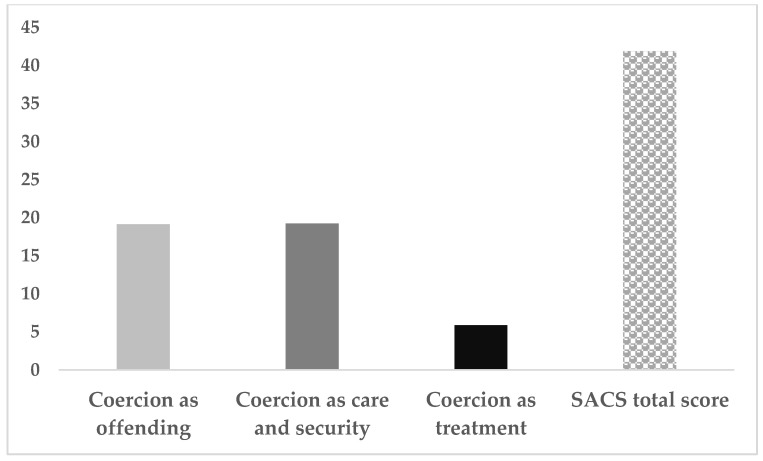 Figure 1
Peer Reviews
No public reviews on file for this paper yet. If you reviewed it on a platform where reviews are public (OpenReview, ICLR, NeurIPS, ICML), you can paste yours below so the community can read it here.
Videos
No videos yet. Explain this paper in a talk, walkthrough, or lecture? Add one.
Taxonomy
TopicsHealthcare Decision-Making and Restraints · Ethics in medical practice · Ethics and Legal Issues in Pediatric Healthcare
Text Correction
There were three errors in the original publication [1].
- (1)A correction has been made to the Abstract, regarding the definition of SACS score increase and decrease, which were reversed (the correction is in bold).
Abstract Background/Objectives: The use of coercive measures in psychiatry is an ethically controversial issue. Staff attitude towards coercive measures could explain the different application frequencies of coercive measures across psychiatric services. Methods: We analyzed the attitude towards coercion held by professionals working in a psychiatric department using the Staff Attitude to Coercion Scale (SACS). We statistically evaluated the correlation between the SACS score and the demographic and work characteristics of professionals. Results: The most represented category of participants was nurses (73.03%). Most professionals worked in a Mental Health Community Service (MHCS) (72.09%). We reported a score of 41.9 ± 8.8 SD in total SACS and high scores in two SACS factors: “Coercion as offending” and “Coercion as care and security”. Professionals working in Service for Psychiatric Diagnosis and Care (SPDC) showed increased scores in total SACS and reduced the SACS dimension “Coercion as offending” score. Place of work, particularly “working in SPDC”, was statistically significantly associated with total SACS in a positive way and with the “Coercion as offending” score in a negative way in our regression multivariate test. Conclusions: Our professionals showed a predominantly critical and pragmatic attitude towards coercive measures. The professionals who are more frequently exposed to violent and aggressive behavior, such as those who work in SPDC, showed a reduced critical attitude towards coercion in comparison with those working in MHCS, suggesting that exposure to violence can shape the response of professionals.
(2)In the original publication [1], the means and standard deviation of the SACS score were incorrectly reported in Table 2, as published. The corrected Table 2 is reported below (corrections are in bold).(3)In the original publication [1], there was a mistake in Figure 1 as published. The corrected Figure 1 appears below.
The authors state that the scientific conclusions are unaffected. This correction was approved by the Academic Editor. The original publication has also been updated.
The reference list from the paper itself. Each links out to its DOI / PubMed record.