The Impact of Anosmia on Intimacy: A Linear Mixed-Effects Model Analysis of Sexual Wellbeing Following COVID-19
Arianna Miclet, Daniele Mollaioli, Marco Lauriola, Giacomo Ciocca, Andrea Sansone, Emmanuele A. Jannini, Erika Limoncin

TL;DR
This study shows that losing the sense of smell due to COVID-19 can negatively affect sexual experiences, especially the intensity of orgasms over time.
Contribution
The study introduces a novel analysis of how anosmia from COVID-19 affects sexual wellbeing using a linear mixed-effects model.
Findings
Participants without anosmia improved orgasmic intensity post-COVID-19, while those with anosmia experienced a decline.
Anosmia was not a direct predictor of orgasmic intensity but influenced its evolution over time.
The absence of smell may have a long-term negative impact on core sexual experiences like orgasm intensity.
Abstract
Olfaction is thought to have a role in intimate relationships and sexuality, despite the major roles that other senses, like sight, might have for human beings. Moreover, one of the specific symptoms of the COVID-19 infection, a disease largely impacting human sexuality at various levels, has been the absence of smell. This study aimed to examine the impact of olfaction on partner selection and on different phases of sexual response. Moreover, we evaluated whether the absence of smell could influence aspects of sexual function, such as orgasmic intensity, by comparing subjects with and without COVID-19 olfactory dysfunction. A group of 259 participants has been initially enrolled through social media. Of the 138 sexually active subjects included in the final analysis, 61 (44.2%) reported olfactory dysfunction (anosmia group) and 77 (55.8%) did not (no-anosmia group). Perceived orgasmic…
Genes, proteins, chemicals, diseases, species, mutations and cell lines named across the full text — each resolved to its canonical identifier and authoritative record.
Click any figure to enlarge with its caption.
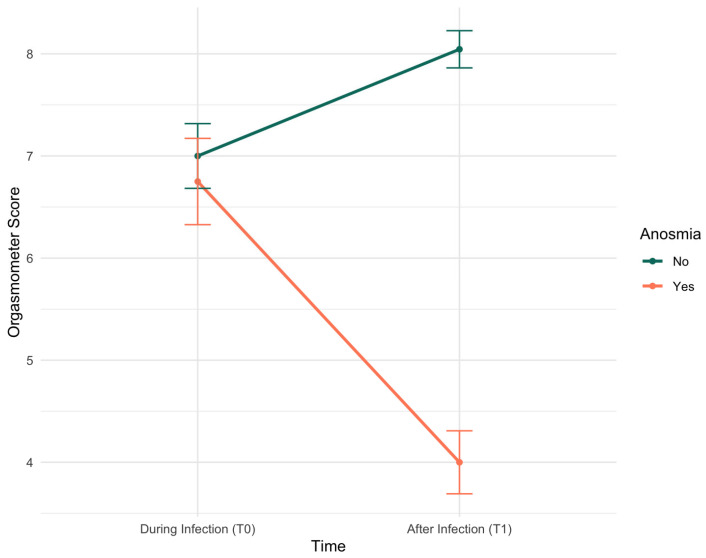 Figure 1
Peer Reviews
No public reviews on file for this paper yet. If you reviewed it on a platform where reviews are public (OpenReview, ICLR, NeurIPS, ICML), you can paste yours below so the community can read it here.
Videos
No videos yet. Explain this paper in a talk, walkthrough, or lecture? Add one.
Taxonomy
TopicsEvolutionary Psychology and Human Behavior · Body Image and Dysmorphia Studies · Eating Disorders and Behaviors