Expected Mitochondrial Haplotype Richness in Remaining Populations of the Critically Endangered European Mink Mustela lutreola and Its Conservation Implications
Jakub Skorupski, Przemysław Śmietana, Christian Seebass, Wolfgang Festl, Alexe Vasile, Natalia Kiseleva, Florian Brandes, Mihai Marinov

TL;DR
This study analyzes mitochondrial diversity in the critically endangered European mink to guide conservation efforts.
Contribution
The study uses complete mitochondrial genomes and advanced estimators to reveal higher haplotype richness than previously known.
Findings
41 haplotypes were detected, but extrapolation suggests much higher richness.
France–Spain and Romania populations show the highest predicted haplotype richness.
Larger sample sizes (70–130 individuals) are needed to fully capture genetic diversity.
Abstract
The European mink Mustela lutreola is one of the most threatened carnivores in Europe, having suffered dramatic range contractions and severe population fragmentation. Accurate knowledge of its genetic diversity is crucial for conservation planning, yet earlier studies based on partial mitochondrial markers offered limited resolution and often underestimated haplotype richness. In this study, complete mitochondrial genomes from four extant populations (Russia, n = 11; Romania, n = 16; Germany, n = 24; France–Spain, n = 15) were analysed using a suite of non-parametric and asymptotic estimators (Fisher’s α, ACE, Jackknife1, Bootstrap, Chao1-based iNEXT) together with negative binomial modelling. A total of 41 haplotypes were detected, but extrapolated estimates indicated substantially higher richness, particularly in populations dominated by singletons. Rarefaction and extrapolation…
Genes, proteins, chemicals, diseases, species, mutations and cell lines named across the full text — each resolved to its canonical identifier and authoritative record.
Click any figure to enlarge with its caption.
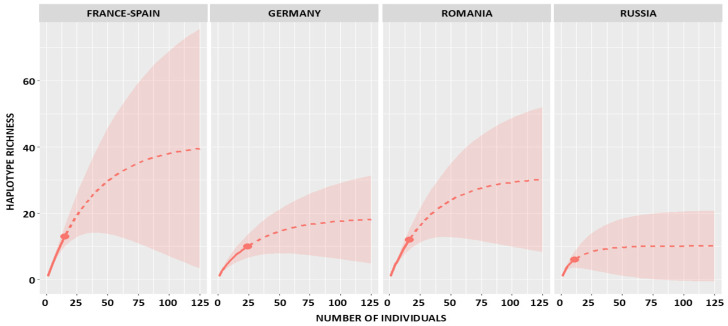 Figure 1
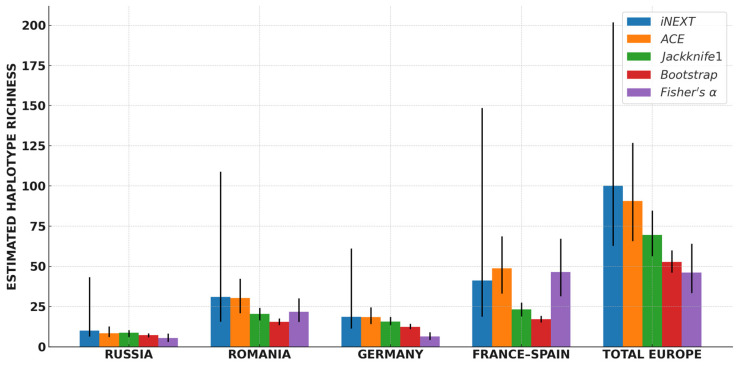 Figure 2
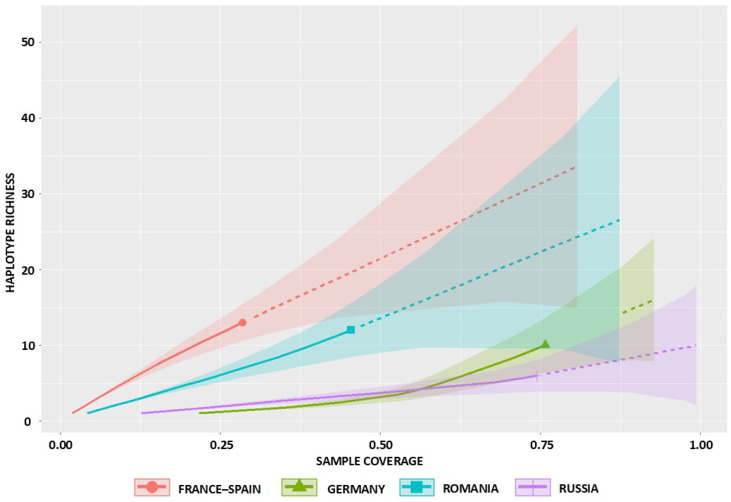 Figure 3
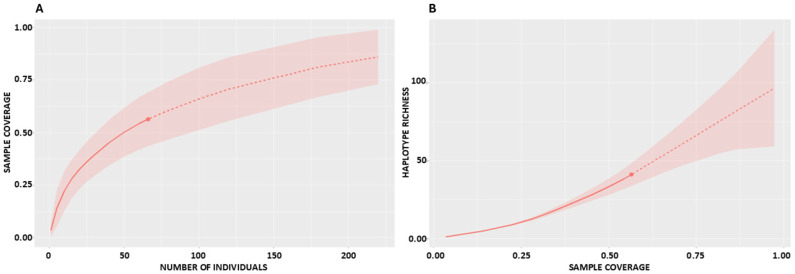 Figure 4
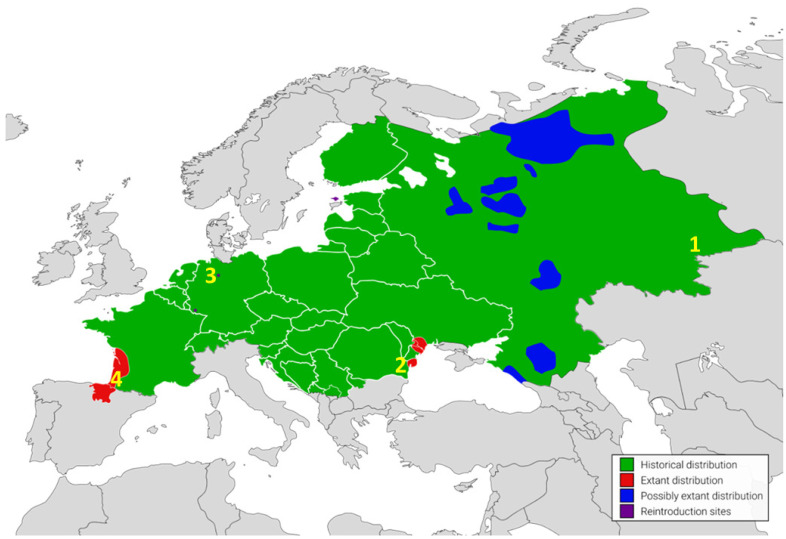 Figure 5
Peer Reviews
No public reviews on file for this paper yet. If you reviewed it on a platform where reviews are public (OpenReview, ICLR, NeurIPS, ICML), you can paste yours below so the community can read it here.
Videos
No videos yet. Explain this paper in a talk, walkthrough, or lecture? Add one.
Taxonomy
TopicsWildlife Ecology and Conservation · Forensic and Genetic Research · Isotope Analysis in Ecology