Dynamic Monitoring of Recurrent Ovarian Cancer Using Serial ctDNA: A Real-World Case Series
Eric Rios-Doria, Jonathan B. Reichel, Marc R. Radke, Enna Manhardt, Mayumi Rubin-Saika, Christina Lockwood, Elizabeth M. Swisher, Kalyan Banda

TL;DR
This study shows that measuring cancer DNA in the blood (ctDNA) can help detect ovarian cancer recurrence earlier than traditional methods in some cases.
Contribution
The study demonstrates the real-world clinical utility of serial ctDNA monitoring in recurrent ovarian cancer patients.
Findings
ctDNA levels generally reflected clinical status and accurately mirrored disease progression and treatment response.
In one case, ctDNA detected cancer recurrence four months before CT scans or blood tests.
Some patients showed clinical progression with undetectable ctDNA, highlighting limitations in sensitivity or biological factors.
Abstract
Ovarian cancer often comes back after the first treatments, but it is hard to detect and monitor in time. Tests like CT scans and blood tests (CA-125) are not always accurate in showing if or when the cancer returns or grows. In this study, we tested whether measuring pieces of cancer DNA found in the blood (circulating tumor DNA or ctDNA) could help detect ovarian cancer earlier and better. We collected serial blood samples from patients over time and found that changes in ctDNA usually matched closely with whether the patient’s cancer was growing or responding to treatment. In one case ctDNA even gave warnings of the cancer returning many months before it could be seen on CT scans or blood tests. However, in a few cases, ctDNA did not show cancer growth. These results suggest that using ctDNA could help make personalized decisions about treatment in ovarian cancer. Recurrent ovarian…
Genes, proteins, chemicals, diseases, species, mutations and cell lines named across the full text — each resolved to its canonical identifier and authoritative record.
Click any figure to enlarge with its caption.
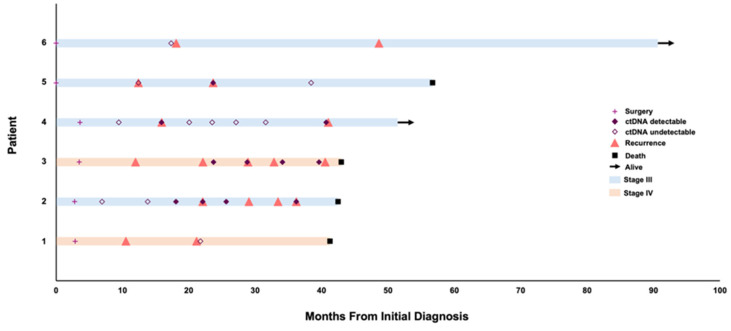 Figure 1
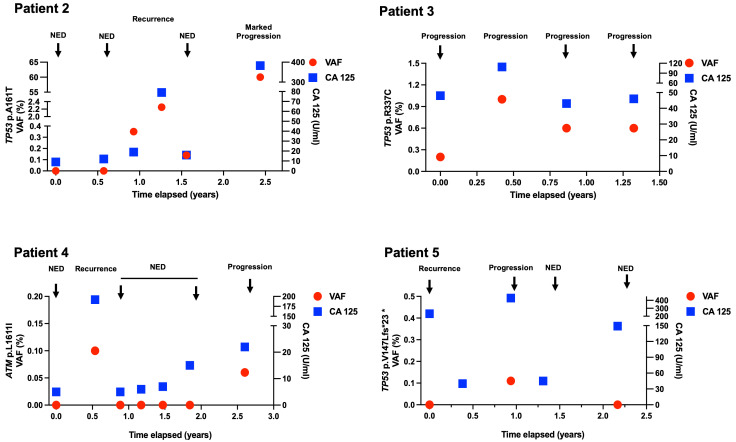 Figure 2
Peer Reviews
No public reviews on file for this paper yet. If you reviewed it on a platform where reviews are public (OpenReview, ICLR, NeurIPS, ICML), you can paste yours below so the community can read it here.
Videos
No videos yet. Explain this paper in a talk, walkthrough, or lecture? Add one.
Taxonomy
TopicsCancer Genomics and Diagnostics · Molecular Biology Techniques and Applications · Single-cell and spatial transcriptomics