Assessment of Cryptosporidium spp. Sub-Families and Giardia duodenalis Assemblages A and B in Ghanaian HIV Patients, Including Socio-Economic, Clinical, and Immunological Associations
Lynn Glyschewski, Hagen Frickmann, Fred Stephen Sarfo, Betty Roberta Norman, Albert Dompreh, Emmanuel Acheamfour-Akowuah, Martin Kofi Agyei, Shadrack Osei Asibey, Richard Boateng, Edmund Osei Kuffour, Veronica Di Cristanziano, Sven Poppert, Felix Weinreich, Albert Eisenbarth

TL;DR
This study examines Cryptosporidium and Giardia infections in Ghanaian HIV patients, finding links between specific parasite sub-types and immune status.
Contribution
The study identifies specific Cryptosporidium sub-families associated with HIV immunosuppression levels and clarifies Giardia's lack of direct HIV link in Ghana.
Findings
Cryptosporidium sub-families Ia and Ib are linked to severe immunosuppression in HIV patients.
C. parvum IIc is found in HIV patients with higher CD4+ T cell counts.
Giardia duodenalis assemblages show no significant association with HIV infection status.
Abstract
Background: Cryptosporidium spp. cause opportunistic infections in immunosuppressed individuals, such as people living with HIV (PLWH). However, the association between giardiasis and HIV infection remains uncertain. This study assessed co-infections in Ghanaian PLWH and HIV-negative individuals, analyzing socio-economic, clinical, and immunological implications, including the Giardia duodenalis assemblage and Cryptosporidium spp. sub-family levels. Methods: Stool samples from Ghanaian PLWH were tested using several real-time PCR assays targeting G. duodenalis at the species level and assemblages A and B to optimize diagnostic accuracy. GD60 gene-based Sanger sequencing was used for Cryptosporidium spp. subtyping. Results were correlated with anonymized patient data to evaluate interactions with HIV infection. Results: In PLWH, C. hominis Ib, C. hominis Ie, and C. parvum IIc were…
Genes, proteins, chemicals, diseases, species, mutations and cell lines named across the full text — each resolved to its canonical identifier and authoritative record.
Click any figure to enlarge with its caption.
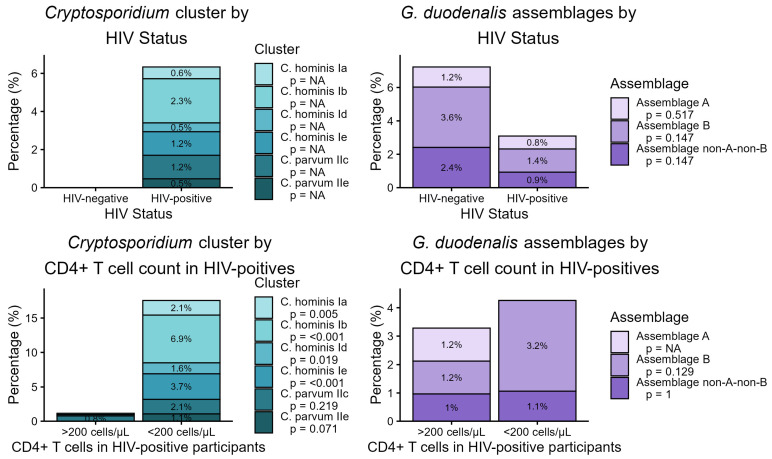 Figure 1
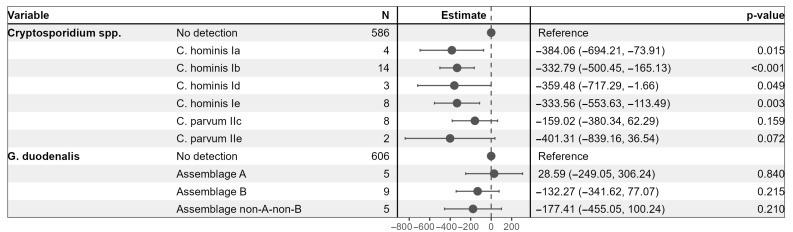 Figure 2
Peer Reviews
No public reviews on file for this paper yet. If you reviewed it on a platform where reviews are public (OpenReview, ICLR, NeurIPS, ICML), you can paste yours below so the community can read it here.
Videos
No videos yet. Explain this paper in a talk, walkthrough, or lecture? Add one.
Taxonomy
TopicsParasitic Infections and Diagnostics · Amoebic Infections and Treatments · Parasites and Host Interactions