A rare subtype of lynch syndrome familial with co-mutation of EpCAM c.344T>C, MSH2 c.2744A>G, PMS2 c.1408C>T and APC c.5465T>A, case report and literature review
Guiyu Lu, Ting Pan, Cuidong Deng, Xiaoqian Wan, Zihan Wang, Tengyue Hu, Xianshuo Cheng, Jian Dong

TL;DR
A rare case of Lynch syndrome with multiple gene mutations is reported, highlighting the importance of thorough genetic testing for early cancer detection.
Contribution
The paper reports a novel co-mutation of EpCAM, MSH2, PMS2, and APC in a rare Lynch syndrome subtype.
Findings
A 25-year-old male with adenocarcinoma had co-mutations in EpCAM, MSH2, PMS2, and APC.
Germline mosaicism was suggested as the son inherited the same mutations.
The mutations suggest a heightened risk of early-onset cancer in this family.
Abstract
Lynch syndrome (LS) is an autosomal dominant disorder caused by germline mutations in mismatch repair (MMR) genes or EpCAM, leading to various cancers, particularly colorectal cancer (CRC). EpCAM mutations account for approximately 1%–3% of LS cases, while co-mutations involving EpCAM and MSH2 are exceedingly rare. To date, co-mutations of EpCAM, MSH2 and PMS2 have not been reported in the literature. This case reports a 25-year-old male diagnosed with adenocarcinoma of the ascending colon. His family history revealed eight cancer cases among 30 relatives across five generations, consistent with LS. Immunohistochemistry (IHC) of the tumor showed loss of EpCAM, MSH2 and MSH6 protein expression. Genetic testing of the proband’s tumor identified a novel large deletion affecting EpCAM exons 8-9 and MSH2 exons 1–16, likely pathogenic mutations disrupting MMR gene function. Whole-exome…
Genes, proteins, chemicals, diseases, species, mutations and cell lines named across the full text — each resolved to its canonical identifier and authoritative record.
Click any figure to enlarge with its caption.
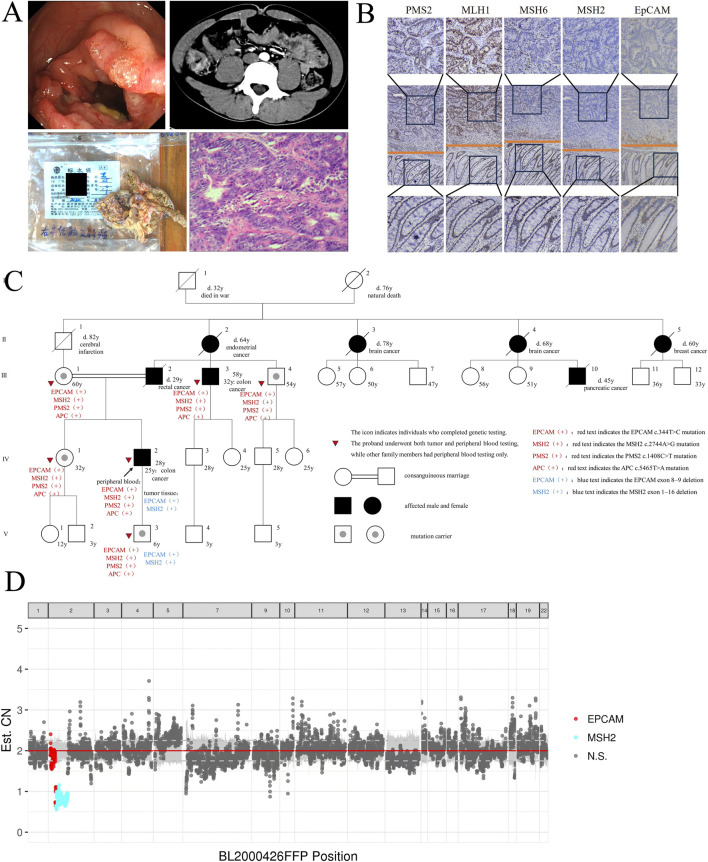 Figure 1
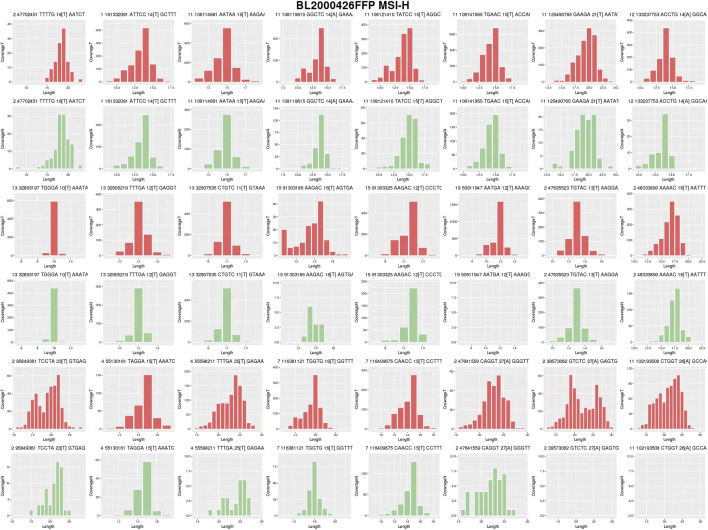 Figure 2
Peer Reviews
No public reviews on file for this paper yet. If you reviewed it on a platform where reviews are public (OpenReview, ICLR, NeurIPS, ICML), you can paste yours below so the community can read it here.
Videos
No videos yet. Explain this paper in a talk, walkthrough, or lecture? Add one.
Taxonomy
TopicsGenetic factors in colorectal cancer · Cancer Genomics and Diagnostics · RNA modifications and cancer