Distribution and Factors Associated with Neisseria gonorrhoeae Cases in Kampala, Uganda, 2016–2020
Fahad Lwigale, Conrad Tumwine, Reuben Kiggundu, Patrick Elungat, Hope Mackline, Dathan M. Byonanebye, Andrew Kambugu, Francis Kakooza

TL;DR
This study analyzed the spread and risk factors for gonorrhea in Kampala, Uganda, finding that younger men are at higher risk and location does not significantly affect infection rates.
Contribution
The study identifies age as the key predictor of N. gonorrhoeae positivity in Kampala, providing insights for targeted public health strategies.
Findings
56% of participants tested positive for N. gonorrhoeae, with no significant spatial variation across Kampala divisions.
Men aged above 24 years were less likely to test positive for N. gonorrhoeae.
Inconsistent or no condom use was associated with a higher risk of N. gonorrhoeae positivity.
Abstract
Background: Gonorrhoea is a common sexually transmitted infection with serious health consequences if not well-treated. Resistance to common therapeutic agents and limited diagnostics further heighten its burden on sexual and reproductive health. This study determined the positivity level, spatial distribution and factors influencing test positivity for Neisseria gonorrhoeae in Kampala, Uganda. Methods: Clinical data and urethral swabs were primarily collected from men with urethritis at 10 high-volume surveillance facilities. Laboratory analysis followed conventional microbiology techniques. Statistical analysis was conducted using R 4.4.3. Results: Among 1663 participants, 923 (56%, 95% CI: 53–58%) tested positive for N. gonorrhoeae, with comparable levels in Kampala divisions. Co-positivity of HIV and N. gonorrhoeae ranged from 5–27%. At bivariable analysis, there was a lower risk of…
Genes, proteins, chemicals, diseases, species, mutations and cell lines named across the full text — each resolved to its canonical identifier and authoritative record.
Click any figure to enlarge with its caption.
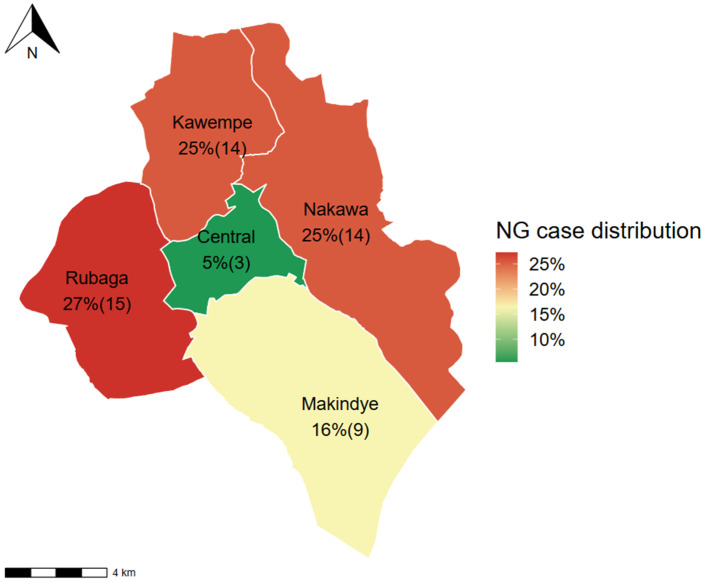 Figure 1
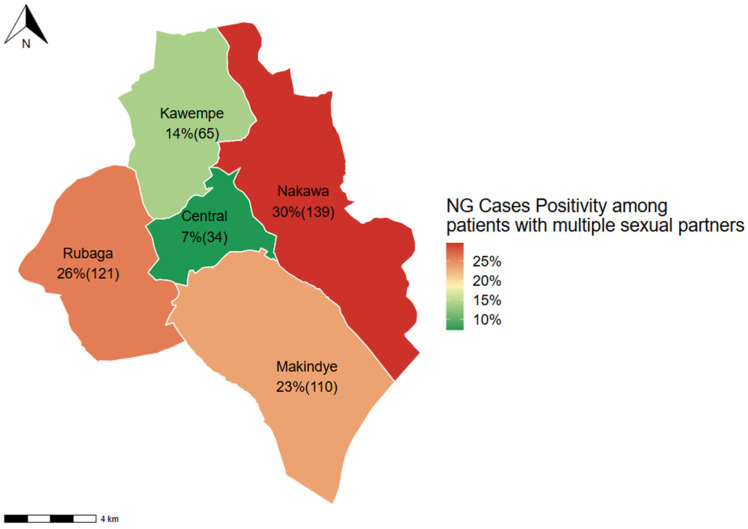 Figure 2
Peer Reviews
No public reviews on file for this paper yet. If you reviewed it on a platform where reviews are public (OpenReview, ICLR, NeurIPS, ICML), you can paste yours below so the community can read it here.
Videos
No videos yet. Explain this paper in a talk, walkthrough, or lecture? Add one.
Taxonomy
TopicsReproductive tract infections research · Syphilis Diagnosis and Treatment · Adolescent Sexual and Reproductive Health