Phase Ib/II Study of Pamiparib Plus Radiation Therapy and/or Temozolomide in Adult Patients with Treatment-Naïve or Recurrent/Refractory Glioblastoma
Anna F. Piotrowski, Kent Shih, Pierre Giglio, Howard Colman, Patrick Y. Wen, Jian Li Campian, Nicholas Butowski, Timothy Cloughesy, Zhaoyin Zhu, Vitaliy Gisin, Michael Badruddoja

TL;DR
This study tested a new drug combination for glioblastoma, a type of brain cancer, and found it to be safe and effective in both newly diagnosed and recurrent cases.
Contribution
The study introduces a novel treatment combination of pamiparib with radiation and/or temozolomide for glioblastoma patients.
Findings
The drug combination was well-tolerated with manageable side effects like fatigue and nausea.
Tumor growth was controlled in 67.9% of newly diagnosed patients and 40.9% of recurrent patients.
Median overall survival was 12.8 months for newly diagnosed and 7.3 months for recurrent patients.
Abstract
Glioblastoma is an aggressive brain cancer with poor survival rates, particularly in patients whose tumors lack a specific genetic marker (chemically modified or methylated O-6-methylguanine-DNA methyltransferase [MGMT]). This study tested pamiparib, a drug that blocks DNA repair, combined with radiation therapy and/or low-dose chemotherapy with temozolomide in 116 patients with newly diagnosed or recurrent glioblastoma. Patients received one of three treatments: pamiparib with radiation, pamiparib with both radiation and temozolomide, or pamiparib with temozolomide for recurrent tumors. The study found that these combinations were well-tolerated regardless of whether the glioblastoma was newly diagnosed or recurrent. The most common side effects were tiredness and nausea. In newly diagnosed patients, 67.9% had their tumor stop growing with 11.3% showing tumor shrinkage, and median…
Genes, proteins, chemicals, diseases, species, mutations and cell lines named across the full text — each resolved to its canonical identifier and authoritative record.
Click any figure to enlarge with its caption.
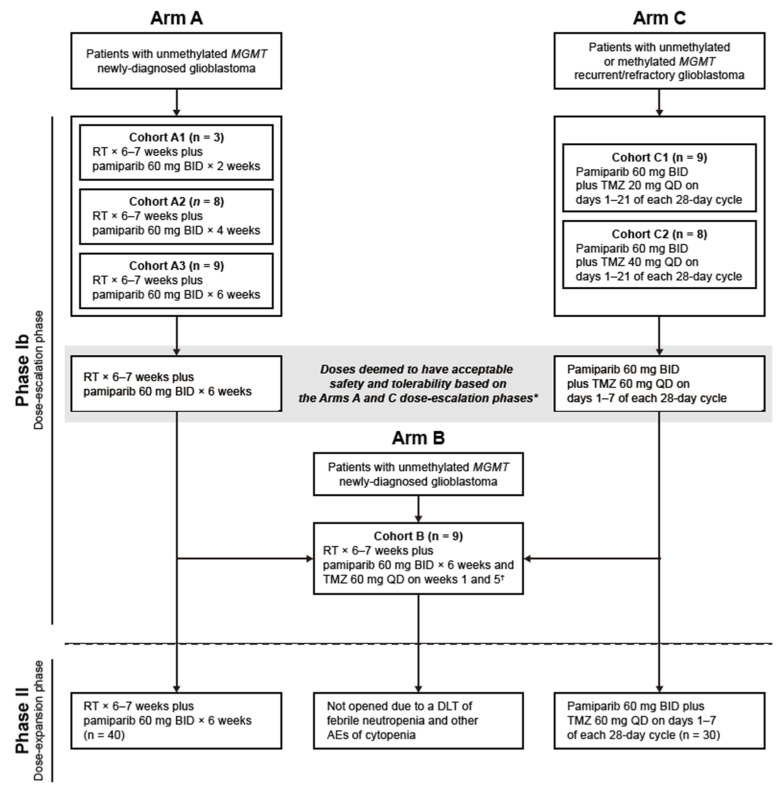 Figure 1
Peer Reviews
No public reviews on file for this paper yet. If you reviewed it on a platform where reviews are public (OpenReview, ICLR, NeurIPS, ICML), you can paste yours below so the community can read it here.
Videos
No videos yet. Explain this paper in a talk, walkthrough, or lecture? Add one.
Taxonomy
TopicsGlioma Diagnosis and Treatment · PARP inhibition in cancer therapy · Neuroblastoma Research and Treatments