Influence of Residual Disease on the Efficacy of PARP Inhibitors in Advanced Epithelial Ovarian Cancer: A Systematic Review and Meta Analysis
Sekyoung Hwang, Ji Hyun Kim, Uisuk Kim, Hyeong In Ha, Sang-Yoon Park, Myong Cheol Lim

TL;DR
PARP inhibitors help prevent cancer recurrence in ovarian cancer patients, regardless of whether they had all the cancer tissue removed during surgery.
Contribution
This study is the first to show that PARP inhibitors are equally effective in preventing cancer progression in patients with or without residual disease after surgery.
Findings
PARP inhibitors significantly improved progression-free survival in patients with no residual disease (R0) and those with residual disease (R1/R2).
The treatment effect was similar between R0 and R1/R2 subgroups (p = 0.66).
Complete cytoreduction remains important for the best prognosis despite the effectiveness of PARP inhibitors.
Abstract
This systematic review and meta analysis evaluated six randomized controlled trials including 3629 patients to determine whether residual disease modifies the clinical benefit of PARP inhibitor maintenance therapy in advanced epithelial ovarian cancer. The analysis demonstrated that PARP inhibitors significantly improve progression-free survival in both patients with no gross residual disease (R0; hazard ratio 0.55, 95% confidence interval 0.44–0.68) and those with macroscopic residual disease (R1/R2; hazard ratio 0.51, 95% confidence interval 0.40–0.65). The treatment effect was similar between subgroups (p = 0.66). These findings indicate that PARP inhibitor maintenance therapy provides substantial benefit regardless of surgical outcome, supporting its use in all eligible patients after first-line platinum-based chemotherapy, while emphasizing that achieving complete cytoreduction…
Genes, proteins, chemicals, diseases, species, mutations and cell lines named across the full text — each resolved to its canonical identifier and authoritative record.
Click any figure to enlarge with its caption.
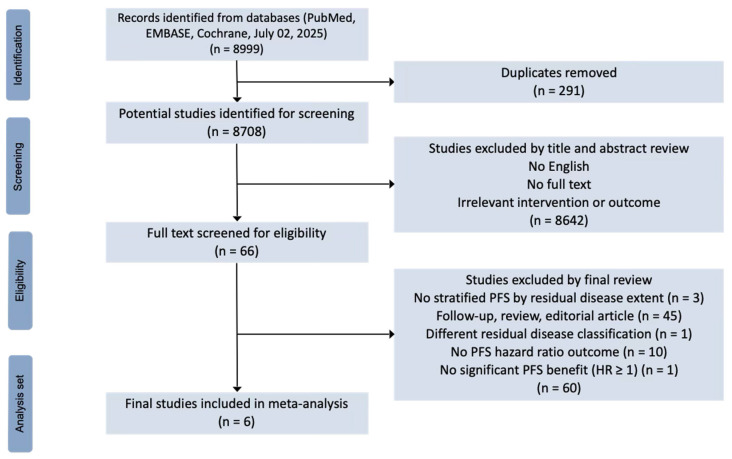 Figure 1
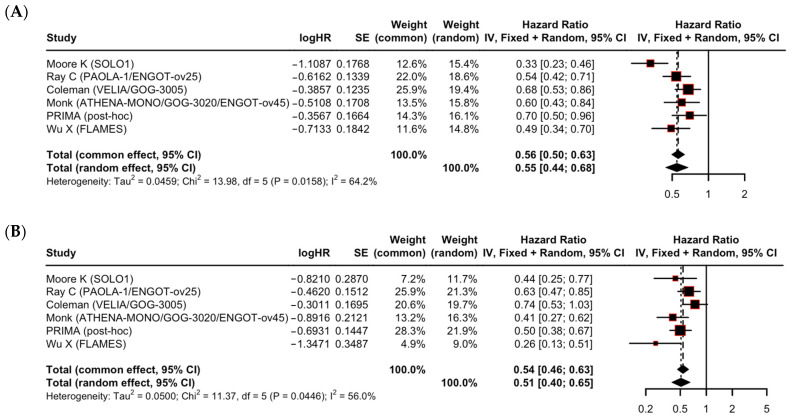 Figure 2
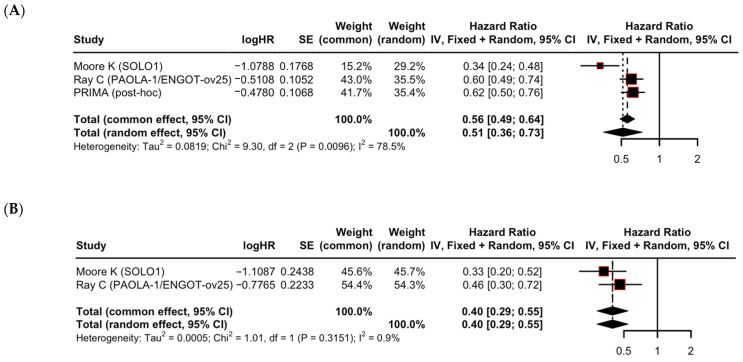 Figure 3
Peer Reviews
No public reviews on file for this paper yet. If you reviewed it on a platform where reviews are public (OpenReview, ICLR, NeurIPS, ICML), you can paste yours below so the community can read it here.
Videos
No videos yet. Explain this paper in a talk, walkthrough, or lecture? Add one.
Taxonomy
TopicsOvarian cancer diagnosis and treatment · PARP inhibition in cancer therapy · Toxin Mechanisms and Immunotoxins