Beyond Morphology: Quantitative MR Relaxometry in Pulmonary Lesion Classification
Markus Graf, Alexander W. Marka, Andreas Wachter, Tristan Lemke, Nicolas Lenhart, Teresa Schredl, Jonathan Stelter, Kilian Weiss, Marcus Makowski, Dimitrios C. Karampinos, Daniela Pfeiffer, Gregor S. Zimmermann, Seyer Safi, Hans Hoffmann, Keno Bressem, Lisa Adams

TL;DR
This study shows that MR relaxometry can accurately tell if lung nodules are benign or malignant without using radiation or invasive methods.
Contribution
The study introduces MR relaxometry as a non-invasive, radiation-free method for classifying lung lesions based on T1 and T2 relaxation times.
Findings
Benign lesions had high T2 and low T1 values, while malignant lesions had low T2 and high T1 values.
Binary classification using T1 and T2 achieved 95.7% accuracy in distinguishing benign from malignant lesions.
Malignant subtypes could not be reliably distinguished using the same method.
Abstract
Lung nodules are common and often difficult to classify. Many patients undergo repeated computed tomography (CT), positron emission tomography (PET), or biopsies, all of which have limitations and involve radiation or invasiveness. We investigated whether magnetic resonance relaxometry, which involves taking quantitative measurements of tissue relaxation times (T1 and T2), could help distinguish between benign and malignant lesions. In this prospective study of 64 patients, benign lesions and cancers exhibited distinct relaxation patterns. A classification approach using only T1 and T2 values accurately separated benign and malignant lesions; however, it could not reliably distinguish detailed cancer subtypes. This radiation-free, noninvasive technique may support diagnostic confidence and follow-up decisions. Background/Objectives: Lung nodules present a common diagnostic challenge,…
Genes, proteins, chemicals, diseases, species, mutations and cell lines named across the full text — each resolved to its canonical identifier and authoritative record.
Click any figure to enlarge with its caption.
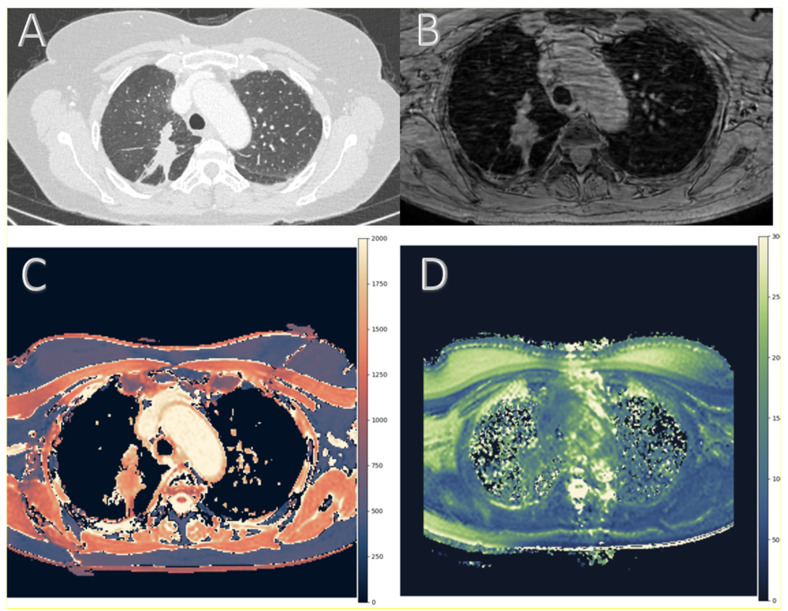 Figure 1
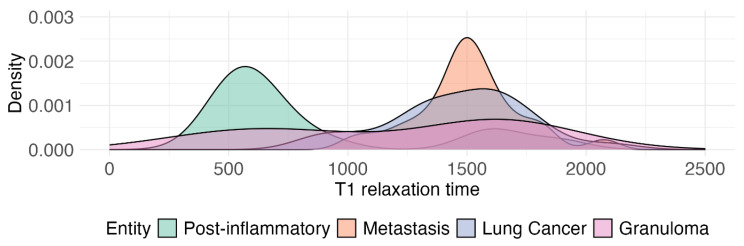 Figure 2
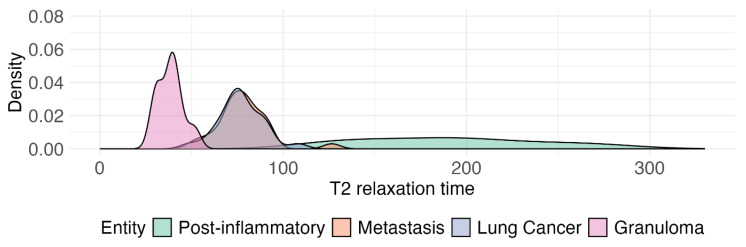 Figure 3
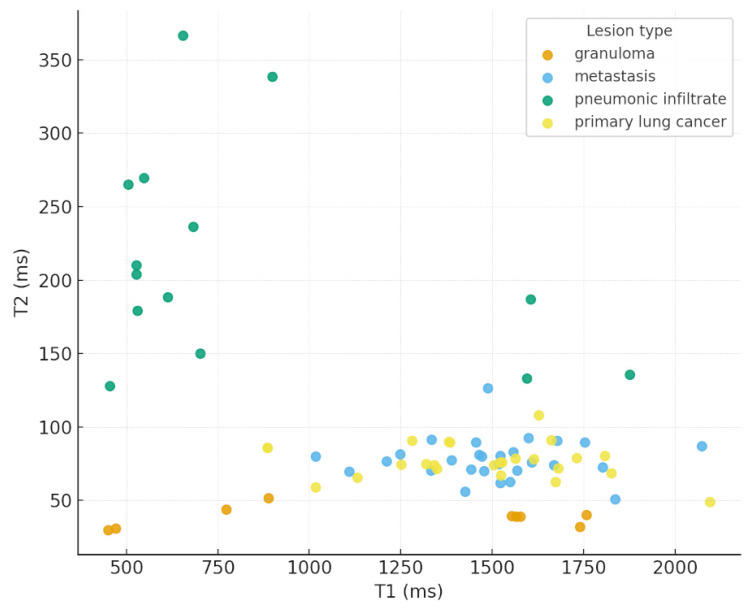 Figure 4
Peer Reviews
No public reviews on file for this paper yet. If you reviewed it on a platform where reviews are public (OpenReview, ICLR, NeurIPS, ICML), you can paste yours below so the community can read it here.
Videos
No videos yet. Explain this paper in a talk, walkthrough, or lecture? Add one.
Taxonomy
TopicsAtomic and Subatomic Physics Research · Radiomics and Machine Learning in Medical Imaging · Lung Cancer Diagnosis and Treatment