Pedigree-Based Estimation of Y-STR Mutation and Male Differentiation Rates: Application to Historical Remains Identification
Jasmine R. Connell, Toni White, Thais Zielke, Luke Armstrong, Natasha Mitchell, Lyn R. Griffiths

TL;DR
This study uses family data to estimate Y-STR mutation rates and male differentiation rates, showing their usefulness in identifying historical remains.
Contribution
The study provides new insights into Y-STR mutation rates and differentiation rates using pedigree data for historical remains identification.
Findings
Mutation rates for 22 of 25 Y-STR loci matched published father–son values.
Differentiation rates reached 60.1% for male relatives, aiding in distinguishing unrelated individuals.
Excessive mutations over generations may obscure patrilineal relationships in distant comparisons.
Abstract
Background/Objectives: High differentiation rates provided by Y-chromosomal short tandem repeats (Y-STRs) are highly advantageous in most forensic and genealogical casework, as they enhance the ability to exclude close or moderately related individuals, refine an individual’s position within a pedigree, and uncover the population substructure in otherwise homogeneous groups. However, the impact for historical remains identification casework is underexplored. Methods: We present a pedigree analysis of 366 males from 183 pedigrees, separated by 4 to 16 meioses at 27 Y-STR loci, from the Yfiler Plus kit. The differentiation rate for a given degree of separation was defined as the proportion of pairs at that specific number of meioses showing at least one allelic difference, relative to the total number of such pairs. Results: Our pedigree-based locus-specific mutation rates were consistent…
Genes, proteins, chemicals, diseases, species, mutations and cell lines named across the full text — each resolved to its canonical identifier and authoritative record.
Click any figure to enlarge with its caption.
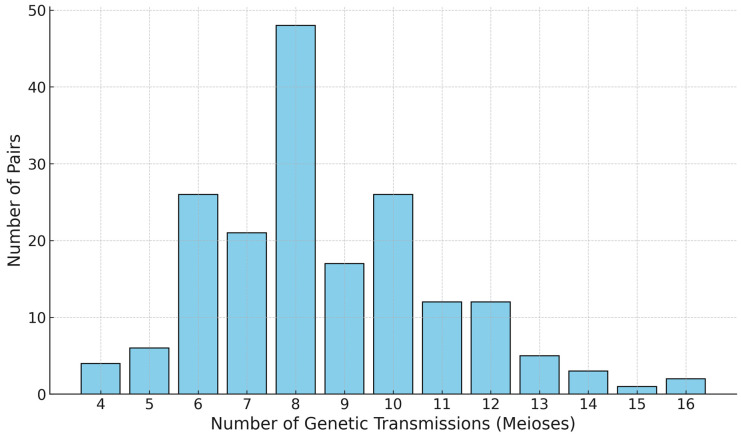 Figure 1
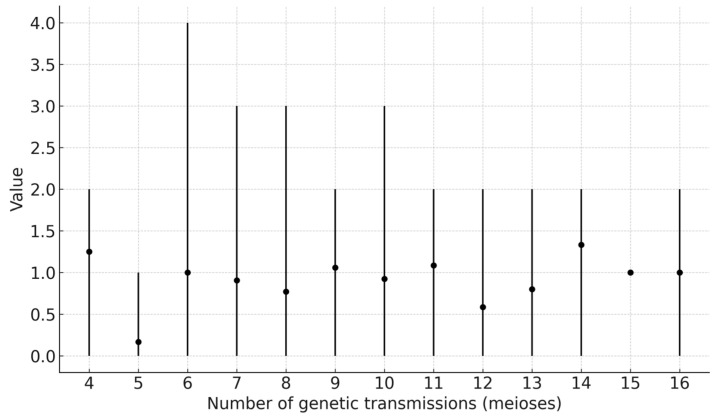 Figure 2
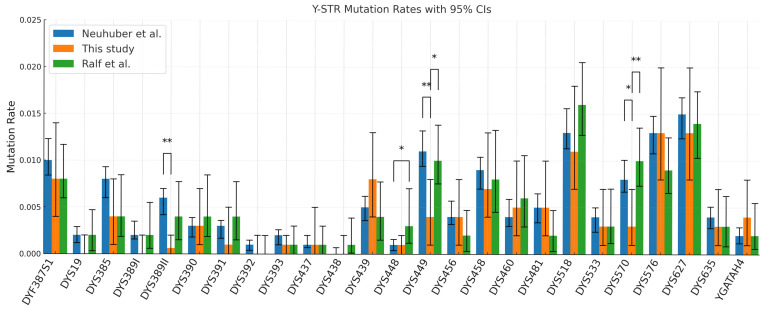 Figure 3
Peer Reviews
No public reviews on file for this paper yet. If you reviewed it on a platform where reviews are public (OpenReview, ICLR, NeurIPS, ICML), you can paste yours below so the community can read it here.
Videos
No videos yet. Explain this paper in a talk, walkthrough, or lecture? Add one.
Taxonomy
TopicsForensic and Genetic Research · Image Processing and 3D Reconstruction · Forensic Anthropology and Bioarchaeology Studies