Animal-Assisted Activities for Patients with Central Nervous System Disease in Acute Rehabilitation Setting
Vittorio Casati, Valentina Re, Paola Bardasi, Andrea Contini, Pilade Cortellazzi, Angelica Gallarati, Emilia Bozzini, Valentina Castignoli, Gianfranco Lamberti, Fabio Razza, Simona Galante, Chiara Frati, Francesca Ronchetti, Monica Morelli, Emanuela Ricci, Gianluca Ciardi

TL;DR
This study explores how animal-assisted activities can help reduce stress and improve outcomes for patients with neurological conditions like stroke and spinal cord injury.
Contribution
The study provides empirical evidence on the effectiveness of animal-assisted activities in reducing neurobehavioral disorders in patients with central nervous system diseases.
Findings
AAA significantly reduced neurobehavioral disorder scores in stroke and TBI patients by over 40%.
SCI patients showed modest improvements in anxiety and depression, though only depression reached statistical significance.
The study suggests that AAA could be a beneficial intervention in acute rehabilitation settings for neurological patients.
Abstract
Background: Animal-assisted activities (AAA) are participative interventions, designed to lower hospitalization-related stress and anxiety, enhance communicative readiness, improve quality of life and encourage human–animal interaction. The aim of the present study was to evaluate AAA effects in the context of intensive rehabilitation of patients with spinal cord injury (SCI), traumatic brain injury (TBI), stroke. Methods: AAA in this study were structured by a local specialized association, for small groups of patients (5/7 a time), biweekly; each session lasted 60 min. Each patient participated in 10 sessions of AAA. Evaluation rating scales were administered at T0 (before the first session) and T1 (after the last session, five weeks later) as follows: Neurobehavioral Rating Scale (NRS) in case of patient with stroke/TBI without disorder of consciousness; Hospital Anxiety and…
Genes, proteins, chemicals, diseases, species, mutations and cell lines named across the full text — each resolved to its canonical identifier and authoritative record.
Click any figure to enlarge with its caption.
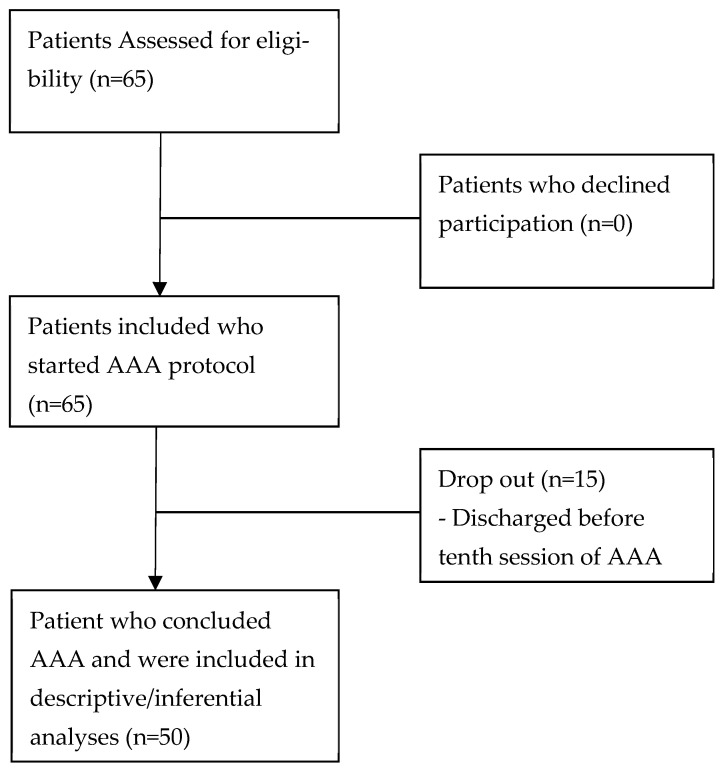 Figure 1
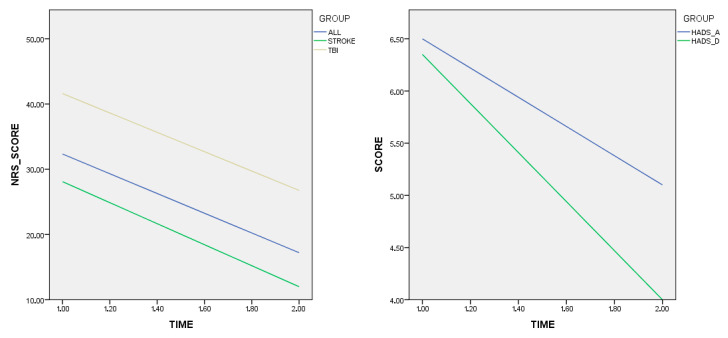 Figure 2
Peer Reviews
No public reviews on file for this paper yet. If you reviewed it on a platform where reviews are public (OpenReview, ICLR, NeurIPS, ICML), you can paste yours below so the community can read it here.
Videos
No videos yet. Explain this paper in a talk, walkthrough, or lecture? Add one.
Taxonomy
TopicsHuman-Animal Interaction Studies · Veterinary Orthopedics and Neurology · Animal testing and alternatives