Improvement of Three-Party Semi-Quantum Protocol for Deterministic Secure Quantum Dialogue Based on GHZ States
Ling Zhang, Xun Liu, Xiang-Jun Xin, Chao-Yang Li, Li Gong

TL;DR
This paper identifies vulnerabilities in a quantum communication protocol and proposes a more secure and efficient version.
Contribution
An improved protocol is proposed that is secure against dishonest participants and more efficient.
Findings
The original protocol is vulnerable to attacks by dishonest participants.
The improved protocol is robust against internal and external attacks.
The improved protocol enhances quantum communication efficiency.
Abstract
Through the analysis of “Three-party semi-quantum protocol for deterministic secure quantum dialogue based on GHZ states”, we demonstrate that the protocol is vulnerable to attacks from dishonest participants. Specifically, the fully quantum-capable participant may behave dishonestly, leading the two semi-quantum participants to receive incorrect secret information, with the dishonest behavior remaining undetected. Accordingly, we propose an improved protocol that demonstrates robustness against various internal and external attacks, including dishonest participant attacks, and we further prove that it does not suffer from information leakage. Moreover, compared to the original protocol, the improved version achieves a significant enhancement in quantum communication efficiency.
Genes, proteins, chemicals, diseases, species, mutations and cell lines named across the full text — each resolved to its canonical identifier and authoritative record.
Click any figure to enlarge with its caption.
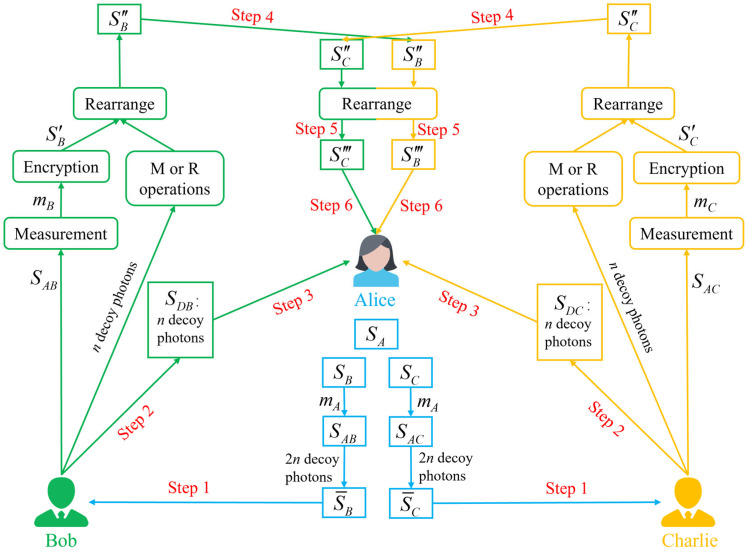 Figure 1
Peer Reviews
No public reviews on file for this paper yet. If you reviewed it on a platform where reviews are public (OpenReview, ICLR, NeurIPS, ICML), you can paste yours below so the community can read it here.
Videos
No videos yet. Explain this paper in a talk, walkthrough, or lecture? Add one.
Taxonomy
TopicsQuantum Information and Cryptography · Quantum Mechanics and Applications · Quantum optics and atomic interactions