Associations Between Polygenic Risk for Alzheimer’s Disease and Grey Matter Volume Are Dependent on APOE, Pathological and Diagnostic Status
Valerio Nocella, Riccardo Manca, Annalena Venneri

TL;DR
This study explores how genetic risk for Alzheimer's disease relates to brain volume changes in different groups of people, including those with and without the disease.
Contribution
The study reveals that genetic risk scores for Alzheimer's are linked to brain volume changes, but these associations depend on amyloid status, APOE, and diagnostic group.
Findings
PRSs were negatively associated with grey matter volumes in specific brain regions like the hippocampus and amygdala.
Associations were strongest in amyloid-negative non-atrophic participants and cognitively unimpaired or AD individuals.
Findings did not survive correction for multiple testing using the false discovery rate.
Abstract
Background/Objectives: Studies have shown that higher polygenic risk scores (PRSs) for Alzheimer’s disease (AD) are associated with smaller volumes in temporal brain regions typically affected by this disease. These effects have also been found in cognitively unimpaired (CU) older adults. This study aimed to investigate the relationship between PRSs and brain volumes in specific areas associated with early AD. Methods: 342 participants were selected from the Alzheimer’s Disease Neuroimaging Initiative and stratified into three groups: 114 amyloid-positive atrophic (A+N+), 114 amyloid-negative non-atrophic (A−N−), and 114 amyloid-positive non-atrophic (A+N−) people. Linear regressions were performed within each group to investigate associations between PRSs and regional grey matter volumes. Analyses were also repeated after stratifying groups by APOE status and clinical diagnosis. Two…
Genes, proteins, chemicals, diseases, species, mutations and cell lines named across the full text — each resolved to its canonical identifier and authoritative record.
Click any figure to enlarge with its caption.
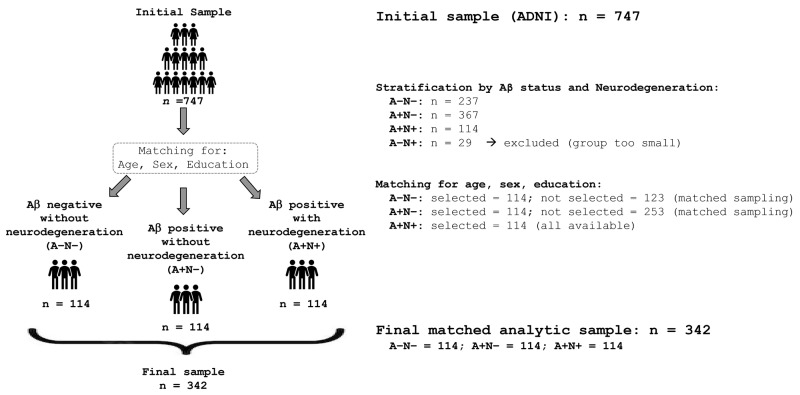 Figure 1
Peer Reviews
No public reviews on file for this paper yet. If you reviewed it on a platform where reviews are public (OpenReview, ICLR, NeurIPS, ICML), you can paste yours below so the community can read it here.
Videos
No videos yet. Explain this paper in a talk, walkthrough, or lecture? Add one.
Taxonomy
TopicsNutritional Studies and Diet