Cardiovascular Disease and COVID-19: Is There a Place for Mid-Regional Pro-Adrenomedullin? Preliminary Data from a Clinical Cohort
Paulina Pietraszko, Marcin Żórawski, Emilia Bielecka-Richter, Małgorzata Gryciuk, Kacper Mil, Aleksandra Zbroch, Edyta Zbroch

TL;DR
This study examined mid-regional pro-adrenomedullin (MR-proADM) levels in patients with and without cardiovascular disease and COVID-19 to determine its role in predicting heart complications.
Contribution
The study provides preliminary evidence that MR-proADM does not offer additional prognostic value for cardiovascular complications in the context of COVID-19.
Findings
MR-proADM levels did not differ significantly between patients with and without COVID-19 or cardiovascular disease.
MR-proADM was not predictive of chronic heart failure or myocardial infarction.
No significant correlations were found between MR-proADM and standard cardiac biomarkers like troponin or proBNP.
Abstract
Mid-regional pro-adrenomedullin (MR-proADM) has emerged as a promising biomarker reflecting endothelial dysfunction and systemic inflammation. Its prognostic role in cardiovascular complications, particularly in the context of COVID-19 infection, remains under investigation. This study aimed to evaluate MR-proADM concentrations in patients with and without cardiovascular disease and COVID-19 and to assess its association with cardiac complications and biomarkers of myocardial injury. A total of 157 patients (mean age: 72.3 years; 66 men) hospitalized in a tertiary referral center were enrolled. The study population consisted of three groups: patients with cardiovascular disease and COVID-19 (n = 64), patients with cardiovascular disease but no COVID-19 (n = 74), and a control group without cardiovascular disease or COVID-19 (n = 17). Plasma MR-proADM levels were measured, and their…
Genes, proteins, chemicals, diseases, species, mutations and cell lines named across the full text — each resolved to its canonical identifier and authoritative record.
Click any figure to enlarge with its caption.
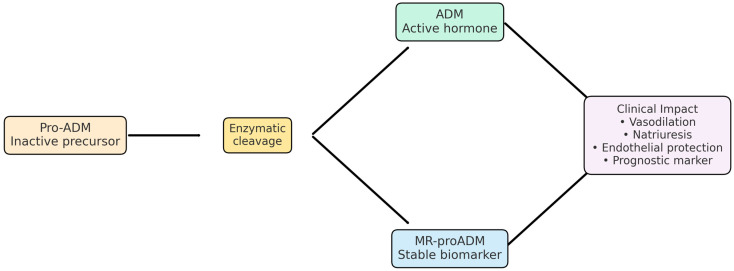 Figure 1
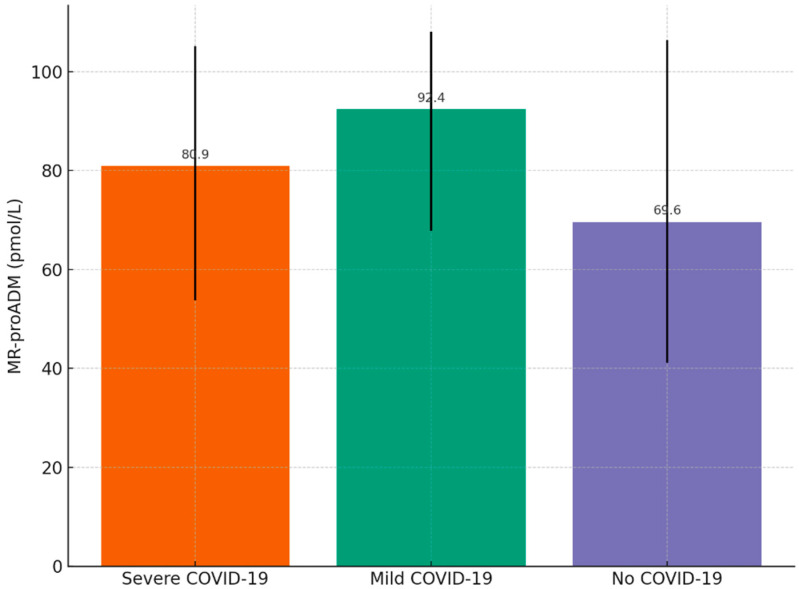 Figure 2
Peer Reviews
No public reviews on file for this paper yet. If you reviewed it on a platform where reviews are public (OpenReview, ICLR, NeurIPS, ICML), you can paste yours below so the community can read it here.
Videos
No videos yet. Explain this paper in a talk, walkthrough, or lecture? Add one.
Taxonomy
TopicsNeuropeptides and Animal Physiology · Hormonal Regulation and Hypertension · Sepsis Diagnosis and Treatment