Cross-Domain OTFS Detection via Delay–Doppler Decoupling: Reduced-Complexity Design and Performance Analysis
Mengmeng Liu, Shuangyang Li, Baoming Bai, Giuseppe Caire

TL;DR
This paper introduces a new low-complexity detection method for OTFS modulation by separating delay and Doppler effects, improving performance without high computational cost.
Contribution
A novel reduced-complexity cross-domain detection method for OTFS using delay-Doppler decoupling and eigenvalue decomposition.
Findings
Delay and Doppler effects can be decoupled and treated separately in OTFS modulation.
The proposed scheme achieves near-optimal error performance with significantly reduced computational complexity.
Eigenvalue decomposition makes computational complexity independent of cross-domain iterations.
Abstract
In this paper, a reduced-complexity cross-domain iterative detection for orthogonal time frequency space (OTFS) modulation is proposed that exploits channel properties in both time and delay–Doppler domains. Specifically, we first show that in the time-domain effective channel, the path delay only introduces interference among samples in adjacent time slots, while the Doppler becomes a phase term that does not affect the channel sparsity. This investigation indicates that the effects of delay and Doppler can be decoupled and treated separately. This “band-limited” matrix structure further motivates us to apply a reduced-size linear minimum mean square error (LMMSE) filter to eliminate the effect of delay in the time domain, while exploiting the cross-domain iteration for minimizing the effect of Doppler by noticing that the time and Doppler are a Fourier dual pair. Furthermore, we apply…
Genes, proteins, chemicals, diseases, species, mutations and cell lines named across the full text — each resolved to its canonical identifier and authoritative record.
Click any figure to enlarge with its caption.
 Figure 1
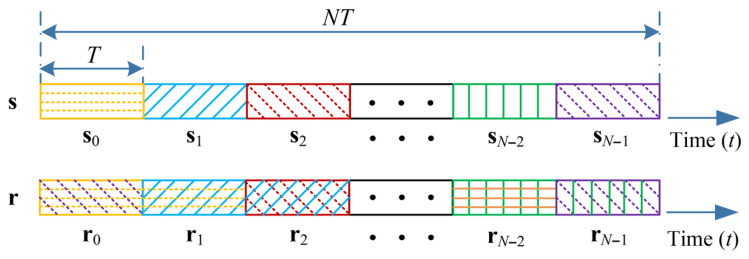 Figure 2
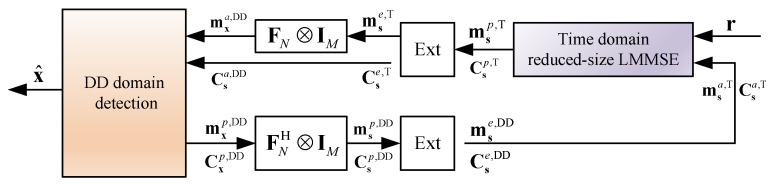 Figure 3
 Figure 4
 Figure 5
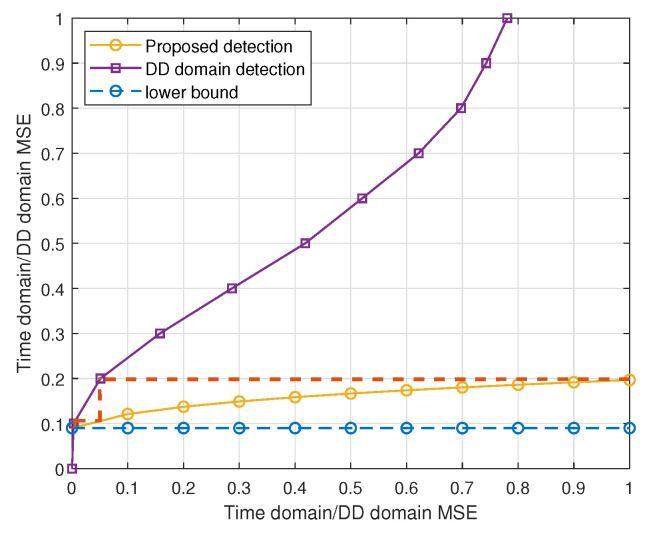 Figure 6
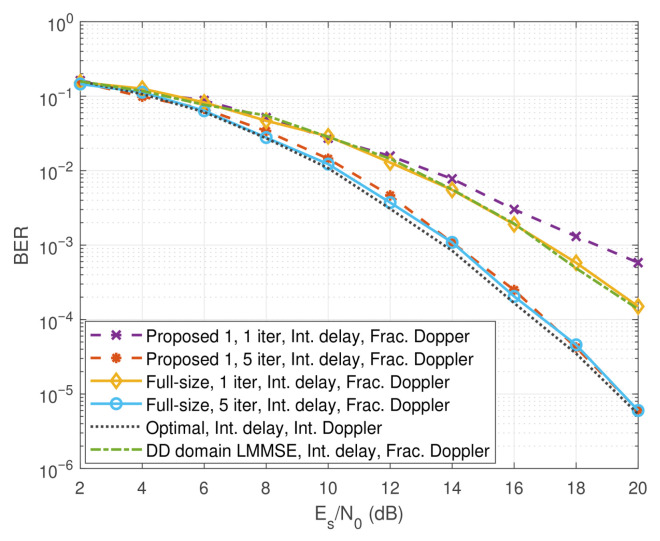 Figure 7
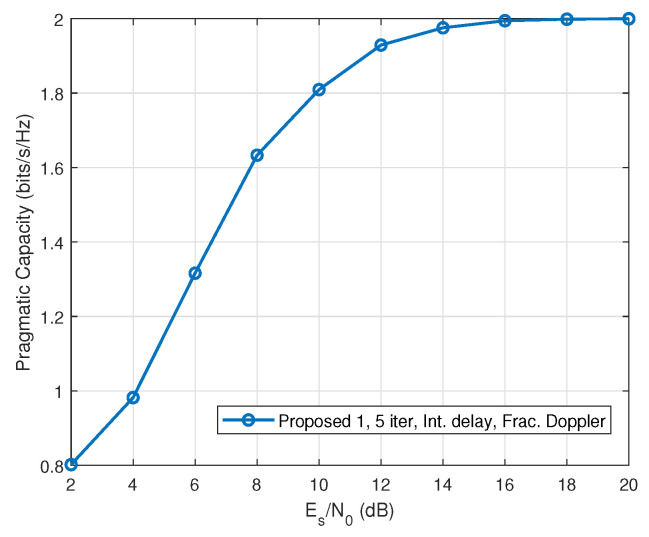 Figure 8
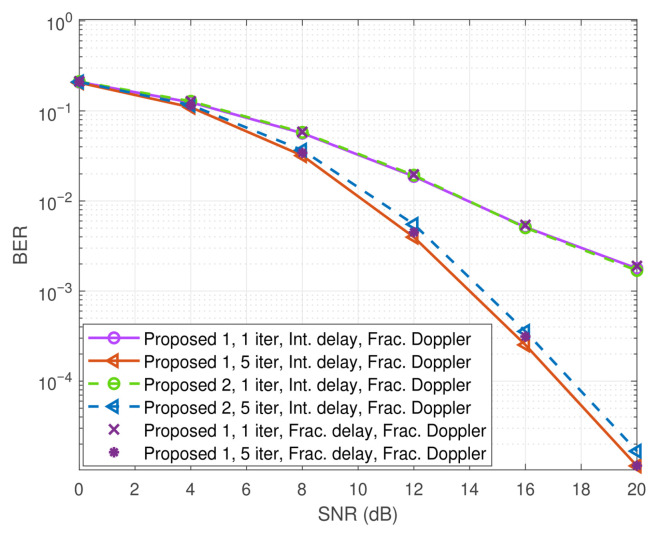 Figure 9
Peer Reviews
No public reviews on file for this paper yet. If you reviewed it on a platform where reviews are public (OpenReview, ICLR, NeurIPS, ICML), you can paste yours below so the community can read it here.
Videos
No videos yet. Explain this paper in a talk, walkthrough, or lecture? Add one.
Taxonomy
TopicsPAPR reduction in OFDM · Optical Wireless Communication Technologies · Optical Network Technologies