Integrating Virtual Learning Into a Primarily Cadaveric-Based Curriculum: Medical Students’ Perspectives, Opinions, and Attitudes
Justin Lindsay, Aurelia Incristi, Alexander Hull, Anes Gadun, Sydne Ballengee, Graham Kessler, Barbara Kraszpulska

TL;DR
Medical students found virtual learning tools helpful for anatomy education, especially when combined with traditional cadaver-based methods.
Contribution
This study provides new insights into student perspectives on integrating virtual resources into cadaver-based anatomy education.
Findings
69.2% of students felt virtual resources were more effective than traditional methods.
92.3% of students rated virtual tools as slightly to extremely useful.
Students saw potential for greater integration of virtual learning in anatomical education.
Abstract
Human anatomy is a crucial component of medical education, traditionally taught through human cadaveric dissection, prosections, and formal lectures. However, challenges such as limited exposure to material, difficulty visualizing structures, and cadaver shortages have prompted the integration of virtual anatomy technologies, such as software applications, web-based educational three-dimensional (3D) platforms, and virtual reality, into curricula. These resources offer advantages by accommodating different learning styles, enabling the analysis of anatomical structures in various planes, and increasing exposure to learning materials. Although research has explored modernizing anatomy education with virtual tools, limited focus has been placed on student opinions of integrating virtual resources. This study aimed to examine how the first-time implementation of virtual resources,…
Genes, proteins, chemicals, diseases, species, mutations and cell lines named across the full text — each resolved to its canonical identifier and authoritative record.
Click any figure to enlarge with its caption.
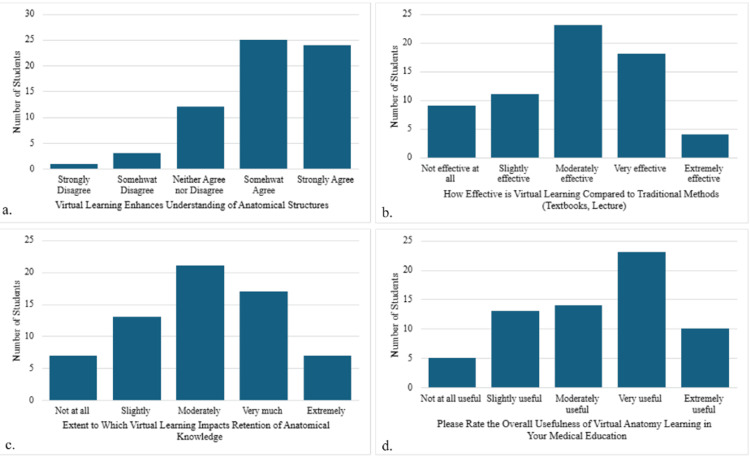 Figure 1
Peer Reviews
No public reviews on file for this paper yet. If you reviewed it on a platform where reviews are public (OpenReview, ICLR, NeurIPS, ICML), you can paste yours below so the community can read it here.
Videos
No videos yet. Explain this paper in a talk, walkthrough, or lecture? Add one.
Taxonomy
TopicsAnatomy and Medical Technology · Innovations in Medical Education · Biomedical and Engineering Education