Primary Versus Secondary Non-Urothelial Tumors Involving the Bladder: A 10-Year Analysis of Clinicopathologic Profiles and Adverse Feature Burden
Alexei Croitor, Vlad Dema, Alin Cumpanas, Razvan Bardan, Diana Herman, Mihail Nanu, Sorin Dema

TL;DR
This study compares primary and secondary non-urothelial bladder tumors, finding that secondary tumors, especially from the prostate, are more aggressive and require tailored surgical approaches.
Contribution
The study identifies origin-specific risk gradients in secondary bladder tumors and proposes a practical surgical strategy based on tumor origin and adverse features.
Findings
Secondary bladder tumors showed significantly higher rates of adverse pathology compared to primary tumors.
Prostate-origin secondary tumors had the highest burden of aggressive features like advanced pT and positive margins.
Adverse feature count correlated strongly with advanced tumor stage (pT).
Abstract
Non-urothelial tumors can involve the bladder either as primary cancers (squamous, adenocarcinoma, neuroendocrine, and sarcomatoid) or as “secondary” spread from nearby organs (colon, prostate, and cervix). In a 10-year single-center cohort of 235 patients, secondary involvement was much more likely to show aggressive pathology than primary non-urothelial tumors, including deeper local invasion, tumors in vessels or nerves, and lymph-node metastases. Among secondaries, prostate origin had the highest burden of adverse features, followed by colorectal and cervical sources. These patterns support a practical approach: confirm tumor origin with modern immunohistochemistry, map the extent of disease carefully before surgery, and tailor the operation to obtain negative margins—favoring organ-sparing when anatomically feasible and escalating when margin risk is high (e.g., suspected…
Genes, proteins, chemicals, diseases, species, mutations and cell lines named across the full text — each resolved to its canonical identifier and authoritative record.
Click any figure to enlarge with its caption.
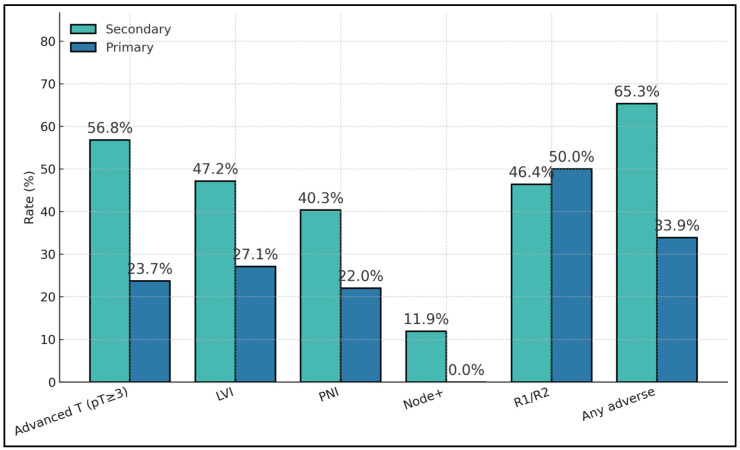 Figure 1
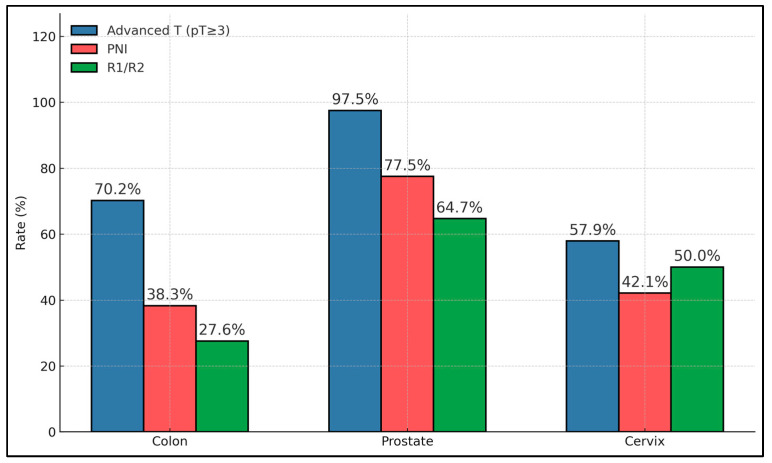 Figure 2
Peer Reviews
No public reviews on file for this paper yet. If you reviewed it on a platform where reviews are public (OpenReview, ICLR, NeurIPS, ICML), you can paste yours below so the community can read it here.
Videos
No videos yet. Explain this paper in a talk, walkthrough, or lecture? Add one.
Taxonomy
TopicsUrinary and Genital Oncology Studies · Bladder and Urothelial Cancer Treatments · Urological Disorders and Treatments