Imprinting Disorders and Epigenetic Alterations in Children Conceived by Assisted Reproductive Technologies: Mechanisms, Clinical Outcomes, and Prenatal Diagnosis
Antonella Gambadauro, Valeria Chirico, Francesca Galletta, Ferdinando Gulino, Roberto Chimenz, Giorgia Serraino, Immacolata Rulli, Alessandro Manganaro, Eloisa Gitto, Lucia Marseglia

TL;DR
This review examines how assisted reproductive technologies may affect imprinting disorders in children, focusing on epigenetic changes and prenatal diagnosis.
Contribution
The paper provides a comprehensive review of the mechanisms and clinical outcomes of imprinting disorders in ART-conceived children.
Findings
ART-conceived children show a higher prevalence of Beckwith–Wiedemann and Silver–Russell syndromes.
Evidence suggests ART procedures may contribute to epigenetic dysregulation in imprinting control regions.
Data on Angelman and Prader–Willi syndromes remain inconsistent across studies.
Abstract
Assisted reproductive technologies (ARTs) have revolutionized infertility treatment, leading to the birth of over 10 million children worldwide. Despite their success, increasing concerns have been expressed regarding the potential long-term outcomes of ART-conceived individuals, particularly in relation to imprinting disorders (IDs). IDs result from the abnormal expression of imprinted genes, which are expressed in a parent-of-origin-specific manner and regulated by epigenetic mechanisms (e.g., DNA methylation). Disruption of these processes, through environmental, genetic, or procedural factors, can lead to disorders such as Beckwith–Wiedemann syndrome (BWS), Silver–Russell syndrome (SRS), Angelman syndrome (AS), and Prader–Willi syndrome (PWS). These syndromes are characterized by distinct clinical features, including growth abnormalities, neurodevelopmental delay, endocrine…
Genes, proteins, chemicals, diseases, species, mutations and cell lines named across the full text — each resolved to its canonical identifier and authoritative record.
Click any figure to enlarge with its caption.
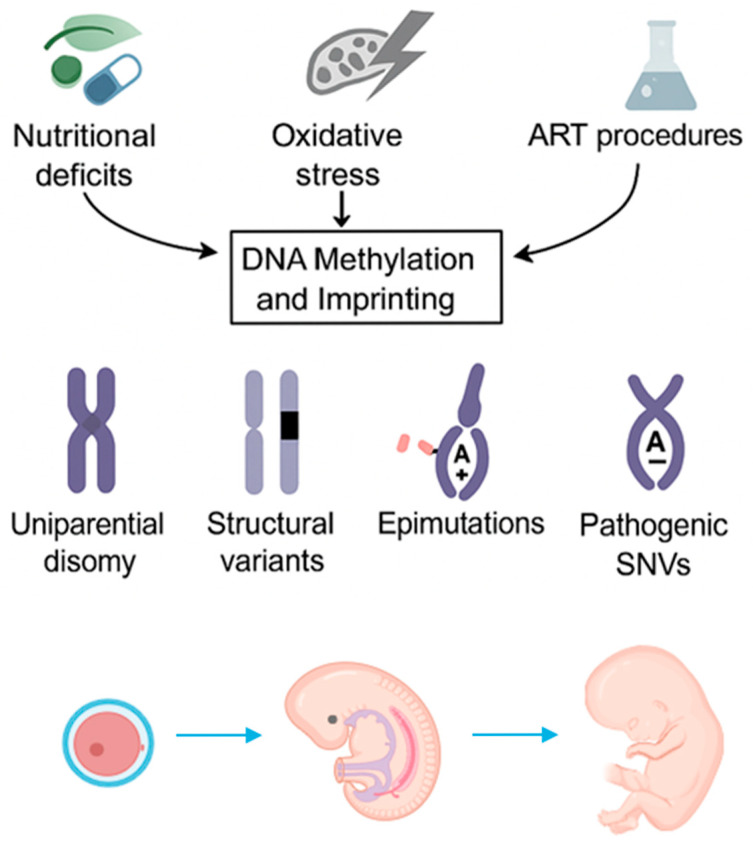 Figure 1
Peer Reviews
No public reviews on file for this paper yet. If you reviewed it on a platform where reviews are public (OpenReview, ICLR, NeurIPS, ICML), you can paste yours below so the community can read it here.
Videos
No videos yet. Explain this paper in a talk, walkthrough, or lecture? Add one.
Taxonomy
TopicsGenetic Syndromes and Imprinting · Prenatal Screening and Diagnostics · Assisted Reproductive Technology and Twin Pregnancy