Neuroimaging and Machine Learning in OCD: Advances in Diagnostic and Therapeutic Insights
Norah A. Alturaiqi, Wijdan S. Aljebreen, Wedad Alawad, Shuaa S. Alharbi, Haifa F. Alhasson

TL;DR
This review explores how combining neuroimaging and machine learning can improve OCD diagnosis and treatment by identifying brain abnormalities and enabling personalized strategies.
Contribution
The paper highlights the novel integration of transfer learning with neuroimaging to address dataset limitations and improve diagnostic accuracy for OCD.
Findings
ML algorithms achieved over 80% accuracy in diagnosing OCD by identifying CSTC circuit abnormalities.
Transfer learning enhances predictive modeling and supports personalized treatment in resource-limited settings.
Abnormalities in the cortico-striato-thalamo-cortical circuit are consistently linked to OCD.
Abstract
Background/Objectives: Obsessive–Compulsive Disorder (OCD) is a chronic mental health condition characterized by intrusive thoughts and repetitive behaviors. Traditional diagnostic methods rely on subjective clinical assessments, delaying effective intervention. This review examines how advanced neuroimaging techniques, such as Magnetic Resonance Imaging (MRI) and Diffusion Tensor Imaging (DTI), integrated with machine learning (ML), can improve OCD diagnostics by identifying structural and functional brain abnormalities, particularly in the cortico-striato-thalamo-cortical (CSTC) circuit. Methods: Findings from studies using MRI and DTI to identify OCD-related neurobiological markers are synthesized. Machine learning algorithms like Convolutional Neural Networks (CNNs) and Support Vector Machines (SVMs) are evaluated for their ability to analyze neuroimaging data. The role of transfer…
Genes, proteins, chemicals, diseases, species, mutations and cell lines named across the full text — each resolved to its canonical identifier and authoritative record.
Click any figure to enlarge with its caption.
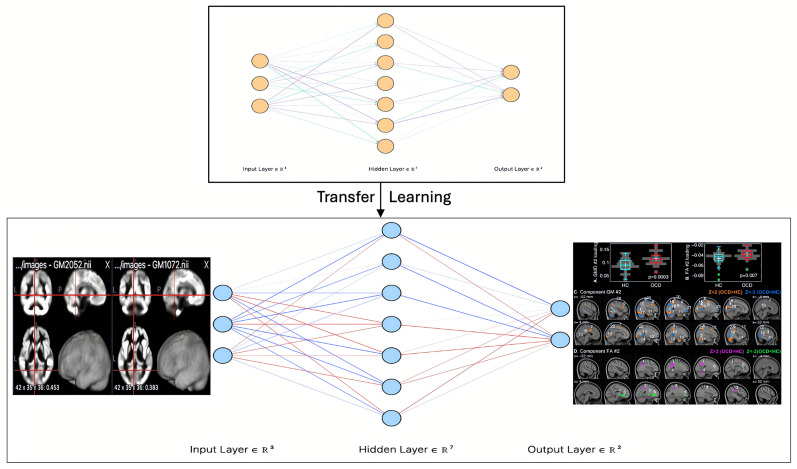 Figure 1
 Figure 2
 Figure 3
 Figure 4
Peer Reviews
No public reviews on file for this paper yet. If you reviewed it on a platform where reviews are public (OpenReview, ICLR, NeurIPS, ICML), you can paste yours below so the community can read it here.
Videos
No videos yet. Explain this paper in a talk, walkthrough, or lecture? Add one.
Taxonomy
TopicsObsessive-Compulsive Spectrum Disorders