Signs, symptoms, and health-related quality of life in MELAS: measuring what’s important from the patient and clinician perspectives
Paolo Medrano, Benjamin Banderas, Marisa Brimmer, Lily Settel, Sari Berger, Alan Shields, Amy Goldstein, Amel Karaa, Austin Larson, Sumit Parikh, Fernando Scaglia, Karra Danyelle Harrington, Chris James Edgar, Pamela Ventola, Matthew Webster, Jennifer Chickering, Chad Gwaltney

TL;DR
This study explores the signs, symptoms, and quality of life impacts in MELAS from both patient and clinician perspectives to guide future clinical trials.
Contribution
The study identifies key symptoms and quality-of-life impacts in MELAS patients, showing they can self-report effectively.
Findings
Patients with MELAS frequently report physical and mental fatigue, hearing loss, and memory problems.
Adaptive behaviors, work impacts, and emotional function are the most affected quality-of-life domains.
Patients can self-report their symptoms and quality-of-life impacts reliably.
Abstract
Mitochondrial encephalomyopathy with lactic acidosis and stroke-like episodes (MELAS) is a rare genetic syndrome mostly associated with pathogenic variants in mitochondrial DNA. As there is limited research on the life experience of patients with MELAS, this study aimed to develop an understanding of the patient experience of MELAS through qualitative interviews to identify, describe, and substantiate important and relevant signs, symptoms, and health-related quality-of-life (HRQoL) impact (S/S/I) concepts. Clinician and patient interviews were conducted virtually using semi-structured interview guides. During 60-minute interviews with five experts in the United States, clinicians were asked for their perspective on S/S/I of patients with MELAS, patient experience of fatigue and cognitive impairment, and whether patients would be able to accurately report and rate their symptoms and…
Genes, proteins, chemicals, diseases, species, mutations and cell lines named across the full text — each resolved to its canonical identifier and authoritative record.
Click any figure to enlarge with its caption.
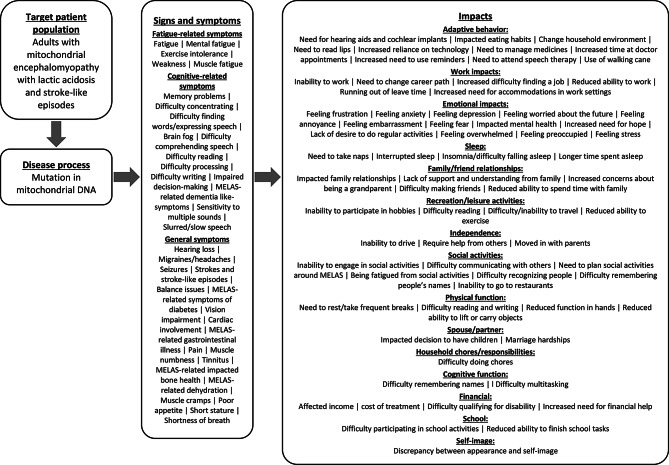 Figure 1
Peer Reviews
No public reviews on file for this paper yet. If you reviewed it on a platform where reviews are public (OpenReview, ICLR, NeurIPS, ICML), you can paste yours below so the community can read it here.
Videos
No videos yet. Explain this paper in a talk, walkthrough, or lecture? Add one.
Taxonomy
TopicsMitochondrial Function and Pathology · Endoplasmic Reticulum Stress and Disease · Metabolism and Genetic Disorders