Stereoselective Syntheses of Cyclic Microsclerodermin Derivatives
Kevin Bauer, Uli Kazmaier

TL;DR
Scientists created six cyclic microsclerodermin derivatives using sugar-based starting materials and specific chemical reactions.
Contribution
The paper introduces a stereoselective synthetic route for cyclic microsclerodermin derivatives using Sakurai allylations and photochemical rearrangements.
Findings
Six cyclic microsclerodermin derivatives were synthesized from l-xylose and d-arabinose.
Sakurai allylations showed stereochemical control based on the Lewis acid used.
Photochemical Wolff rearrangements enabled the formation of complex aminofuranosides.
Abstract
Starting from l‐xylose and d‐arabinose, six different cyclic microscleroderma derivatives were successfully obtained. Key steps of the syntheses are, on the one hand, Sakurai allylations, whose stereochemical course depends on the Lewis acid used, and on the other hand, photochemical Wolff rearrangements in the presence of complex aminofuranosides. Finally, aromatic side chains were introduced via cross metathesis. Six different cyclic microsclerodermin derivatives are obtained from l‐xylose and d‐arabinose via stereoselective Sakurai allylations and photochemical Arndt‐Eistert homologations.
Genes, proteins, chemicals, diseases, species, mutations and cell lines named across the full text — each resolved to its canonical identifier and authoritative record.
Click any figure to enlarge with its caption.
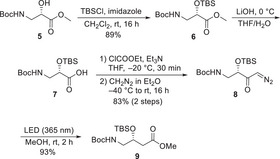 Figure 1
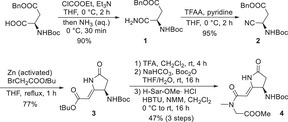 Figure 2
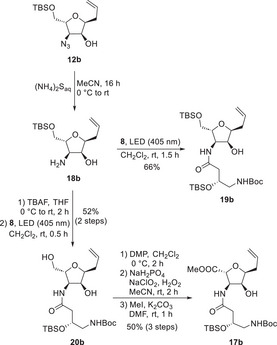 Figure 3
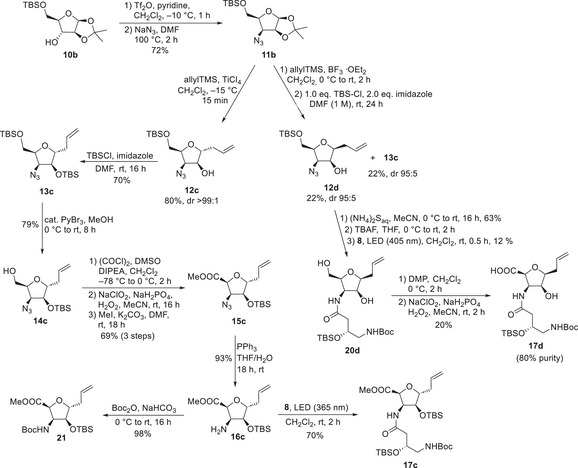 Figure 4
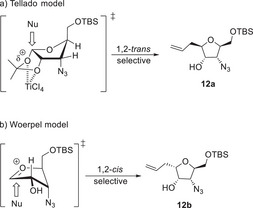 Figure 5
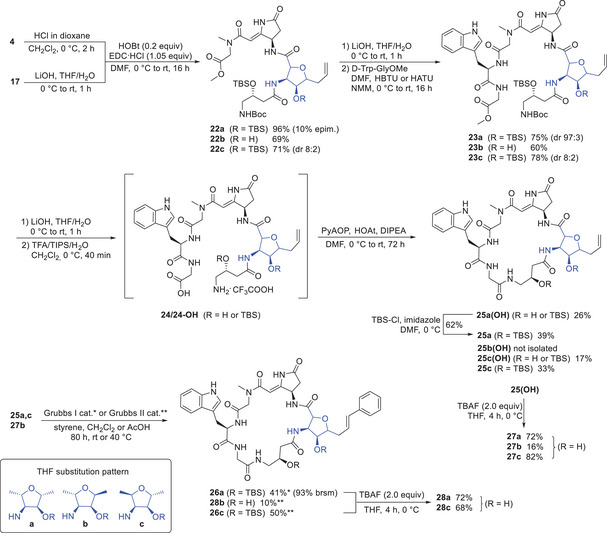 Figure 6
 Figure 7
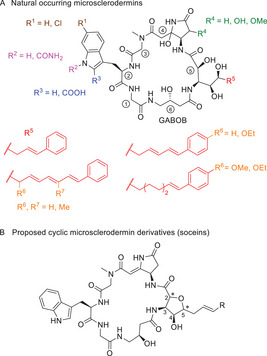 Figure 8
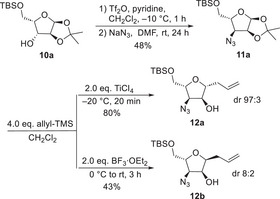 Figure 9
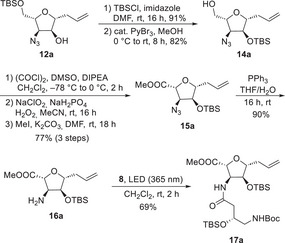 Figure 10
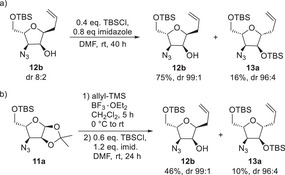 Figure 11
Peer Reviews
No public reviews on file for this paper yet. If you reviewed it on a platform where reviews are public (OpenReview, ICLR, NeurIPS, ICML), you can paste yours below so the community can read it here.
Videos
No videos yet. Explain this paper in a talk, walkthrough, or lecture? Add one.
Taxonomy
TopicsSynthetic Organic Chemistry Methods · Carbohydrate Chemistry and Synthesis · Fungal Plant Pathogen Control