Synthesis of the Soft Lewis Superacid Tris(4‐bromo‐2,3,5,6‐tetrafluorophenyl)borane B(C6F4Br)3 via C‒Ag to C‒B Transmetalation
Amina L. Moshtaha, Erika M. Peter, Robin Sievers, Tim‐Niclas Streit, Moritz Malischewski

TL;DR
Scientists synthesized a new strong Lewis acid and found it to be more acidic than a similar compound, with potential for easier structural analysis.
Contribution
A new synthesis method for the soft Lewis superacid B(C6F4Br)3 and its comparative acidity assessment.
Findings
B(C6F4Br)3 has higher fluoride and hydride ion affinities than B(C6F5)3.
B(C6F4Br)3 shows increased Lewis acidity compared to B(C6F5)3.
Bromine atoms in B(C6F4Br)3 may aid in structural analysis of its adducts.
Abstract
The Lewis acid tris(4‐bromo‐2,3,5,6‐tetrafluorophenyl)borane B(C6F4Br)3 was synthesized via transmetalation from BBr3 and AgC6F4Br. The latter was prepared from 1,4‐C6F4BrSiMe3 with AgF and crystallized as a toluene solvate [2(AgC6F4Br)4•7.46(toluene)]. The solid‐state structure of free B(C6F4Br)3 and its Lewis base adducts with EtCN, H2O, and POEt3 was determined by single‐crystal X‐ray diffraction. DFT calculations show that B(C6F4Br)3 has approximately 1% higher fluoride and hydride ion affinities (FIA and HIA) than tris(pentafluorophenyl)borane B(C6F5)3. Similarly, the Gutmann‐Beckett method indicates an increase in Lewis acidity of 2%, whereas IR spectroscopy of the CD3CN adducts reveals a slightly lower ṽ(CN) vibration for B(C6F4Br)3. The presence of bromine atoms is expected to facilitate structural analysis of Lewis acid‐base adducts of B(C6F4Br)3 by single‐crystal X‐ray…
Genes, proteins, chemicals, diseases, species, mutations and cell lines named across the full text — each resolved to its canonical identifier and authoritative record.
Click any figure to enlarge with its caption.
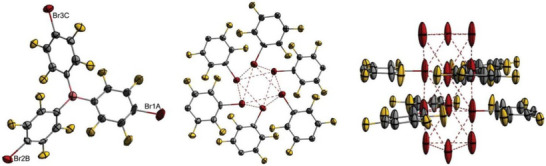 Figure 1
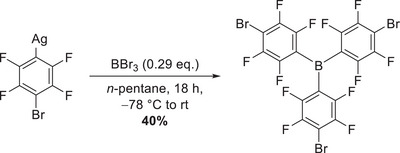 Figure 2
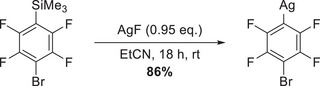 Figure 3
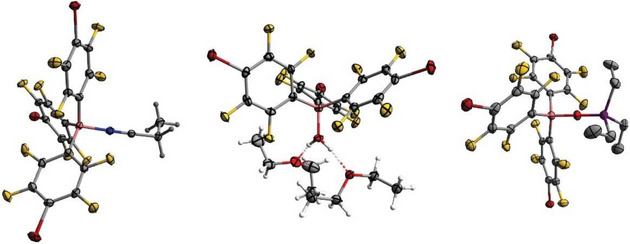 Figure 4
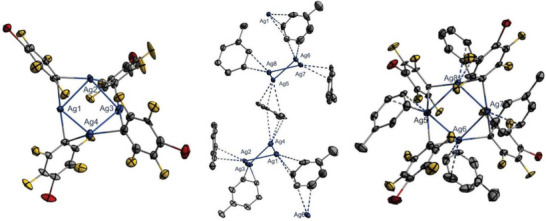 Figure 5
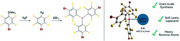 Figure 6
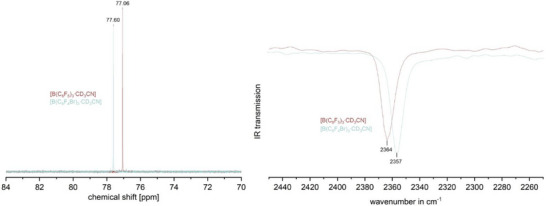 Figure 7
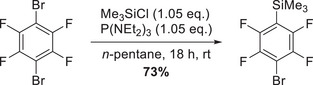 Figure 8
Peer Reviews
No public reviews on file for this paper yet. If you reviewed it on a platform where reviews are public (OpenReview, ICLR, NeurIPS, ICML), you can paste yours below so the community can read it here.
Videos
No videos yet. Explain this paper in a talk, walkthrough, or lecture? Add one.
Taxonomy
TopicsOrganoboron and organosilicon chemistry · Synthesis and characterization of novel inorganic/organometallic compounds · Crystallography and molecular interactions