The N‐Bromo‐Hammick Intermediate
Virinder Bhagat, J. Philipp Wagner

TL;DR
Scientists identified a unique chemical intermediate with a special electronic structure that allows it to convert into a more stable form without bending.
Contribution
The discovery of the N-bromo-Hammick intermediate's σ²σ*⁰ electronic structure and planar isomerization mechanism.
Findings
The N-bromo-Hammick intermediate is a singlet carbene with a σ²σ*⁰ electronic structure.
It isomerizes to bromopyridine via a planar transition state, avoiding structural distortion.
Its reaction with hydrogen is blocked by a small but significant energy barrier at low temperatures.
Abstract
We report the characterization of bromopyridin‐2‐ylidene, the N‐bromo‐Hammick intermediate, isolated in solid neon at 4.4 K. Computations (B2PLYP, NEVPT2), IR, and UV/vis spectroscopy characterize this intermediate as a singlet carbene with a vacant σ*‐type frontier orbital. This unusual electronic structure (σ2σ*0) allows the carbene to isomerize to its more stable pyridine tautomer via a planar transition state, avoiding the deviation from planarity seen in other singlet carbenes. The compound's reaction with molecular hydrogen faces a minor but prohibitive barrier (8.4 kcal mol−1) at the low temperatures of the experiment. Spectroscopic and computational analysis uncovers the σ2σ*0 electronic structure of the N‐bromo‐Hammick intermediate, a singlet N‐heterocyclic carbene isolated in solid neon, whose back‐isomerization to bromopyridine proceeds via a planar transition state.
Genes, proteins, chemicals, diseases, species, mutations and cell lines named across the full text — each resolved to its canonical identifier and authoritative record.
Click any figure to enlarge with its caption.
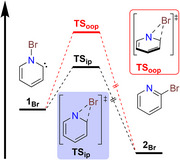 Figure 1
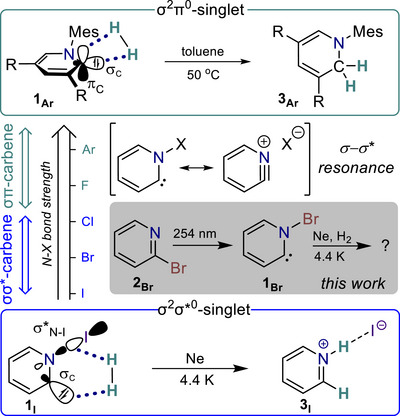 Figure 2
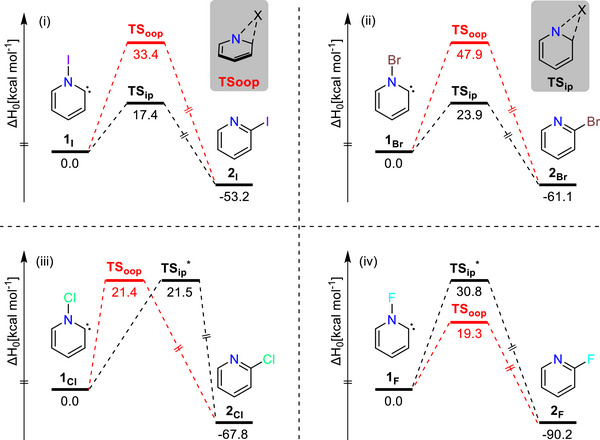 Figure 3
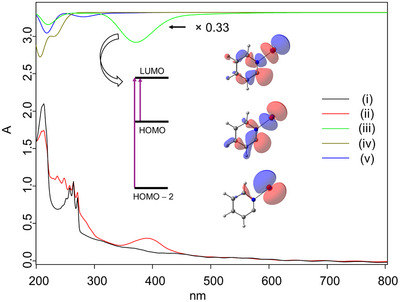 Figure 4
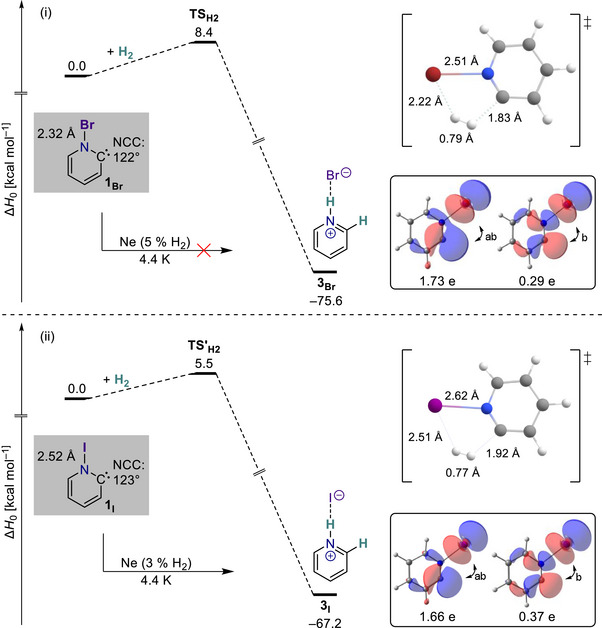 Figure 5
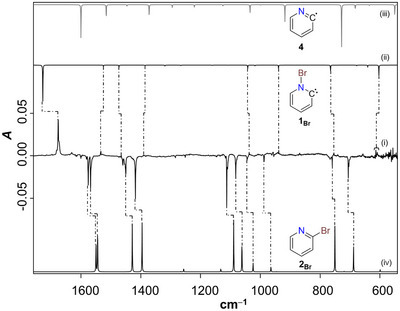 Figure 6
Peer Reviews
No public reviews on file for this paper yet. If you reviewed it on a platform where reviews are public (OpenReview, ICLR, NeurIPS, ICML), you can paste yours below so the community can read it here.
Videos
No videos yet. Explain this paper in a talk, walkthrough, or lecture? Add one.
Taxonomy
TopicsN-Heterocyclic Carbenes in Organic and Inorganic Chemistry · Cyclopropane Reaction Mechanisms · Catalytic Cross-Coupling Reactions