Experimental evidence for social learning in semi-natural, wild-type Norway rats
Sacha C. Engelhardt, Harshkumar Vasoya, Michael Taborsky

TL;DR
Wild Norway rats can learn a complex task through social learning, even without close family ties.
Contribution
Demonstrates social learning in wild-type Norway rats for non-intuitive tasks in semi-natural settings.
Findings
Rats learned a seesaw task faster when living with experienced rats.
Social transmission of the task occurred regardless of colony relatedness.
Innovations in task performance arose through trial-and-error learning.
Abstract
Animals may acquire information about their environment by social learning. Social transmission can affect the rate of trait acquisition and performance. It is often unclear, how behaviours are acquired when social information is available. In particular, the role of social learning in the acquisition of non-intuitive tasks is currently obscure. We asked whether wild-type Norway rats, Rattus norvegicus, in six semi-natural outside colonies benefit from each other in the acquisition and performance of a non-intuitive task by social learning. The task involved the opening of a seesaw mechanism to obtain a food reward. We induced innovations in four of six colonies and controlled the number of trained individuals and the relatedness composition. The latency to the first successful seesaw manipulation was shorter for naïve rats living with four experienced rats than for those living with…
Genes, proteins, chemicals, diseases, species, mutations and cell lines named across the full text — each resolved to its canonical identifier and authoritative record.
Click any figure to enlarge with its caption.
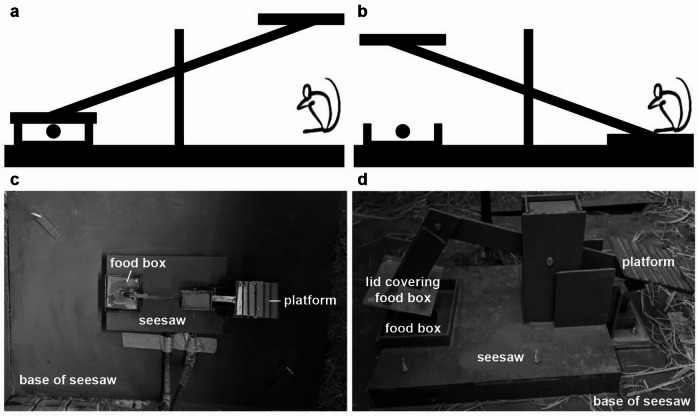 Figure 1
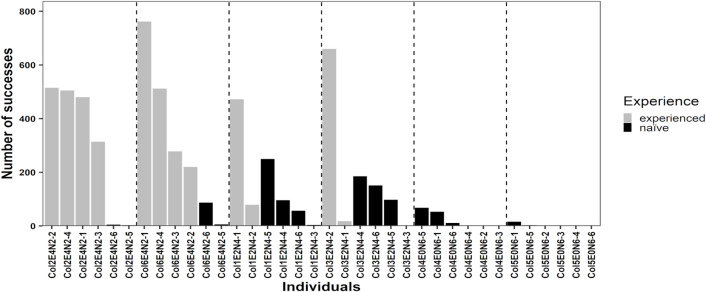 Figure 2
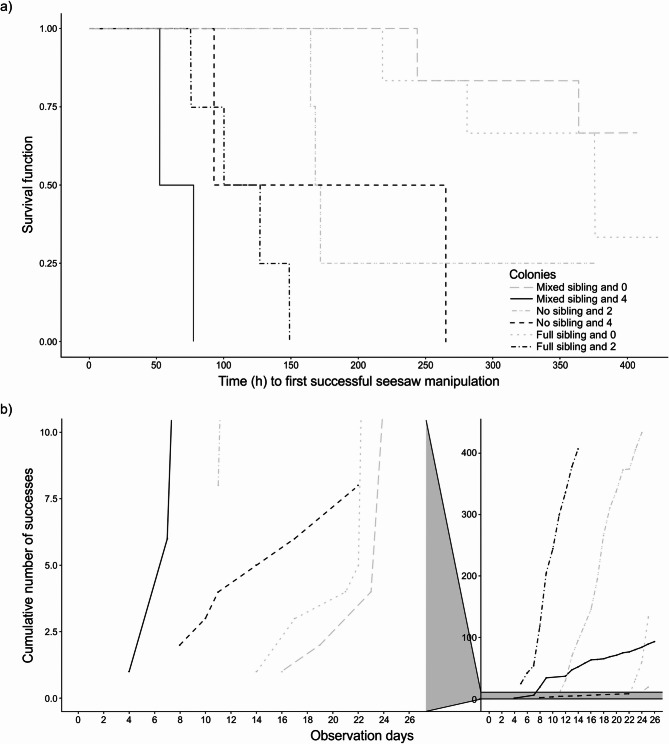 Figure 3
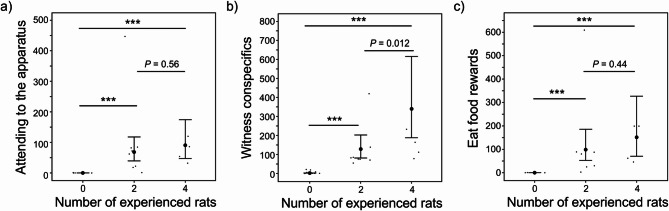 Figure 4
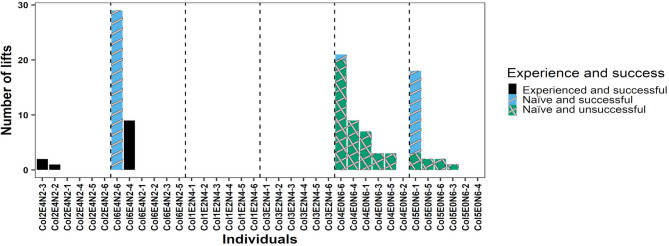 Figure 5
Peer Reviews
No public reviews on file for this paper yet. If you reviewed it on a platform where reviews are public (OpenReview, ICLR, NeurIPS, ICML), you can paste yours below so the community can read it here.
Videos
No videos yet. Explain this paper in a talk, walkthrough, or lecture? Add one.
Taxonomy
TopicsNeuroendocrine regulation and behavior · Primate Behavior and Ecology · Behavioral and Psychological Studies