Development and validation of predictive model for emesis in cervical cancer patients receiving concurrent chemoradiotherapy based on multi-institutional retrospective study
Kensuke Yoshida, Hajime Morita, Masaki Nakai, Yusuke Kawamura, Takuma Matsumoto, Yoshinobu Gohara, Naoto Hoshino, Naoya Tonomura, Manami Banba, Ayako Yamaguchi, Masaki Tachibana, Tomoki Fukushima, Hiroki Hosokawa, Takuya Mura, Tsuyoshi Yabuki, Kyongsun Pak, Shinichi Watanabe

TL;DR
This study created a model to predict chemotherapy-induced nausea and vomiting in cervical cancer patients undergoing chemoradiotherapy, which could help tailor antiemetic treatments.
Contribution
The study introduces a validated predictive model for CINV in cervical cancer patients receiving CCRT, which is a novel tool for personalized antiemetic strategies.
Findings
The model achieved an ROC-AUC of 0.772 in the training dataset and 0.808 in the validation dataset.
The model includes predictors such as age, smoking history, and cancer stage, showing good discrimination and calibration.
The model may help individualize antiemetic strategies and improve patient care.
Abstract
Chemotherapy-induced nausea and vomiting (CINV) remains a significant barrier to treatment adherence and quality of life in cervical cancer patients receiving chemoradiotherapy. No validated predictive models exist to assess CINV risk in this population. We aimed to develop and temporal validate a predictive model for CINV incidence in cervical cancer patients receiving concurrent chemoradiotherapy (CCRT). This multi-institutional, retrospective cohort study analyzed 921 patients who received CCRT with weekly cisplatin (40 mg/m2) between January 2016 and March 2024. Candidate predictors were selected through expert consultations and literature reviews. A multivariate logistic regression model was developed using training data, and the model with the highest receiver operating characteristic-area under the curve (ROC-AUC) was tested using validation data. The model (age, smoking history,…
Genes, proteins, chemicals, diseases, species, mutations and cell lines named across the full text — each resolved to its canonical identifier and authoritative record.
Click any figure to enlarge with its caption.
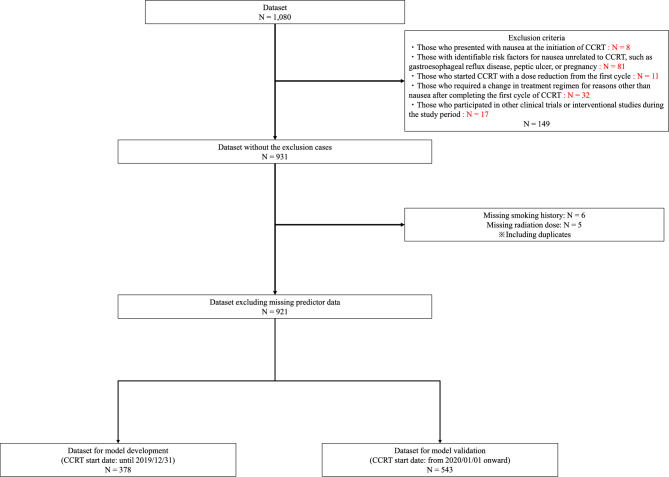 Figure 1
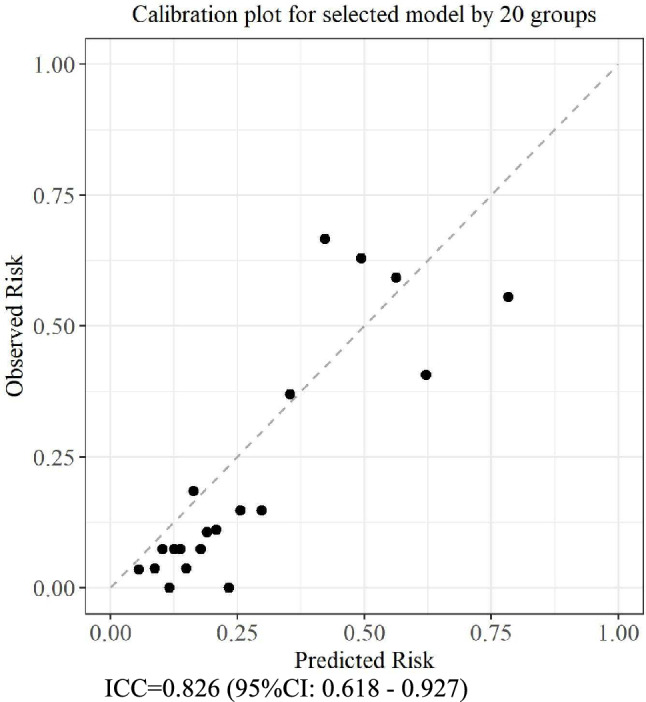 Figure 2
Peer Reviews
No public reviews on file for this paper yet. If you reviewed it on a platform where reviews are public (OpenReview, ICLR, NeurIPS, ICML), you can paste yours below so the community can read it here.
Videos
No videos yet. Explain this paper in a talk, walkthrough, or lecture? Add one.
Taxonomy
TopicsNausea and vomiting management · Anesthesia and Pain Management · Pathogenesis and Treatment of Hiccups