Resilience in neurodivergence: professional perspectives mapped to the World Health Organisations’ International Classification of Functioning
Melissa H. Black, Julie Segers, Soheil Mahdi, Cecilia Ingard, Vincent Grimaldi de Puget, Sven Bölte

TL;DR
The study explores factors that support well-being in neurodivergent individuals, using a global framework to identify resilience and risk factors across their lives.
Contribution
The study maps professional perspectives on resilience in neurodivergent populations to the WHO’s ICF framework, identifying bio-psycho-social factors.
Findings
Environmental and activity-related factors are seen as key for resilience in neurodivergent individuals.
Factors like emotional functions, brain structure, and family dynamics were identified as important for well-being.
The findings highlight potential targets for interventions to support neurodivergent people’s mental health and functioning.
Abstract
Individuals with childhood-onset divergent neurological development, such as autism or Attention-Deficit Hyperactivity Disorder (ADHD), may live a good life according to objectively or subjectively determined standards. Yet, most research has focused on deficits and risks for negative outcomes. This international study forms part of a larger project examining the factors contributing to well-being, mental health, and functioning outcomes in neurodivergent populations using the World Health Organization (WHO) International Classification of Functioning (ICF). Following ICF research branch methodology, 198 professionals were surveyed on the factors that they believe are important for risk and resilience in neurodivergent populations and linked responses to ICF nomenclature using a standardized linking process. A range of bio-psycho-social factors perceived to be important for risk and…
Genes, proteins, chemicals, diseases, species, mutations and cell lines named across the full text — each resolved to its canonical identifier and authoritative record.
Click any figure to enlarge with its caption.
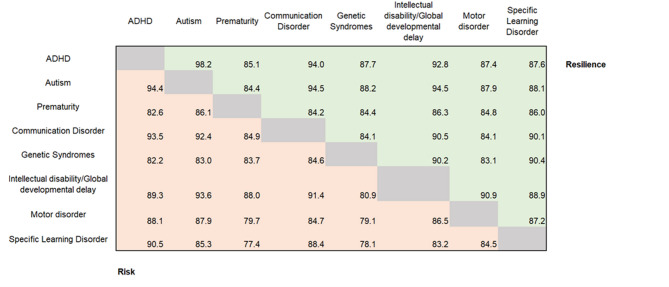 Figure 1
Peer Reviews
No public reviews on file for this paper yet. If you reviewed it on a platform where reviews are public (OpenReview, ICLR, NeurIPS, ICML), you can paste yours below so the community can read it here.
Videos
No videos yet. Explain this paper in a talk, walkthrough, or lecture? Add one.
Taxonomy
TopicsAutism Spectrum Disorder Research · Attention Deficit Hyperactivity Disorder · Cerebral Palsy and Movement Disorders