Trends in the incidence of brain cancer and the use of mobile phones: analysis of the Spanish Network of Cancer Registries (REDECAN)
Jaume Galceran, Alberto Ameijide, Adela Cañete, Rafael Peris-Bonet, Arantza López de Munain, Amaia Aizpurúa, Marta de la Cruz, Arantza Sanvisens, María José Sánchez, Isabel Palacios, Paula Franch, Antonia Sánchez, Marcela Guevara, Marià Carulla, Pilar Gutiérrez, Isabel Sáez

TL;DR
This study examines trends in brain cancer incidence in Spain from 1985 to 2015 and finds no evidence linking it to mobile phone use.
Contribution
The study provides updated Spanish data on CNS cancer trends and evaluates their potential ecological correlation with mobile phone use.
Findings
Adult brain cancer rates increased slightly until 1996 then declined, while children's rates rose until 1991 then fell.
The observed incidence changes are likely due to improved diagnostics rather than mobile phone use.
No significant correlation was found between mobile phone use and brain cancer incidence.
Abstract
The association between the use of mobile phones use and the risk of brain cancer remains controversial. The aim of this study is to describe trends in the incidence of central nervous system (CNS) cancers in Spain and its possible relationship with mobile phone use. Trends and trend changes from 1985 to 2015 in adjusted incidence rates of CNS cancers by sex, age (adults and children), site, and histological type were assessed using data from 14 general and paediatric cancer registries. The study included 20,325 CNS malignancies in adults and 2,372 in children. For adults, the overall rate of malignant brain tumours showed a slight increase of 0.2% (95% CI: 0.1 - 0.4) per year. This increase was concentrated in the early years up to 1996 (1.7% per year, 95% CI: 0.9 - 2.6) followed by 20 years of a non-significant slight decline of -0.1% (95% CI: -0.4 - 0.1) per year until 2015. In…
Genes, proteins, chemicals, diseases, species, mutations and cell lines named across the full text — each resolved to its canonical identifier and authoritative record.
Click any figure to enlarge with its caption.
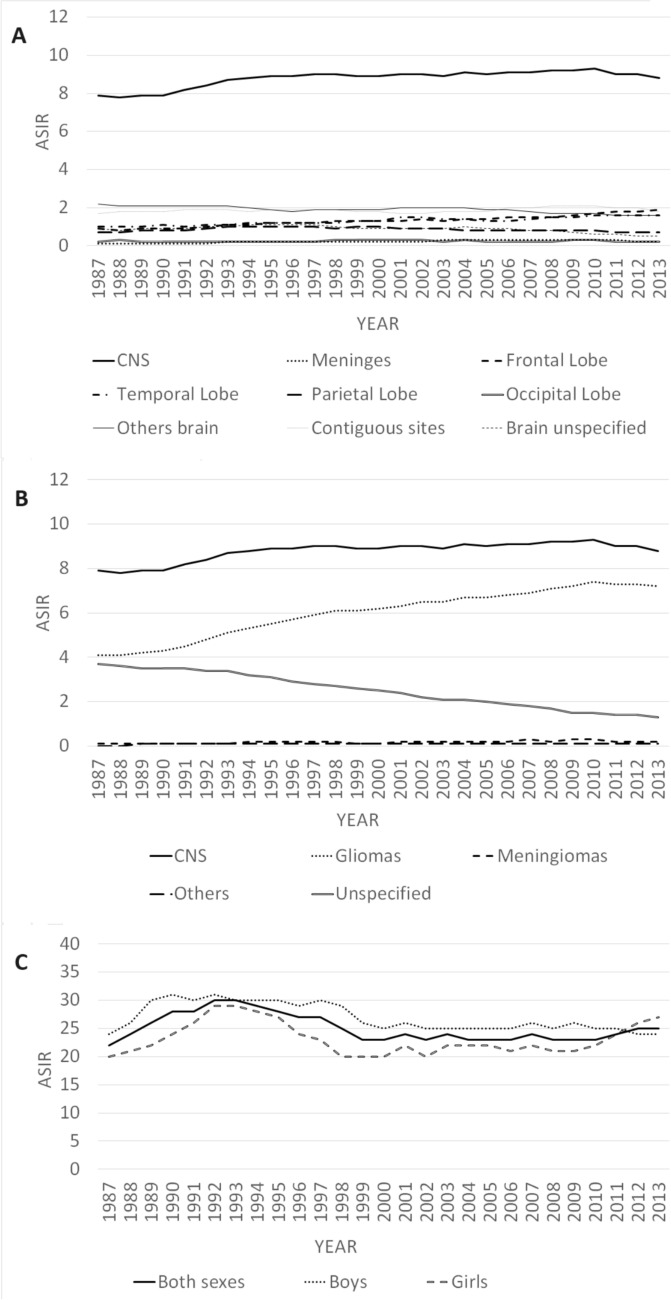 Figure 1
Peer Reviews
No public reviews on file for this paper yet. If you reviewed it on a platform where reviews are public (OpenReview, ICLR, NeurIPS, ICML), you can paste yours below so the community can read it here.
Videos
No videos yet. Explain this paper in a talk, walkthrough, or lecture? Add one.
Taxonomy
TopicsElectromagnetic Fields and Biological Effects · Acute Lymphoblastic Leukemia research · Childhood Cancer Survivors' Quality of Life