Wall Thickness‐Guided vs. Voltage‐Guided Pulmonary Vein Isolation for Atrial Fibrillation
Moyuru Hirata, Ryuta Watanabe, Koichi Nagashima, Yuji Wakamatsu, Naoto Otsuka, Shu Hirata, Yuji Saito, Masanaru Sawada, Shiro Nakahara, Yasuo Okumura

TL;DR
This study compares two methods for treating atrial fibrillation and finds that one method results in fewer complications during the procedure.
Contribution
The study introduces a new approach using wall thickness to guide ablation, showing better results than the traditional voltage-guided method.
Findings
The wall thickness-guided group had a lower incidence of PV gaps compared to the voltage-guided group.
Both ablation strategies were performed without procedural complications.
Multivariable analysis showed wall thickness-guided ablation was more effective in preventing PV gaps.
Abstract
The efficacy and safety of tailored pulmonary vein isolation (PVI) guided by either left atrial wall thickness (LAWT) or bipolar voltage remain unclear. The aim of this prospective study was to evaluate the efficacy and safety of each ablation strategy. We conducted a prospective analysis of 97 patients with non‐valvular atrial fibrillation (AF) who underwent an initial RF catheter ablation procedure known as an extensive encircling PVI. Fifty patients underwent PVI using a wall thickness (WT)‐guided approach using ADAS 3D software and 47 patients using a voltage‐guided approach. In each strategy, high‐power short‐duration (HPSD) ablation was applied to regions with increased LAWT or elevated bipolar voltage, respectively, while very high‐power short‐duration (vHPSD) ablation was delivered to the remaining regions. The first‐pass PVI rate tended to be higher in the WT‐guided group…
Genes, proteins, chemicals, diseases, species, mutations and cell lines named across the full text — each resolved to its canonical identifier and authoritative record.
Click any figure to enlarge with its caption.
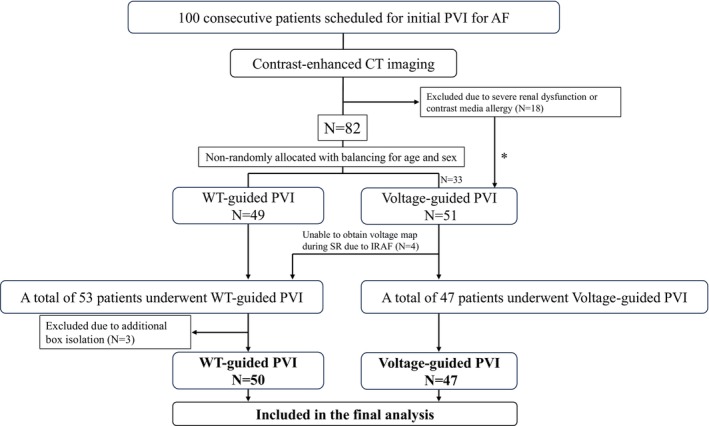 Figure 1
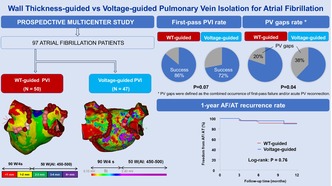 Figure 2
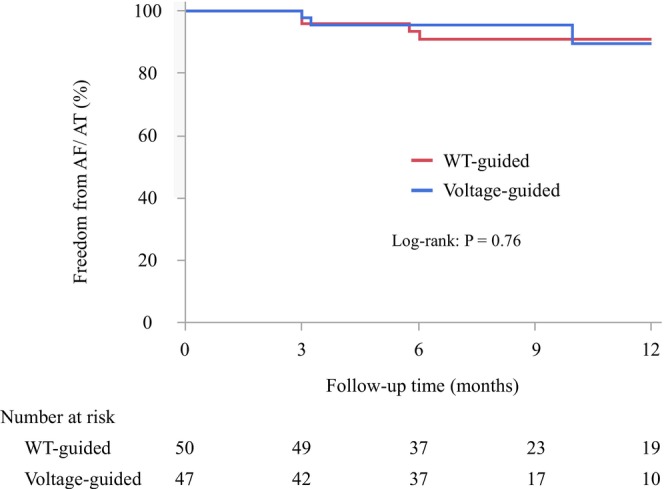 Figure 3
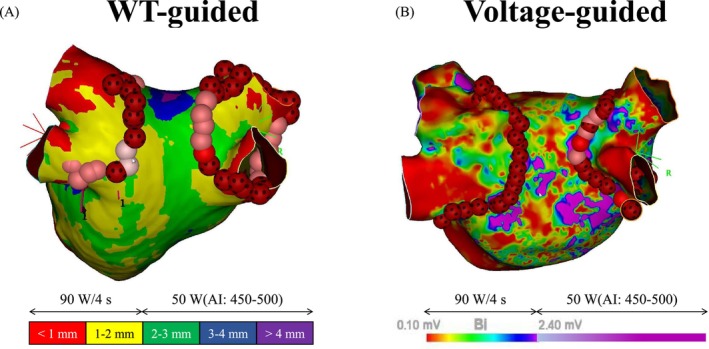 Figure 4
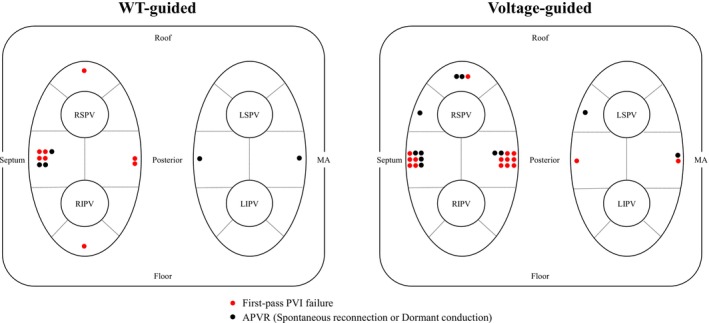 Figure 5
Peer Reviews
No public reviews on file for this paper yet. If you reviewed it on a platform where reviews are public (OpenReview, ICLR, NeurIPS, ICML), you can paste yours below so the community can read it here.
Videos
No videos yet. Explain this paper in a talk, walkthrough, or lecture? Add one.
Taxonomy
TopicsAtrial Fibrillation Management and Outcomes · Cardiac Arrhythmias and Treatments · Microbial Inactivation Methods