Prognostic value of quantitative and visual electroencephalography in disorders of consciousness: a retrospective study
Yuhei Mori, Kazuko Kanno, Hiroshi Hoshino, Ken Suzutani, Asami Oyama, Shuntaro Itagaki, Yasuto Kunii, Itaru Miura

TL;DR
This study compares visual and quantitative EEG methods for predicting outcomes in patients with impaired consciousness, finding that combining both with clinical factors improves accuracy.
Contribution
The study directly compares visual and quantitative EEG for prognosis in disorders of consciousness and evaluates their combined use with clinical factors.
Findings
Visual EEG had moderate predictive accuracy for survival and neurological outcomes.
qEEG models showed comparable performance to visual EEG but with no significant difference.
Adding clinical factors significantly improved predictive accuracy for neurological recovery.
Abstract
Electroencephalography (EEG) is widely used to assess prognosis in patients with disorders of consciousness (DoC). Visual assessments by physicians and quantitative EEG (qEEG) are commonly used; however, only a few studies have directly compared their predictive accuracy. Therefore, in this study, we aimed to compare the prognostic value of visual EEG classification versus that of qEEG-based spectral analysis for survival and neurological outcomes in patients with impaired consciousness. In this retrospective study, we examined 97 patients with impaired consciousness admitted to the Emergency and Critical Care Center of Fukushima Medical University Hospital between April 2018 and December 2023. Visual EEG grading was performed using a conventional grading system based on established criteria. Receiver operating characteristic (ROC) curves were used to compare predictive performance.…
Genes, proteins, chemicals, diseases, species, mutations and cell lines named across the full text — each resolved to its canonical identifier and authoritative record.
Click any figure to enlarge with its caption.
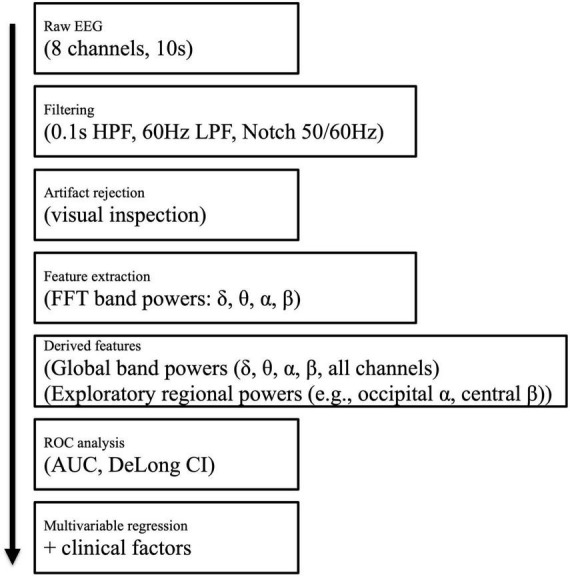 Figure 1
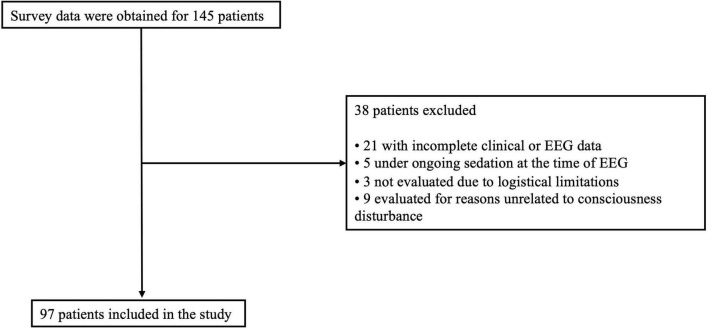 Figure 2
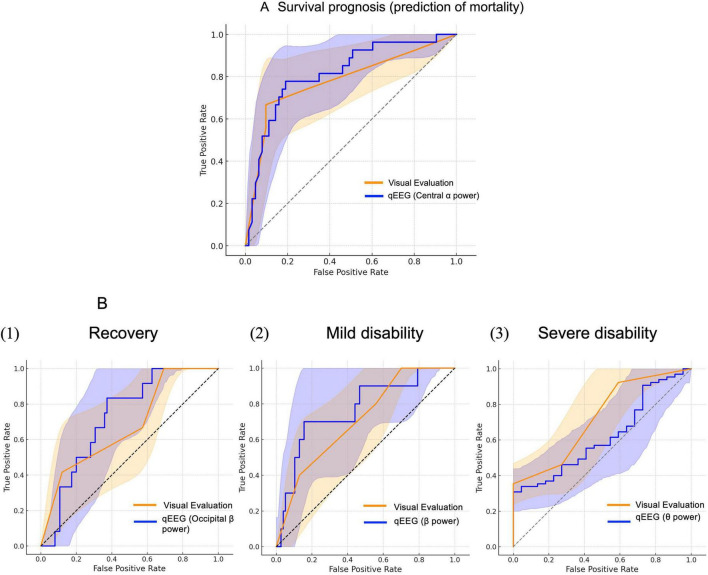 Figure 3
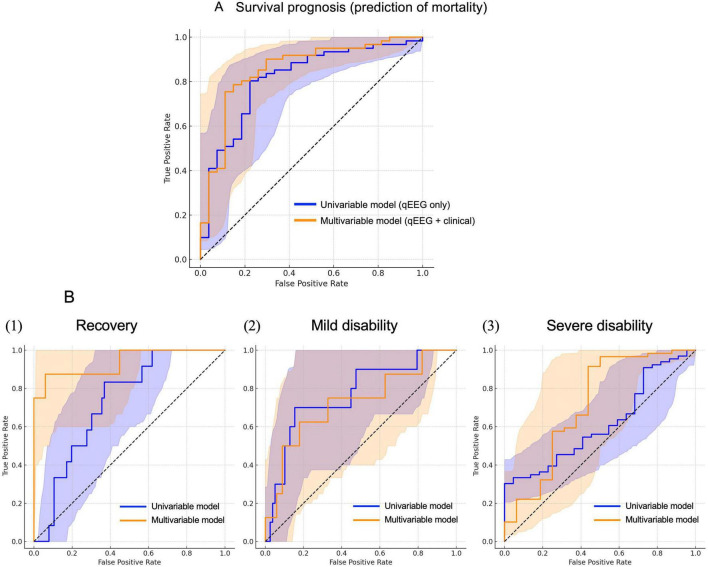 Figure 4
Peer Reviews
No public reviews on file for this paper yet. If you reviewed it on a platform where reviews are public (OpenReview, ICLR, NeurIPS, ICML), you can paste yours below so the community can read it here.
Videos
No videos yet. Explain this paper in a talk, walkthrough, or lecture? Add one.
Taxonomy
TopicsTraumatic Brain Injury Research · Traumatic Brain Injury and Neurovascular Disturbances · Cardiac Arrest and Resuscitation