A Rare Familial Case of Harlequin Ichthyosis in an Infant of a Diabetic Mother: A Diagnostic and Management Challenge in Low and Middle Income Settings
Muhammad Zaeem, Ameer Hamza Mehmood Ul Hassan, Muhammad Hassaan Javaid, Muhammad Usman, Muhammad Ahmed, Muhammad Usama Naveed, Mohammad Yassin Al Aboud

TL;DR
This paper describes a rare case of Harlequin Ichthyosis in a diabetic mother's infant, highlighting challenges in diagnosis and management in low- and middle-income countries.
Contribution
The paper presents the first reported case in the region linking maternal diabetes to increased severity of Harlequin Ichthyosis.
Findings
The neonate showed classical signs of Harlequin Ichthyosis but succumbed to sepsis despite treatment.
Maternal diabetes may worsen HI severity through epigenetic effects on fetal gene expression.
Healthcare system gaps and consanguinity contribute to poor HI outcomes in low-resource settings.
Abstract
Harlequin Ichthyosis (HI) is an extremely rare, autosomal recessive, and highly fatal condition in neonates. It is especially difficult to control in the low‐ and middle‐income countries (LMICs) due to the low rate of prenatal screening, cultural reluctance, and lack of access to neonatal intensive care. We present a 37‐week neonate born to a diabetic mother from a consanguineous marriage with a background of HI‐related neonatal mortality. The child had classical manifestations of HI in the form of hyperkeratotic armor‐like plates, eclabium, ectropion, and limb contractures. Oral acitretin was started at 1.1 mg/kg/day along with intensive supportive care but the neonate had become septic and succumbed on day nine despite multi‐antibiotic therapy, intravenous fluid resuscitation, and oral retinoid therapy. There was mild dermatological improvement with retinoid therapy but systemic…
Genes, proteins, chemicals, diseases, species, mutations and cell lines named across the full text — each resolved to its canonical identifier and authoritative record.
Click any figure to enlarge with its caption.
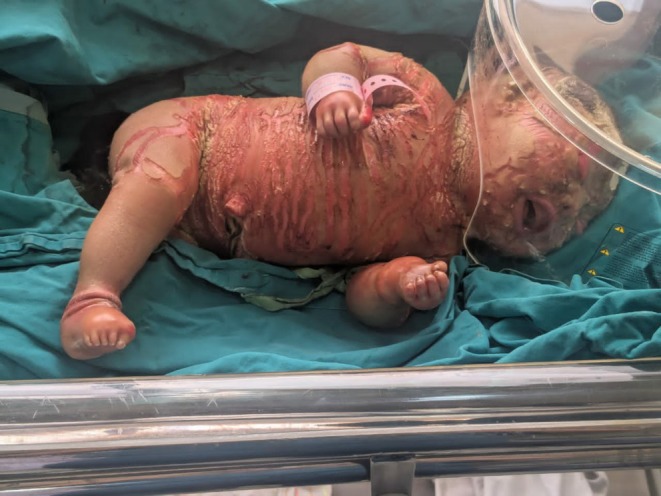 Figure 1
Peer Reviews
No public reviews on file for this paper yet. If you reviewed it on a platform where reviews are public (OpenReview, ICLR, NeurIPS, ICML), you can paste yours below so the community can read it here.
Videos
No videos yet. Explain this paper in a talk, walkthrough, or lecture? Add one.
Taxonomy
TopicsSkin and Cellular Biology Research · Neonatal skin health care · Skin Diseases and Diabetes