Guiding first-line treatment decisions in advanced urothelial carcinoma: a global survey
Enrique Grande, Joaquim Bellmunt, Syed A Hussain, Mubarak M Al Mansour, Aristotle Bamias, Philippe Barthélémy, David J Benjamin, Normand Blais, Maria T Bourlon, Daniel Castellano, Pongwut Danchaivijitr, Mauricio Fernandez Lazzaro, Patrizia Giannatempo, Félix Guerrero-Ramos

TL;DR
This global survey explores how doctors decide to use a new cancer treatment for advanced urothelial carcinoma, focusing on factors that affect its safe and effective use.
Contribution
The study provides real-world insights into physician decision-making and perceived contraindications for a novel first-line therapy in advanced urothelial carcinoma.
Findings
Sensory or motor neuropathy grade ≥2 was the most frequently cited contraindication for EV-P.
Physicians emphasized the importance of ECOG-PS ≥3 and non-urothelial tumor components as critical factors.
The survey highlights the need for guidance to optimize EV-P integration into clinical practice.
Abstract
Enfortumab vedotin combined with pembrolizumab (EV-P) has become the new standard first-line therapy for patients with advanced urothelial carcinoma (aUC), based on its superior efficacy over platinum-based chemotherapy. As this regimen is increasingly adopted in routine care, treatment decisions may often occur in sites without dedicated genitourinary oncology expertise. This global survey aimed to explore how physicians perceive clinical factors that may influence the safe and effective use of EV-P in daily practice. A panel of international physicians with experience in treating patients with genitourinary cancers developed a 17-question survey addressing practice settings, experience in managing aUC, and clinical considerations relevant to the use of EV-P. The participants were recruited through a network-based convenience sampling method. The responses were descriptively analyzed.…
Genes, proteins, chemicals, diseases, species, mutations and cell lines named across the full text — each resolved to its canonical identifier and authoritative record.
Click any figure to enlarge with its caption.
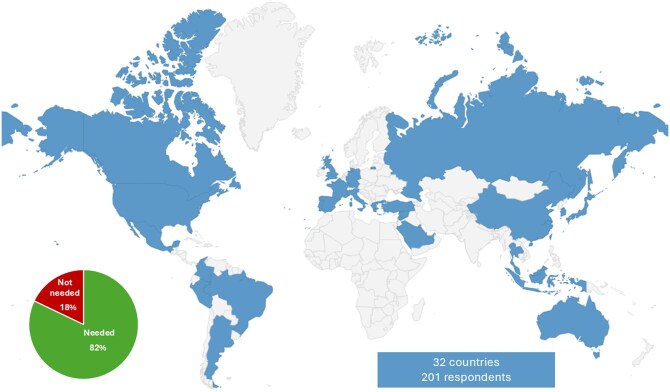 Figure 1
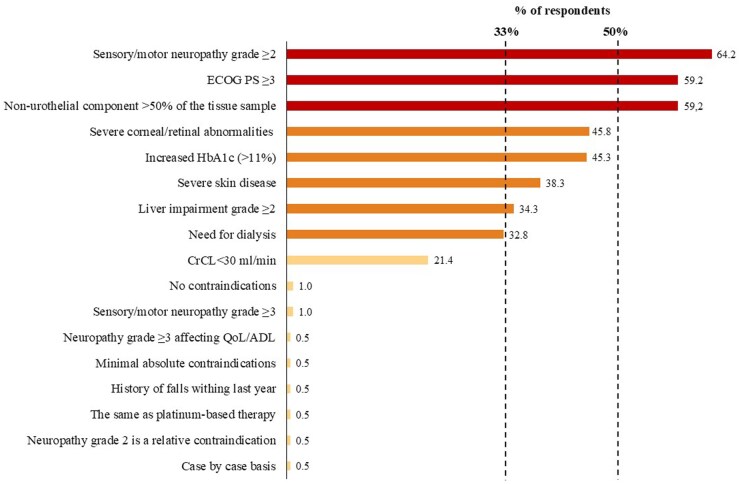 Figure 2
Peer Reviews
No public reviews on file for this paper yet. If you reviewed it on a platform where reviews are public (OpenReview, ICLR, NeurIPS, ICML), you can paste yours below so the community can read it here.
Videos
No videos yet. Explain this paper in a talk, walkthrough, or lecture? Add one.
Taxonomy
TopicsBladder and Urothelial Cancer Treatments · Ovarian cancer diagnosis and treatment · Urinary and Genital Oncology Studies