Molecular pathogenesis, diagnosis, and management challenges in complete androgen insensitivity syndrome
Chunqing Wang, Qinjie Tian

TL;DR
Complete androgen insensitivity syndrome causes female-like appearance in individuals with male chromosomes due to androgen receptor mutations, leading to challenges in diagnosis and management.
Contribution
This review provides a comprehensive overview of the molecular pathogenesis, diagnosis, and management of complete androgen insensitivity syndrome.
Findings
CAIS is caused by androgen receptor gene mutations, leading to female phenotypes despite male chromosomes.
Diagnosis is challenging due to atypical symptoms and requires hormonal assays, imaging, and genetic testing.
Management involves gonadectomy, hormone therapy, and psychological support to address physical and mental health risks.
Abstract
Complete androgen insensitivity syndrome (CAIS) is a rare X-linked recessive disorder of sex development (DSD) caused by androgen receptor (AR) gene mutation and present with female phenotypes with male chromosomal karyotype. Primitive bipotent gonads in CAIS differentiate into testes producing androgens and antimüllerian hormone (AMH). However, androgens cannot stimulate embryonic wolffian ducts into male internal reproductive organs owing to AR defect and hormone resistance, while AMH induces the regression of müllerian ducts with the absence of uterus, fallopian tubes, and upper third of the vagina. Thus, with male sex chromosome and testes, individuals with CAIS present with a typical female phenotype, primary amenorrhea (PA) and infertility, spontaneous thelarche during puberty, absent or sparse axillary/pubic hair, and increased risk of gonadal tumors in cryptorchidism. Though…
Genes, proteins, chemicals, diseases, species, mutations and cell lines named across the full text — each resolved to its canonical identifier and authoritative record.
Click any figure to enlarge with its caption.
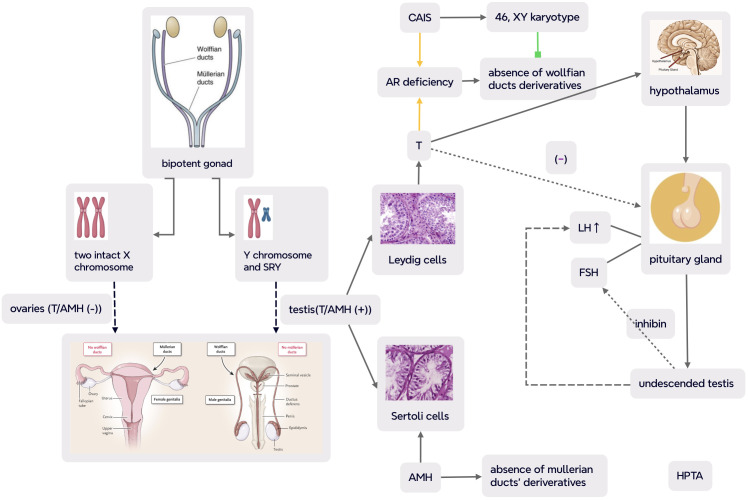 Figure 1
 Figure 2
Peer Reviews
No public reviews on file for this paper yet. If you reviewed it on a platform where reviews are public (OpenReview, ICLR, NeurIPS, ICML), you can paste yours below so the community can read it here.
Videos
No videos yet. Explain this paper in a talk, walkthrough, or lecture? Add one.
Taxonomy
TopicsSexual Differentiation and Disorders · Hormonal and reproductive studies · Blood groups and transfusion