Must Epidemiologically Impactful Vector Control Interventions Disrupt Mosquito Population Structure? A Case Study of a Cluster‐Randomised Controlled Trial
Tristan P. W. Dennis, W. Moussa Guelbeogo, Heather M. Ferguson, Steve Lindsay, Sagnon N'Fale, Patricia Pignatelli, Hilary Ranson, Antoine Sanou, Alfred Tiono, David Weetman, Mafalda Viana

TL;DR
This study examines whether a mosquito control intervention affects mosquito population structure and finds that even with reduced malaria cases and mosquito numbers, the genetic makeup of the mosquito population remains largely unchanged.
Contribution
The study provides the first evidence that epidemiologically meaningful reductions in vector density may not impact genetic diversity or connectivity in large mosquito populations.
Findings
ITN-PPF reduced clinical malaria by 12% and vector density by 22%, but no significant changes in An. gambiae population genetic structure or diversity were observed.
Population differentiation was low, and no discernible clustering by treatment, time, or space was detected.
Genome-wide scans showed no signatures of selection between trial arms, suggesting ITN-PPF did not alter An. gambiae genetic structure.
Abstract
Large epidemiological impacts resulting from disease vector control interventions are typically associated with significant disruption of vector populations. While vector density is a frequently measured response, impacts on demography and connectivity are suspected but rarely quantified. We analysed low‐coverage whole‐genome sequence data of 893 Anopheles gambiae mosquitoes collected between 2014 and 2015 during a cluster‐randomized control trial (cRCT) in Burkina Faso to compare a pyrethroid‐only net (ITN) with a pyrethroid‐pyriproxyfen (ITN‐PPF) net. Despite reductions of clinical malaria by 12% and vector density by 22% in the ITN‐PPF arm, we found no significant changes in An. gambiae population genetic structure or diversity. We found remarkably low population differentiation and a lack of discernible clustering by treatment, time, or space. Nucleotide diversity and inbreeding…
Genes, proteins, chemicals, diseases, species, mutations and cell lines named across the full text — each resolved to its canonical identifier and authoritative record.
Click any figure to enlarge with its caption.
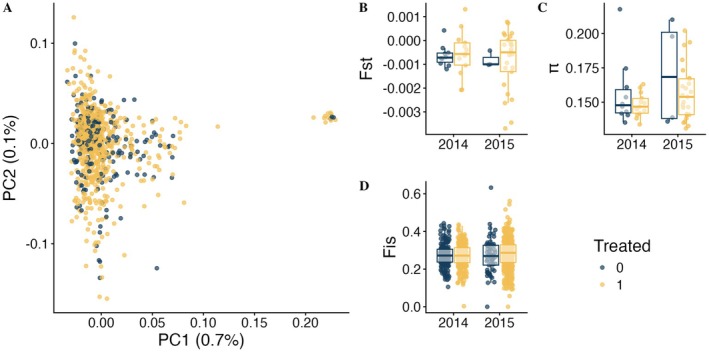 Figure 1
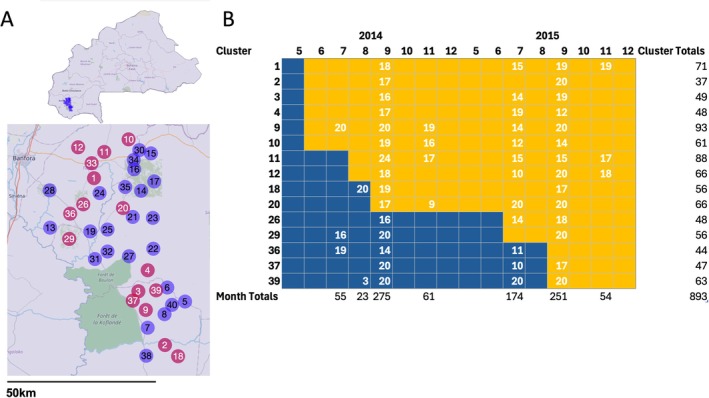 Figure 2
Peer Reviews
No public reviews on file for this paper yet. If you reviewed it on a platform where reviews are public (OpenReview, ICLR, NeurIPS, ICML), you can paste yours below so the community can read it here.
Videos
No videos yet. Explain this paper in a talk, walkthrough, or lecture? Add one.
Taxonomy
TopicsMalaria Research and Control · Mosquito-borne diseases and control · Invertebrate Immune Response Mechanisms