Detection of PDR5-mediated alachlor efflux using a chemically induced dimer biosensor
Hadar Dubkin, Gil Zimran, Assaf Mosquna

TL;DR
This paper introduces a biosensor to detect how the PDR5 transporter helps yeast expel the herbicide alachlor, offering a new tool for studying herbicide resistance.
Contribution
A synthetic biosensor is used to identify and validate PDR5 as a transporter of alachlor in yeast.
Findings
The biosensor detected PDR5-mediated alachlor efflux in yeast.
Alachlor accumulation was reduced when PDR5 was active.
A known PDR5 substrate inhibited alachlor efflux, confirming transporter activity.
Abstract
The development of herbicide-resistant crops is a key strategy for achieving efficient and sustainable agriculture. Herbicide tolerance can be conferred by transporters that mediate the efflux of herbicides, making them of particular interest for resistance development. However, identifying a transporter for a specific compound can be a challenging task. Here, we demonstrate the use of a synthetic, yeast two-hybrid-based molecular biosensor to identify transporter activity. A previously engineered biosensor responsive to the herbicide alachlor was utilized to monitor cytosolic alachlor levels in yeast, allowing for the evaluation of candidate transporters. A biosensor-reported shift in alachlor accumulation indicated the Saccharomyces cerevisiae transporter PDR5 as a potential mediator of alachlor efflux. PDR5’s effect on alachlor accumulation was suppressed by a known competing…
Genes, proteins, chemicals, diseases, species, mutations and cell lines named across the full text — each resolved to its canonical identifier and authoritative record.
Click any figure to enlarge with its caption.
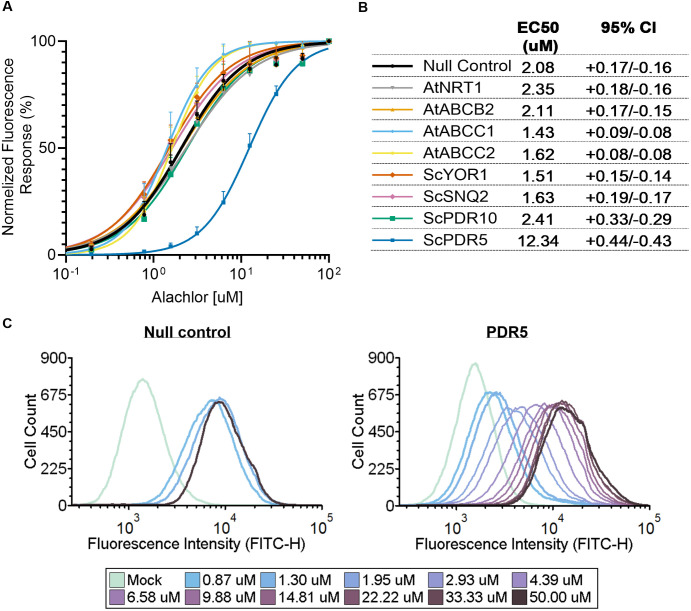 Figure 1
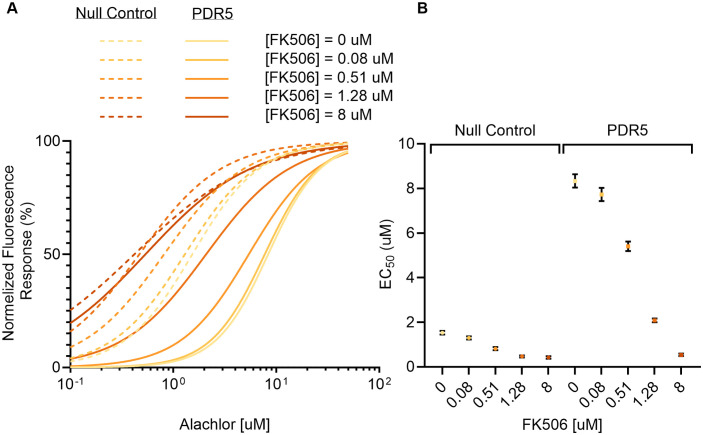 Figure 2
Peer Reviews
No public reviews on file for this paper yet. If you reviewed it on a platform where reviews are public (OpenReview, ICLR, NeurIPS, ICML), you can paste yours below so the community can read it here.
Videos
No videos yet. Explain this paper in a talk, walkthrough, or lecture? Add one.
Taxonomy
TopicsReceptor Mechanisms and Signaling · Mass Spectrometry Techniques and Applications · Advanced biosensing and bioanalysis techniques