Relationship between the asymmetry of the resting scapular position and the prevalence of latent myofascial trigger points in the trapezius muscle in asymptomatic adults
Yasuhiro Aki, Ippei Okino, Genki Tsuyama, Yoshiyasu Tanitsu, Hisao Nishijo, Kouichi Takamoto, Prateek Srivastav, Prateek Srivastav, Prateek Srivastav

TL;DR
This study finds a link between scapular asymmetry and muscle trigger points in asymptomatic adults, which could lead to musculoskeletal pain.
Contribution
It establishes a novel relationship between scapular position asymmetry and latent myofascial trigger points in asymptomatic individuals.
Findings
The horizontal scapular alignment angle was lower in individuals with latent trigger points in the right upper trapezius muscle.
Right scapular depression was more common in those with latent trigger points in the right upper trapezius muscle.
Dominant arm and presence of latent trigger points significantly predicted scapular asymmetry.
Abstract
Myofascial trigger points (MTrPs) and body postural misalignment, including the position of the scapula, can contribute to the onset and persistence of musculoskeletal pain. However, the relationship in asymptomatic cases remains unclear. Therefore, this study aimed to investigate the relationship between the asymmetry of the resting scapular position and latent MTrPs in the upper trapezius muscle (UTM) in asymptomatic adults. A total of 32 asymptomatic adult men (mean age, 26.28 ± 1.1 years) were included in this study. Full-body photographs were taken from the posterior view, with the participants resting in a standing position. To determine the degree of asymmetry of the resting scapular position, the horizontal scapular alignment angle (HSAA) was analyzed from the photographs. The assessor identified the presence of latent MTrPs in the right and left UTMs. The HSAA was significantly…
Genes, proteins, chemicals, diseases, species, mutations and cell lines named across the full text — each resolved to its canonical identifier and authoritative record.
Click any figure to enlarge with its caption.
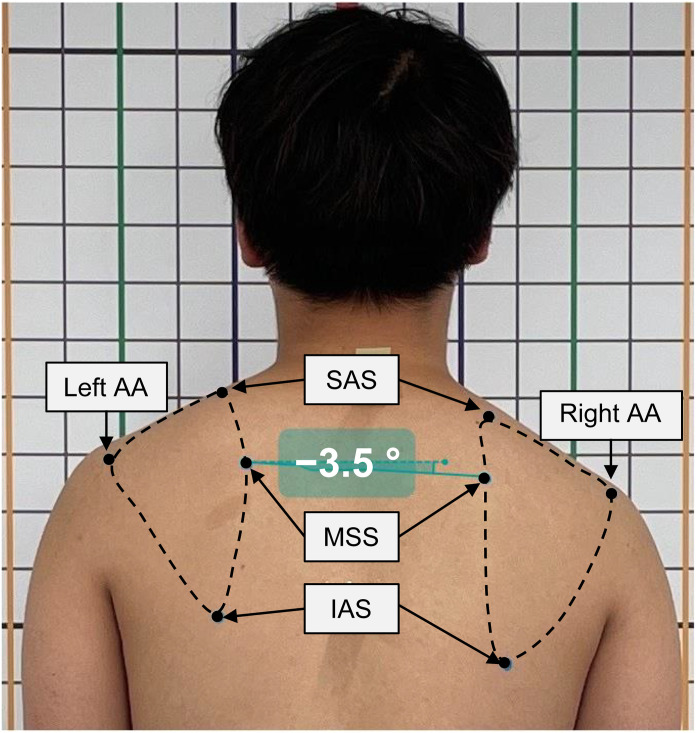 Figure 1
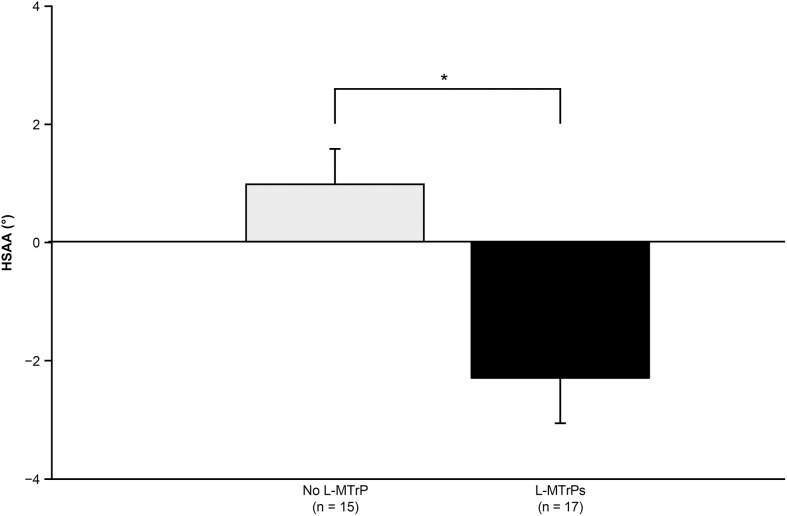 Figure 2
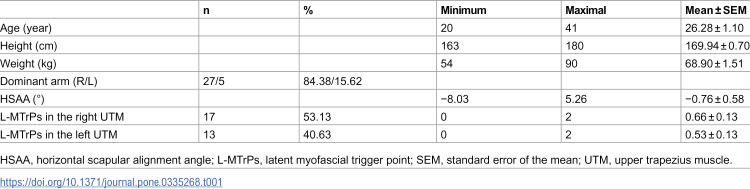 Figure 3
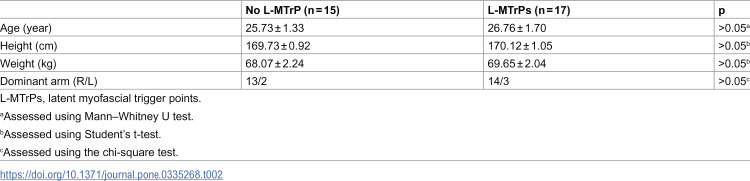 Figure 4
Peer Reviews
No public reviews on file for this paper yet. If you reviewed it on a platform where reviews are public (OpenReview, ICLR, NeurIPS, ICML), you can paste yours below so the community can read it here.
Videos
No videos yet. Explain this paper in a talk, walkthrough, or lecture? Add one.
Taxonomy
TopicsMyofascial pain diagnosis and treatment · Musculoskeletal pain and rehabilitation · Bach Studies and Logistics Development