Implementation of remote-sensing models to identify post-disaster health facility damage: Comparative approaches to the 2023 earthquake in Turkey
Anu Ramachandran, Akash Yadav, Andrew Schroeder

TL;DR
This paper evaluates AI models using satellite imagery to assess health facility damage after the 2023 Turkey earthquake, finding they can provide rapid reports but lack sufficient accuracy to replace manual assessments.
Contribution
The study introduces a novel method of overlaying AI model outputs with health facility data to estimate damage and identifies key error sources.
Findings
Model A estimated 10.4% damage, while Model B estimated 4.3% across 25 hospitals, 13 dialysis centers, and 454 pharmacies.
Sensitivity was low (42.9%) for both models, but specificity was high (93.6% for Model A, 96.8% for Model B).
Spatially aggregated damage estimates improved sensitivity and agreement compared to individual facility assessments.
Abstract
Earthquakes and other disasters often cause substantial damage to health facilities, impacting short-term response capacity and long-term health system needs. Identifying health facility damage following disasters is therefore crucial for coordinating response, but ground-based evaluations require substantial time and labor. Artificial intelligence (AI) models trained on satellite imagery can estimate building damage and could be used to generate rapid health facility damage reports. There is little published about methods of generating these estimates, testing real-world accuracy, or exploring error. This study presents a novel method of overlaying model damage outputs with health facility location data to generate health facility damage estimates following the February 2023 earthquake in Turkey. Two models were compared for agreement, accuracy, and errors. Building-level damage…
Genes, proteins, chemicals, diseases, species, mutations and cell lines named across the full text — each resolved to its canonical identifier and authoritative record.
Click any figure to enlarge with its caption.
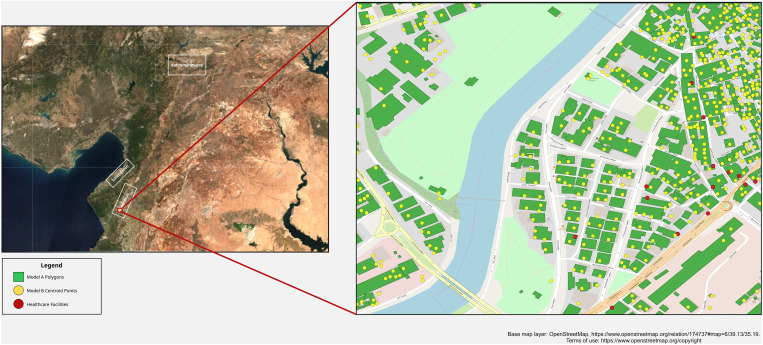 Figure 1
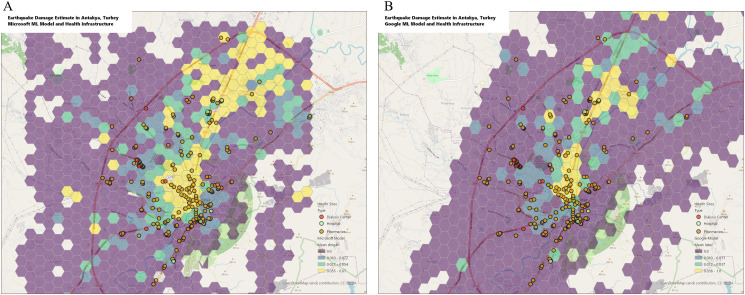 Figure 2
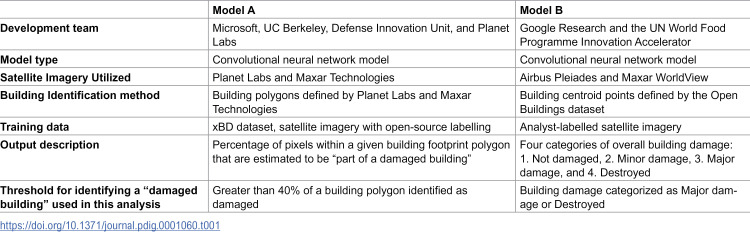 Figure 3
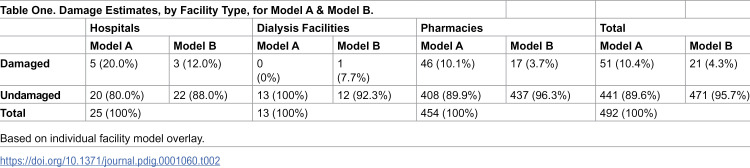 Figure 4
Peer Reviews
No public reviews on file for this paper yet. If you reviewed it on a platform where reviews are public (OpenReview, ICLR, NeurIPS, ICML), you can paste yours below so the community can read it here.
Videos
No videos yet. Explain this paper in a talk, walkthrough, or lecture? Add one.
Taxonomy
TopicsRemote-Sensing Image Classification · Anomaly Detection Techniques and Applications · Disaster Response and Management