Application of Commonly Used Physical Tests in a Virtual Environment in Patients With Concussion to Patients With Various Types and Severities of Acquired Brain Injury: Prospective Cohort Method Comparison Study
Keely Barnes, Heidi Sveistrup, Mark Bayley, Michel Rathbone, Monica Taljaard, Mary Egan, Martin Bilodeau, Motahareh Karimijashni, Shawn Marshall

TL;DR
This study evaluates how well physical concussion tests work when done virtually, finding that some tests are reliable while others need in-person assessment.
Contribution
The study provides psychometric data for virtual concussion testing in brain injury patients, identifying reliable and unreliable measures.
Findings
Virtual VOMS change in symptoms showed excellent interrater reliability (Cohen κ=0.93).
Sensitivity for saccades was excellent (100%) while cervical spine extension had poor interrater reliability (Cohen κ=0.20).
Wide confidence intervals suggest variability, indicating the need for larger samples before standardizing virtual assessments.
Abstract
People who sustain a concussion and live in remote areas can experience challenges in accessing specialized assessments. In these cases, virtual approaches to assessment are of value. There is limited information on important psychometric properties of physical assessment measures used to evaluate people postconcussion virtually. The aims of this method-comparison psychometric study were to determine (1) inter- and intrarater reliability of a battery of concussion physical tests administered virtually in people with brain injury and (2) sensitivity and specificity of the virtual battery when compared to the in-person assessment. A total of 60 people living with acquired brain injuries attended an in-person and virtual assessment at the Ottawa Hospital Rehabilitation Centre. The order of the assessments, in-person and virtual, was randomized. The following physical measures were…
Genes, proteins, chemicals, diseases, species, mutations and cell lines named across the full text — each resolved to its canonical identifier and authoritative record.
Click any figure to enlarge with its caption.
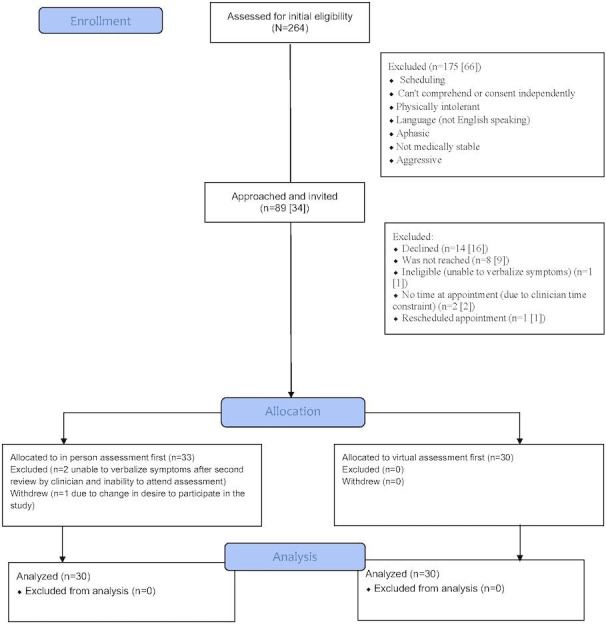 Figure 1
Peer Reviews
No public reviews on file for this paper yet. If you reviewed it on a platform where reviews are public (OpenReview, ICLR, NeurIPS, ICML), you can paste yours below so the community can read it here.
Videos
No videos yet. Explain this paper in a talk, walkthrough, or lecture? Add one.
Taxonomy
TopicsTraumatic Brain Injury Research · Stroke Rehabilitation and Recovery · Occupational Therapy Practice and Research